

Zoho Writer, the cloud-based word processing application from global technology firm Zoho Corporation, is celebrating its 20th anniversary this year by emphasizing its transition from a standard document editor to a comprehensive "work processor." Since its inception in 2005, the platform has evolved to address the increasing complexity of digital business operations, aiming to eliminate the friction caused by fragmented software ecosystems. As small and medium-sized businesses (SMBs) grapple with "app fatigue"—the necessity of using multiple disparate tools for a single task—Zoho Writer has positioned itself as a unified solution that integrates document creation, automated workflows, real-time collaboration, and digital signatures within a single interface.
The Historical Context: Two Decades of Cloud Evolution
The journey of Zoho Writer began during the early days of the "Software as a Service" (SaaS) movement. When it launched in 2005, it was one of the first web-based word processors to challenge the dominance of desktop-bound software like Microsoft Word. At the time, the concept of editing a document in a browser was revolutionary, predating the mainstream adoption of Google Docs. Over the last twenty years, Zoho Writer has moved through several developmental phases: from a basic text editor to a collaborative tool, and finally to its current iteration as an automation engine.

This evolution mirrors a broader shift in the technology industry. In the mid-2000s, businesses were focused on digitization. By the 2010s, the focus shifted to collaboration. Today, the priority is integration and automation. Zoho’s 20-year milestone highlights its ability to sustain growth in a highly competitive market by pivoting toward the specific needs of SMBs, who often lack the IT budgets of large enterprises but face the same administrative burdens.
The Problem of Document Fragmentation
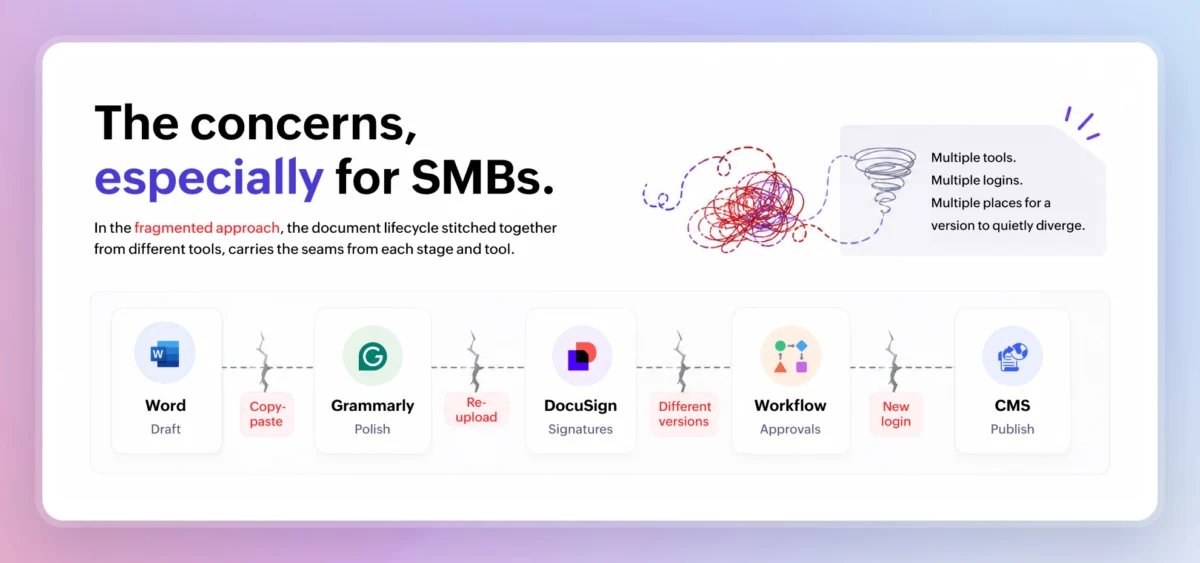
The modern document lifecycle is often hindered by what industry experts call "context switching." According to productivity research, it can take an average of 23 minutes for a worker to return to a state of deep focus after switching between different applications. For a typical small business, managing a single document—such as a vendor agreement or a project proposal—often requires four to seven different tools: a word processor for drafting, a grammar checker for polishing, an email client for internal reviews, a PDF converter for formatting, a digital signature platform for execution, and a cloud storage service for filing.
Balaji V., a product expert for Zoho Writer, notes that this fragmented approach creates significant operational risks. "Let’s take a marketing analyst on a five-person team who needs a signed vendor agreement back by Thursday," Balaji explains. In a traditional workflow, that analyst drafts the document in one program, runs it through an external AI assistant like Grammarly, emails it to colleagues for feedback, and then uploads it to a signature service like DocuSign.

This process leads to "quiet divergence," where multiple versions of a document exist simultaneously across different platforms. "A client signs off on the wrong pricing, or legal reviews a clause that got fixed two versions ago," Balaji warns. "By the time someone catches it, it’s not a formatting problem anymore—it’s a legal or financial liability."
Data-Driven Efficiency: The "Work Processor" Model
To combat these inefficiencies, Zoho Writer has integrated the entire lifecycle into a single sign-in environment. The platform now connects natively with Zoho CRM, Zoho Sign, and Zoho WorkDrive, as well as third-party applications like AdobeSign. This integration allows for "Smart Fields" and "Merge Fields," which automatically pull data from databases to populate documents, reducing the need for manual data entry—a primary source of human error in business documentation.
Industry data suggests that automation in document processing can reduce operational costs by up to 30%. Zoho Writer leverages this by utilizing Zia, Zoho’s proprietary AI writing assistant. Unlike generic AI tools, Zia is designed for business context, offering grammar suggestions, style improvements, and the ability to generate content based on existing business data.

Chronology of a Modern Workflow: The Offer Letter Example
To illustrate the impact of a unified platform, Zoho points to the standard human resources task of issuing employment offer letters. In a fragmented system, this task involves manual typing, multiple email threads for approval, and manual filing. In the Zoho ecosystem, the chronology is streamlined:
- Drafting: An HR manager selects a pre-approved "Offer of Employment" template within Zoho Writer.
- Data Integration: The manager connects a Zoho Sheet or CRM entry containing the candidate’s name, salary, and start date. Zoho Writer automatically merges this data into the document.
- Collaboration: Team members are tagged directly in the document to review specific clauses. No email attachments are sent; only one version of the document exists.
- Execution: The document is sent for digital signature via Zoho Sign without leaving the Writer interface.
- Automation: Once signed, the platform automatically generates an acceptance letter and saves both documents to a designated folder in Zoho WorkDrive.
This workflow requires no additional sign-ins and prevents the creation of redundant file copies, ensuring that the version stored in the company archives is the same one that was signed by the employee.
Broader Impact and Industry Implications
The move toward integrated document platforms reflects a growing demand for "reduced IT overhead." For small businesses, such as an architectural firm in Alabama or a digital marketing agency in Michigan, the cost of maintaining six or seven different software subscriptions is not just financial; it is an administrative burden.

Sathish Kumar Giddi, Product Marketer for Zoho Writer, emphasizes that for SMBs, the primary challenge is human capital. "The company wants to make sure its platform helps small business owners do more with less," Giddi states. By consolidating tools, businesses can reduce the time spent on IT configuration and troubleshooting software that was never designed to work together.
Furthermore, the security implications of a single-platform approach are substantial. Each additional third-party tool used in a document’s journey represents a potential vulnerability or "attack surface." By keeping sensitive information, such as client contracts or tax documents, within a single encrypted ecosystem with one set of credentials, businesses can significantly improve their compliance with data protection regulations like GDPR or CCPA.
Analysis of Competitive Advantage
While competitors like Microsoft 365 and Google Workspace offer robust suites, Zoho Writer’s advantage lies in its deep integration with a wider range of business-specific applications (like CRM and Books) and its focus on "no-code" automation. While Microsoft Word remains the industry standard for high-end desktop publishing, it often requires third-party plugins to achieve the level of workflow automation that Zoho Writer provides natively.

Zoho also addresses the "legacy hurdle" by allowing businesses to migrate existing document libraries from Word or Google Drive into Zoho Writer. This ensures that businesses do not have to "start from scratch" when transitioning to a more automated system.
Conclusion: The Future of the Digital Document
As Zoho Writer enters its third decade, the definition of a "document" continues to change. As Balaji V. explains, "A document today isn’t really a file anymore. It’s a complete process. It collects information, routes its own approvals, triggers workflows, updates other systems, and collects legally valid signatures."
The evolution of Zoho Writer from a 2005-era web editor to a 2025-era automation hub suggests that the future of business productivity lies not in more features, but in better integration. For small businesses looking to remain competitive in an increasingly digital economy, the ability to manage complex document flows without the overhead of multiple subscriptions and fragmented workflows may be the key to sustainable growth. By focusing on cost reduction, security, and operational efficiency, Zoho Writer continues to position itself as an essential tool for the modern enterprise, proving that even after 20 years, there is still room for innovation in the way we write and work.
