

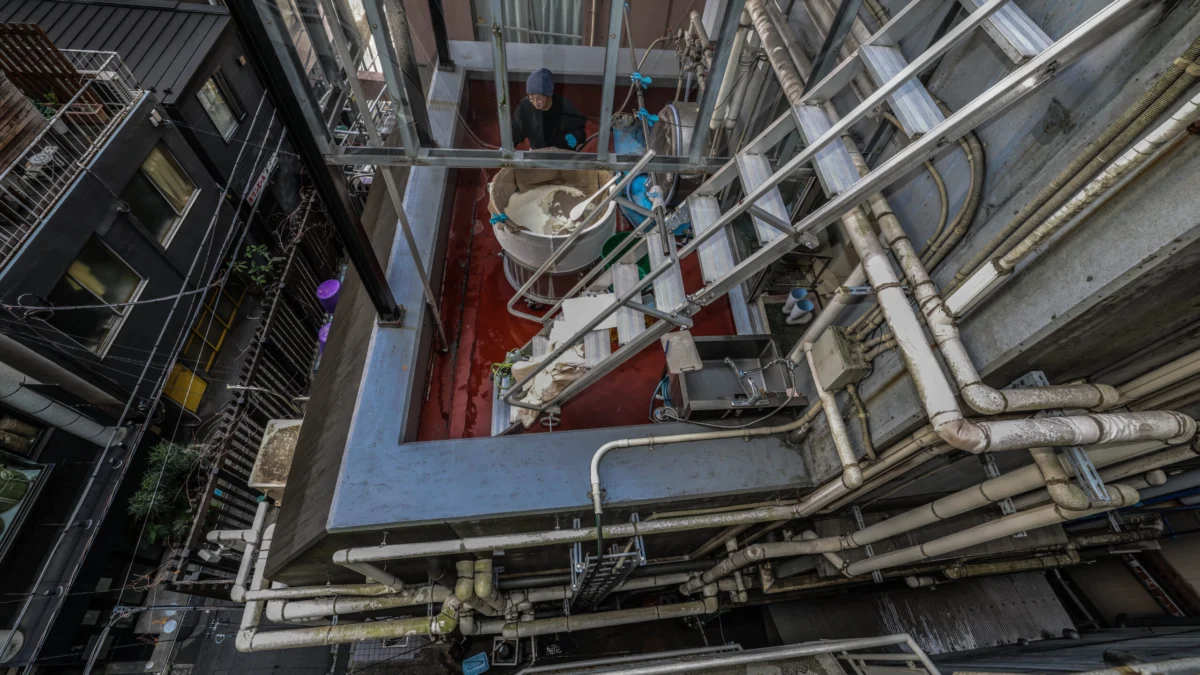
On an early August morning, white steam rises from a building in central Tokyo, a visual testament to an operation challenging conventional notions of where and how sake can be produced. This is not the familiar scene of a traditional countryside brewery, but rather the innovative Tokyo Port Brewery, nestled amidst the bustling office landscape of Tokyo’s Minato Ward. The steam signifies the brewing process, a testament to the brewery’s unique approach: utilizing tap water and moisture drawn directly from the urban air, thereby redefining the concept of terroir in the context of sake production.
A New Frontier in Sake: Urban Terroir and Innovative Brewing
Tokyo Port Brewery, led by its president and master brewer Yoshimi Terasawa, represents a significant departure from the established norms of sake manufacturing. Traditionally, sake production has been intrinsically linked to specific geographical locations, with the purity of local spring water and the distinct climate playing crucial roles in shaping the character of the final product. This notion of terroir, borrowed from the wine industry, has long been considered a cornerstone of sake quality and identity. However, Terasawa and his team are boldly questioning these assumptions by demonstrating that exceptional sake can be crafted even in the heart of a densely populated metropolis.
Their operation, situated on the building’s balcony, is a deliberate statement against the geographical constraints often perceived as essential for authentic sake. By meticulously sourcing and treating the city’s ubiquitous tap water and capturing atmospheric moisture, Tokyo Port Brewery is not only creating a novel brewing environment but also inviting a re-evaluation of what constitutes the essence of sake. This pioneering spirit is at the forefront of a burgeoning trend of urban breweries that are pushing the boundaries of traditional craft production.
The Science and Philosophy Behind Urban Sake
The brewery’s methodology involves a sophisticated understanding of water chemistry and environmental science. Tap water, often perceived as a generic commodity, is subjected to rigorous purification processes to remove impurities and achieve a specific mineral balance crucial for fermentation. Furthermore, the brewery actively explores methods of capturing and condensing ambient humidity, a testament to their commitment to leveraging the immediate urban environment. This approach not only minimizes reliance on external water sources but also imbues the sake with a subtle character derived from the city’s atmospheric composition.
Yoshimi Terasawa, a seasoned master brewer, has spoken about his vision of "urban terroir," suggesting that the unique environmental fingerprint of Tokyo – its air quality, its microclimate influenced by urban heat islands, and even the subtle mineral content of its municipal water supply – can contribute to a distinct flavor profile. This is not about replicating the mineral-rich waters of Niigata or the cool, crisp air of the Japanese Alps. Instead, it is about embracing the specific characteristics of Tokyo and translating them into a unique sake experience. The process involves precise control over temperature, humidity, and air circulation within the brewery, creating a micro-environment that optimizes the fermentation process.
A Timeline of Innovation and Tradition
While the exact founding date of Tokyo Port Brewery is not explicitly stated, its emergence signifies a recent evolution in the sake industry. The traditional sake brewing season typically spans the cooler months, from autumn through spring, to facilitate fermentation. However, urban breweries like Tokyo Port Brewery often employ advanced climate control technologies, allowing for year-round production and greater flexibility.
The development of their unique brewing system likely involved extensive research and development. This would have included:
- Early Stages (Hypothetical): Conceptualization of an urban brewery, research into water treatment technologies suitable for urban tap water, and initial studies on atmospheric moisture capture.
- Pilot Phase (Hypothetical): Small-scale brewing trials to test different water compositions and humidity levels, refinement of fermentation parameters, and sourcing of specialized equipment for urban environments.
- Operational Launch: Establishment of the brewery in its current Tokyo location, commencing full-scale production and marketing of its urban-crafted sake.
- Ongoing Refinement: Continuous monitoring of brewing processes, experimentation with new techniques, and engagement with consumers to gather feedback on the unique characteristics of their sake.
This chronological progression, while inferred, highlights the meticulous planning and dedication required to bring such an innovative concept to fruition. The success of Tokyo Port Brewery lies not just in its novelty but in its ability to consistently produce high-quality sake through its unconventional methods.
Supporting Data and Industry Context
The Japanese sake market, while steeped in tradition, is also experiencing a resurgence and evolution. According to recent industry reports, the domestic sake market has shown signs of stabilization and even modest growth in recent years, driven by increased interest from younger consumers and a growing appreciation for craft beverages.
- Market Trends: While premium sake sales have seen a steady rise, there is also a growing demand for unique and artisanal products. Urban breweries tap into this by offering a narrative of innovation and a departure from the expected.
- Water’s Role: Water constitutes over 80% of sake. Its mineral content significantly impacts yeast activity and flavor development. Traditional sake regions are renowned for their specific water profiles, such as the soft water of Nada, known for producing drier sake, and the harder water of Fushimi, which contributes to a richer flavor. Tokyo Port Brewery’s approach bypasses these natural endowments, relying instead on technological prowess.
- Urban Brewing Phenomenon: While Tokyo Port Brewery might be a prominent example, the concept of urban brewing is not entirely new. Cities worldwide are seeing a rise in craft breweries that adapt to limited space and unique urban resources. In Japan, this trend is particularly noteworthy given the deep cultural roots of sake production.
The success of Tokyo Port Brewery can be seen as a data point in the broader narrative of how traditional industries can adapt and thrive in contemporary urban settings by embracing technological innovation and reinterpreting established principles.
Statements and Reactions from Related Parties (Inferred)
While direct quotes are unavailable from the provided text, we can infer potential reactions and statements from various stakeholders:
- Traditional Sake Producers: Some may view Tokyo Port Brewery with skepticism, questioning the authenticity of sake produced without traditional regional water sources. Others might see it as a welcome innovation that expands the definition of sake and attracts new consumers. A representative from a long-established sake association might comment, "While we respect the spirit of innovation, the purity of water and the influence of climate have been fundamental to sake for centuries. We will be observing their progress with interest."
- Consumers: Sake enthusiasts are likely to be intrigued by the novelty. Many are drawn to the story behind a product, and the idea of sake being crafted from the very essence of Tokyo offers a compelling narrative. A blogger specializing in Japanese beverages might write, "Tokyo Port Brewery is pushing the envelope, offering a taste of the city itself in every sip. It’s a fascinating experiment in urban terroir."
- Industry Analysts: Experts in the food and beverage sector would likely analyze the business model and its potential for scalability. They might comment on the technological investment required and the marketing advantages of such a unique proposition. An analyst could state, "This brewery represents a bold move to decouple sake production from its geographical origins, leveraging technology to create a distinct market position. Its long-term success will depend on consistent quality and consumer acceptance of this new paradigm."
- Local Authorities and Urban Planners: The presence of a brewery within a dense urban environment might also spark discussions about urban industrial integration, sustainable resource management, and the potential for agritourism in metropolitan areas.
Broader Impact and Implications
The work of Tokyo Port Brewery has several significant implications for the sake industry and beyond:
- Redefining Terroir: The most profound implication is the challenge to the traditional understanding of terroir. By demonstrating that unique flavor profiles can be achieved through controlled urban environments and innovative water sourcing, they are opening up new avenues for sake production. This could lead to the development of "urban sake" as a distinct category.
- Sustainability and Resourcefulness: The brewery’s focus on utilizing readily available urban resources like tap water and atmospheric moisture highlights a potentially more sustainable approach to brewing, reducing reliance on specific natural water sources that may be under pressure.
- Democratization of Sake Production: By minimizing the geographical dependency, urban breweries could potentially lower the barriers to entry for new sake producers, fostering greater diversity and innovation within the industry.
- Urban Revitalization and Tourism: The presence of such unique craft operations can contribute to the revitalization of urban neighborhoods, attracting tourists and creating new cultural experiences. A brewery in the heart of Tokyo offers a distinct attraction for visitors interested in both traditional crafts and modern innovation.
- Technological Advancement: The success of Tokyo Port Brewery will likely spur further research and development in water purification, atmospheric moisture capture, and micro-climate control technologies applicable to food and beverage production.
In conclusion, Tokyo Port Brewery’s endeavor is more than just a novel brewing operation; it is a philosophical and technological statement. By embracing the urban landscape and its elemental resources, they are not only crafting sake but also reshaping perceptions and forging a new chapter in the storied history of this cherished Japanese beverage. Their success serves as a compelling testament to human ingenuity and the enduring power of adaptation in the face of tradition.
