

The global energy landscape is currently undergoing a fundamental transformation, transitioning from a centralized model of power distribution to a decentralized, resilient architecture where microgrids have moved from a niche alternative to a cornerstone of the industry. Valued at approximately $36.4 billion in 2024 and projected by Global Market Insights Inc. to surge to nearly $166 billion by 2035, the microgrid market’s rapid expansion reflects a strategic shift in how business leaders, municipal planners, and electrical engineers approach the delivery of power. Once viewed primarily as a localized backup solution for remote military outposts or rural communities, microgrids are now recognized as essential tools for operational continuity, cost control, and the aggressive pursuit of decarbonization goals. However, as the industry scales to meet unprecedented demand, it faces a dual challenge: the need for immediate power in high-growth sectors and the physical bottlenecks currently plaguing the traditional grid edge.
In the current economic climate, the demand for dynamic power is rapidly outpacing the physical capabilities of the legacy grid. This discrepancy is driven by several converging factors, including massive onshoring initiatives in the manufacturing sector, the proliferation of high-density data centers required for artificial intelligence, the expansion of electric vehicle (EV) fleet hubs, and the logistical requirements of temporary large-scale events. These developments create massive load spikes that local utility substations were simply not designed to handle with such suddenness. The scale of the challenge is underscored by the fact that more than 2,500 gigawatts of clean energy projects currently sit stalled in global grid interconnection queues, waiting for the infrastructure upgrades necessary to bring them online. While utility companies are investing billions to modernize transmission lines and expand capacity, high-demand scenarios—ranging from multi-day sporting events and disaster recovery operations to remote construction sites—cannot wait for the multi-year timelines often required for permanent grid upgrades.
The Technical Limitations of Legacy Temporary Power
For decades, the standard response to a lack of grid connectivity was the deployment of diesel-powered generators. While reliable, this "static generation" model carried heavy operational, financial, and environmental costs. In a typical temporary installation, a series of diesel generators would operate around the clock, regardless of the actual load demand. This led to significant "operational blind spots," where a generator might be running at 10% capacity while burning fuel as if it were under much higher stress. The lack of real-time visibility into consumption meant that fuel was wasted, emissions were unnecessarily high, and the noise pollution was constant.
To address these inefficiencies, the industry is moving toward an intelligent, hybrid approach. The objective of modern microgrid design is not necessarily the immediate elimination of all generators, but rather the optimization of the entire energy ecosystem. By integrating Battery Energy Storage Systems (BESS), intelligent energy management platforms, and smart switchgear, engineers can create a flexible "grid-in-a-box" that provides clean, reliable power on demand. These flexible microgrids serve as a testing ground for the permanent grid edge, demonstrating how digital management and storage can decouple energy consumption from the constraints of local utility lines.
Case Study: The NASCAR San Diego Weekend Microgrid
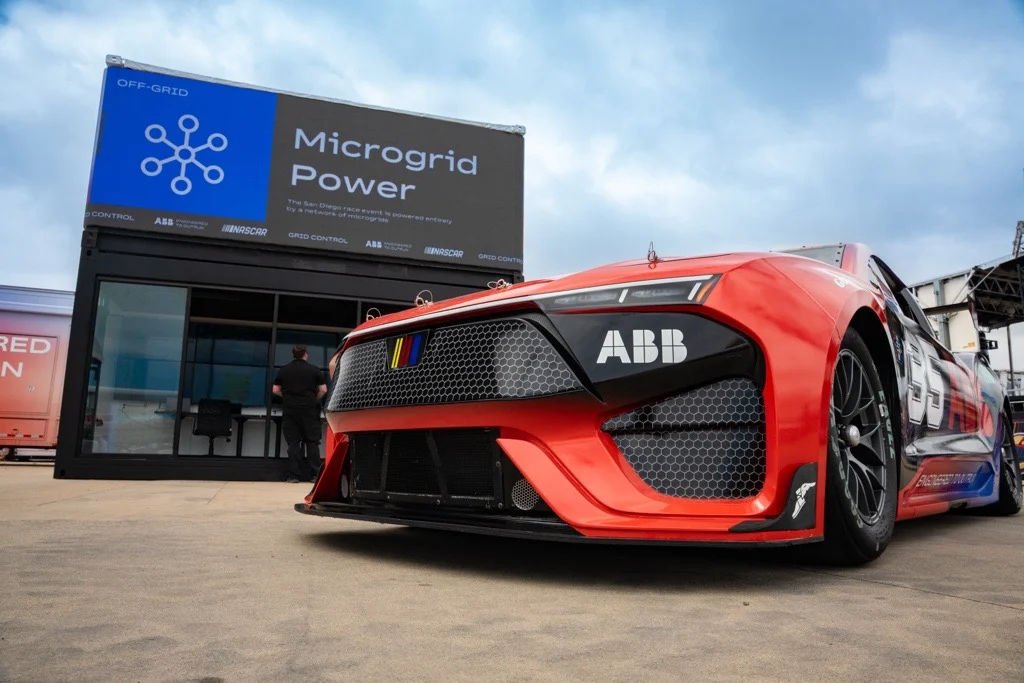
A prominent example of this hybrid architecture in a high-stakes environment was recently demonstrated during the NASCAR San Diego Weekend. Powering a major racing event at a non-traditional venue—one that lacks the permanent electrical infrastructure of a dedicated speedway—presents a monumental logistical challenge. The energy footprint of such an event is massive, requiring power for pit road operations, high-speed telemetry streams, massive fan zones, broadcast compounds, and hospitality suites. Drawing this amount of power directly from the local municipal electricity grid would put excessive strain on existing lines, potentially threatening the reliability of the local grid and causing voltage drops for the surrounding residential and commercial communities.
To mitigate these risks, NASCAR established an independent, temporary microgrid network that operated entirely "islanded" from the local utility. As part of its role as NASCAR’s official electrification partner, ABB introduced an integrated energy management system designed to monitor and optimize the performance of the various hardware components, including BESS units and backup generators provided by equipment partners. This setup represented a departure from traditional event power, prioritizing storage and intelligent distribution over continuous generation.
Chronology of the San Diego Deployment
The deployment followed a sophisticated operational timeline designed to maximize efficiency. Prior to the race weekend, engineers conducted a load analysis to predict the peak requirements of the five distinct event zones. Once the microgrid was established on-site, it utilized a storage-first strategy. Containerized BESS units served as the primary power source for race operations, providing silent, emission-free electricity during the peak hours of the event.
The conventional generators were integrated into the system not as constant power sources, but as charging units for the batteries. During the weekend, the generators were switched on for only two to three hours each day, specifically timed to recharge the BESS units during periods of lower activity. This hybrid strategy reduced generator runtime from the traditional 24-hour cycle to a mere fraction of that time. Throughout the event, real-time edge monitoring and telemetry sensors provided a constant stream of data to an aggregated energy dashboard. This allowed operational leaders to monitor energy consumption, battery state-of-charge, and carbon avoidance in real time, ensuring that the system remained stable under the vibration and high-stress conditions of a professional racing environment.
Data-Driven Results and Environmental Impact
The performance data from the San Diego event highlights the potential for microgrid technology to revolutionize large-scale power delivery. By shifting to a hybrid, storage-heavy model, NASCAR and its partners achieved the following results over the course of the weekend:
- Fuel Savings: The system saved approximately 380 gallons of diesel fuel compared to a traditional generator-only setup.
- Emissions Reduction: The initiative lowered carbon emissions by an estimated 3.9 metric tons.
- Equivalent Impact: This reduction is equivalent to removing 19 semi-trucks from the road for an entire day.
- Reliability: The system provided 24/7 electricity for fans, drivers, and broadcast teams without a single interruption or voltage drop.
Extrapolating these results across an entire NASCAR race season suggests that the cumulative savings in fuel and carbon emissions would be substantial, marking a significant step toward the organization’s broader sustainability goals. Beyond the immediate environmental benefits, the project demonstrated that "clean" power does not have to come at the expense of reliability in mission-critical environments.
Implications for the Broader Energy Market
The success of mobile, off-grid activations in high-vibration and high-stress environments offers a blueprint for other sectors facing power constraints. The lessons learned in San Diego are directly applicable to several key areas of the global economy. In disaster recovery scenarios, for instance, the ability to rapidly deploy a hybrid microgrid can provide essential services to hospitals and emergency shelters long before the permanent grid is repaired. Similarly, as the transition to electric vehicles accelerates, fleet operators can use mobile microgrids to set up temporary charging stations at logistics hubs or remote depots without waiting for utility upgrades.
Furthermore, these systems act as a "pressure-relief valve" for the broader utility infrastructure. By handling temporary or localized load spikes independently, mobile microgrids reduce the strain on local substations during peak usage times. This provides utilities with the breathing room and flexibility needed to plan and execute long-term grid modernization projects without compromising current service quality.
Industry Analysis: The Path Forward
The evolution of the microgrid market indicates that the future of energy is not just about producing more power, but about managing it more intelligently at the edge. The integration of real-time data loops allows for a level of precision that was previously impossible. When engineers can see exactly where and when energy is being consumed, they can fine-tune the balance between storage and generation, leading to continuous improvements in efficiency.
The shift toward flexible distribution equipment and storage-first strategies is also reshaping the economics of power. While the initial capital expenditure for a hybrid microgrid system may be higher than that of a simple diesel generator, the long-term operational savings—driven by reduced fuel consumption, lower maintenance costs, and the avoidance of grid demand charges—make it an increasingly attractive option for industrial and commercial users.
As the microgrid market approaches the $166 billion mark over the next decade, the industry is proving that the choice between immediate power supply and long-term sustainability is a false dichotomy. Through the adoption of advanced energy management systems and hybrid architectures, it is now possible to deliver reliable, sustainable power wherever it is needed—whether on a racetrack, in a disaster zone, or at a high-tech manufacturing facility. The lessons from San Diego underscore a broader truth: the modernization of the global grid will be won or lost at the edge, and the tools to win that battle are already being deployed today.
