

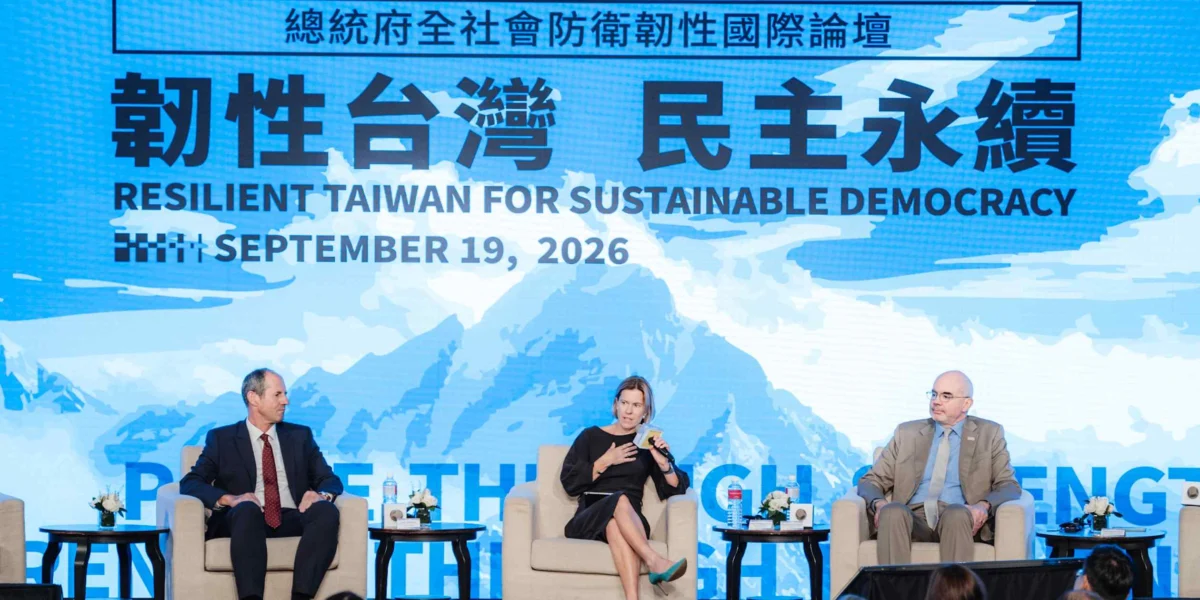
TAIPEI – Senior foreign diplomats stationed in Taiwan have issued a stark warning, asserting that China’s intensifying maritime activities around the island represent a deliberate effort to reshape established international norms at sea. Concurrently, the top U.S. representative in Taipei challenged prevailing pessimism regarding Taiwan’s capacity to withstand a potential blockade scenario, emphasizing the island’s inherent strengths and resilience. The forum, held on September 19th in Taipei, brought together key figures representing the diplomatic interests of major global powers and blocs, underscoring a growing international concern over Beijing’s assertive posture in the Indo-Pacific.
The discussions at the resilience forum, attended by de facto ambassadors Lutz Guellner from the European Union, Ruth Bradley-Jones from the U.K., and Raymond Greene from the U.S., illuminated the multifaceted challenges Taiwan faces. These include not only military and economic coercion but also the subtle, yet potentially destabilizing, erosion of established maritime governance. The diplomats’ pronouncements come at a critical juncture, as China has consistently increased its military presence and operational tempo in the waters and airspace surrounding Taiwan, a self-governing democracy that Beijing claims as its own.
China’s Escalating Maritime Presence: A Strategic Gambit
The diplomats’ observations regarding China’s maritime pressure are rooted in a discernible pattern of actions that have unfolded over several years. This includes the regular incursion of People’s Liberation Army (PLA) aircraft into Taiwan’s Air Defense Identification Zone (ADIZ), naval exercises that simulate blockades, and the deployment of coast guard vessels in contested waters. These activities, often characterized by Beijing as routine training or law enforcement, are viewed by many international observers and Taiwan itself as a form of grey-zone warfare – a strategy designed to achieve strategic objectives through non-military means, gradually altering the status quo without triggering a direct military conflict.
Data from Taiwan’s Ministry of National Defense has consistently documented these incursions. For instance, in 2023, the number of PLA aircraft entering the ADIZ surpassed previous records, with many sorties concentrating in the southwest sector, a key strategic area. Similarly, Chinese coast guard and maritime militia vessels have become more visible in the waters surrounding Taiwan’s outlying islands and in the median line of the Taiwan Strait, a de facto boundary that has historically served to de-escalate tensions.
Redefining the Rules: The Subtle Erosion of Maritime Norms
Lutz Guellner, representing the European Union, articulated the concern that China’s actions are not merely displays of military might but are intended to establish new precedents. "What we are seeing is not just an increase in operational tempo, but a systematic attempt to normalize activities that were previously considered escalatory or outside the established international norms," Guellner stated, though his specific remarks at the forum are not detailed in the provided excerpt. This perspective suggests that by consistently undertaking certain actions, China aims to create a new de facto reality, making such operations appear routine and thus more difficult for the international community to challenge effectively.
This strategy can be understood as an attempt to gradually assert control and influence over maritime spaces that are vital for global trade and security. The Taiwan Strait, for instance, is one of the busiest shipping lanes in the world, and any disruption or perceived control by a single nation has profound economic and geopolitical implications. The EU, as a major trading bloc, has a vested interest in maintaining freedom of navigation and unimpeded access to international waters.
U.S. Diplomat Challenges Blockade Pessimism
Raymond Greene, the highest-ranking U.S. diplomat in Taiwan, directly addressed what he described as "widespread negativity" surrounding Taiwan’s preparedness for a potential blockade. This pessimism, often amplified in public discourse and some analytical circles, tends to focus on Taiwan’s vulnerabilities, such as its reliance on imported energy and food, and its relatively small landmass.
Greene’s counter-argument likely drew upon Taiwan’s significant strategic advantages and its proactive measures to enhance resilience. These measures include:
- Diversified Energy Sources: Taiwan has been investing in renewable energy, including solar and wind power, and is also exploring nuclear energy options to reduce its dependence on imported fossil fuels. While still reliant on imports, the strategic diversification aims to mitigate the impact of a prolonged blockade.
- Strategic Reserves: Taiwan maintains substantial reserves of essential goods, including fuel, food, and medical supplies. These reserves are designed to sustain the population and the economy for a significant period in the event of severe supply disruptions.
- Economic Resilience: Taiwan’s highly developed and diversified economy, with a strong emphasis on advanced manufacturing, particularly in semiconductors, provides a degree of economic resilience. The global demand for Taiwanese products could act as a deterrent to any disruptive actions.
- Civil Defense and Preparedness: The Taiwanese government has been enhancing its civil defense capabilities, including public awareness campaigns, evacuation drills, and the hardening of critical infrastructure. This focus on preparedness aims to bolster societal resilience against various contingencies.
- International Support: While not directly part of Taiwan’s internal capacity, the strong international backing for Taiwan’s security and democratic system, as evidenced by the presence of diplomats from the U.S., U.K., and EU, serves as a critical deterrent and a source of potential support in a crisis.
Greene’s remarks suggest a belief that focusing solely on potential vulnerabilities overlooks Taiwan’s robust defensive strategies and its inherent capacity to endure. The U.S. perspective, often articulated by its government, emphasizes deterrence through strength and the importance of maintaining peace and stability in the Taiwan Strait.
Background: A Long-Standing Geopolitical Flashpoint
The situation in the Taiwan Strait is a consequence of the unresolved Chinese Civil War, which concluded in 1949 with the Nationalist government retreating to Taiwan. The People’s Republic of China (PRC) has since maintained that Taiwan is a province of China and has never ruled out the use of force to achieve unification. Conversely, Taiwan, officially the Republic of China (ROC), has evolved into a vibrant democracy with its own elected government, military, and distinct identity.
For decades, the international community has navigated a complex diplomatic balancing act, recognizing the PRC while maintaining unofficial relations with Taiwan. The U.S. maintains a policy of "strategic ambiguity" regarding its defense commitments to Taiwan, though it has consistently provided Taiwan with defensive weaponry under the Taiwan Relations Act.
The increasing assertiveness of China under President Xi Jinping has heightened tensions. This assertiveness is not confined to the Taiwan Strait but is also evident in the South China Sea and along China’s land borders. The forum in Taipei serves as a platform for key international actors to voice their concerns and coordinate their understanding of these evolving regional dynamics.
Timeline of Escalation and International Response
The current phase of heightened tensions can be traced back to recent years, marked by a series of incidents and policy shifts:
- 2016 onwards: Taiwan’s presidential elections saw the rise of the Democratic Progressive Party (DPP), which advocates for Taiwanese sovereignty. Beijing responded by intensifying military pressure and reducing informal cross-strait exchanges.
- 2019: China’s military activities around Taiwan saw a marked increase in frequency and scale, including more frequent incursions into the ADIZ and large-scale naval exercises.
- 2020-2022: The COVID-19 pandemic did not deter China’s military operations. Instead, there was a sustained surge in PLA air and naval activities, often crossing the median line of the Taiwan Strait.
- August 2022: Then-U.S. House Speaker Nancy Pelosi’s visit to Taiwan triggered unprecedented Chinese military drills around the island, including missile launches that landed in Japan’s Exclusive Economic Zone. This event significantly raised international alarm.
- 2023-Present: China has continued its pattern of military activities, while also engaging in economic coercion, such as restricting imports from Taiwan. Simultaneously, diplomatic engagement from countries like the U.S., U.K., and EU has increased, reflecting a growing commitment to Taiwan’s security and democratic values.
The forum attended by Guellner, Bradley-Jones, and Greene is part of this ongoing international engagement. It signifies a collective effort to understand and counter China’s evolving strategies.
Broader Implications for Regional Stability and Global Trade
The implications of China’s maritime pressure and the international community’s response extend far beyond Taiwan.
- Freedom of Navigation: If China were successful in redefining maritime rules in the Taiwan Strait, it could set a dangerous precedent for other strategically vital waterways globally, potentially impacting freedom of navigation for all nations.
- Global Supply Chains: Taiwan’s critical role in the global semiconductor industry means that any disruption to its operations would have catastrophic consequences for the global economy. The world’s reliance on Taiwanese chips makes its security a matter of international economic interest. According to industry reports, Taiwan Semiconductor Manufacturing Company (TSMC) alone accounts for over half of the global foundry market share.
- Geopolitical Alignment: The increasing diplomatic engagement and expressions of support for Taiwan from democratic nations signal a potential realignment of geopolitical alliances in the Indo-Pacific, aimed at counterbalancing China’s growing influence.
- Economic Warfare: The use of maritime pressure as a tool for coercion, as observed in China’s actions, highlights the evolving nature of conflict and competition in the 21st century, where economic and informational domains are as critical as military ones.
The forum in Taipei underscores a shared recognition among key international players that the status quo in the Indo-Pacific is being challenged. The diplomats’ statements reflect a commitment to upholding international law and norms, while also emphasizing the need for a realistic assessment of Taiwan’s own capabilities and the international support it can expect. The ongoing dialogue and coordinated efforts are crucial in navigating the complex geopolitical landscape of the region and preventing the escalation of conflict.
