

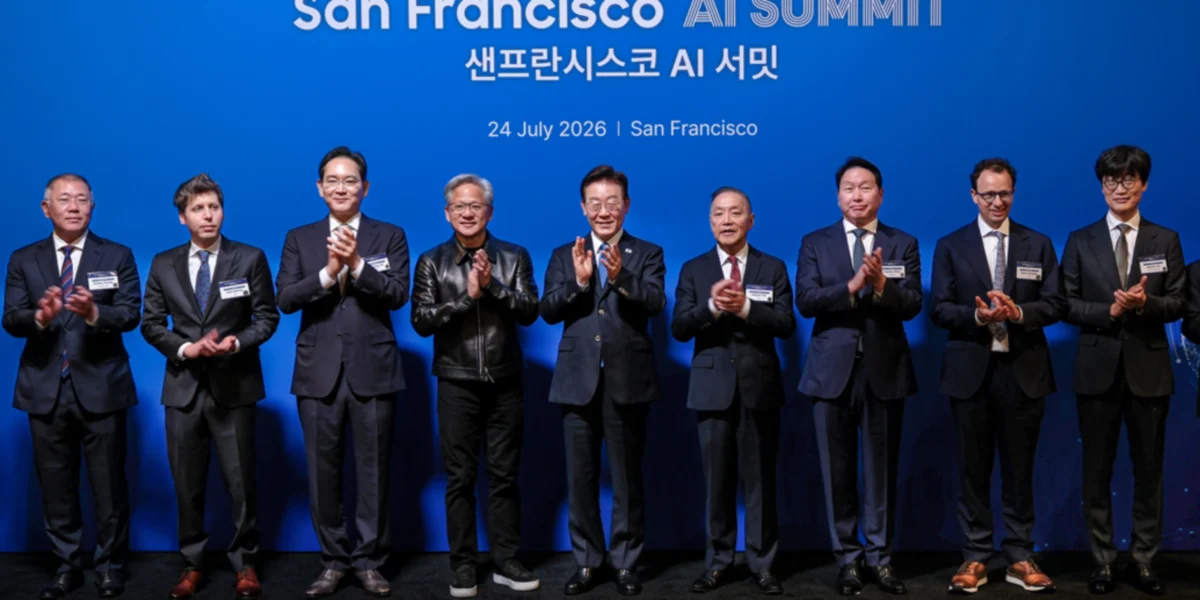
South Korean tech giants Samsung Electronics and SK Group, in collaboration with Nvidia and other prominent U.S. companies, have finalized a series of agreements totaling an unprecedented $700 billion. These landmark deals, focused on the critical sectors of semiconductors and data centers essential for artificial intelligence development and deployment, signal a profound deepening of bilateral cooperation between South Korea and the United States in the rapidly evolving AI landscape. The announcements, made following a high-profile AI Summit hosted in San Francisco, underscore a strategic alignment aimed at bolstering national competitiveness and securing leadership in the global AI race.
The San Francisco AI Summit: A Catalyst for Collaboration
The cornerstone of these significant financial commitments was the AI Summit held in San Francisco on July 24, 2026. Hosted by South Korean President Lee Jae Myung, the event convened a distinguished assembly of U.S. and South Korean business leaders, policymakers, and technology innovators. Among the most notable attendees were Jensen Huang, the chief executive officer of Nvidia, the dominant force in AI chip manufacturing, and Lee Jae-yong, the chairman of Samsung Electronics, a global leader in memory semiconductors and a burgeoning player in AI-specific hardware. Also present was Chey Tae-won, chairman of SK Group, whose conglomerate has diverse interests spanning semiconductors, energy, and telecommunications, all vital components of the AI ecosystem.
The summit served as a crucial platform for dialogue and negotiation, building upon months of behind-the-scenes discussions and strategic planning. The timing of the event, amidst heightened global competition for AI supremacy and ongoing efforts by nations to secure resilient supply chains for critical technologies, amplified its significance. President Lee’s initiative in bringing together these key figures highlights South Korea’s ambition to leverage its technological prowess and forge strategic alliances to secure its position at the forefront of the AI revolution.
Unpacking the $700 Billion Investment: Key Components
While the exact breakdown of the $700 billion figure is still emerging, initial reports indicate a multi-faceted investment strategy encompassing several key areas:
- Semiconductor Manufacturing and Supply Chain Enhancement: A substantial portion of the investment is expected to flow into expanding and upgrading semiconductor fabrication facilities. This includes significant commitments from Samsung Electronics and SK Hynix (a subsidiary of SK Group) to increase their production capacity for high-performance AI chips, such as GPUs (Graphics Processing Units) and AI accelerators. This expansion is crucial to meet the insatiable demand for computing power required by large language models and other advanced AI applications. The investment will likely also focus on enhancing the resilience of the semiconductor supply chain, a critical concern following recent global disruptions. This could involve diversifying raw material sourcing, investing in advanced packaging technologies, and potentially establishing joint research and development initiatives to foster innovation in next-generation chip designs.
- Data Center Infrastructure Development: The burgeoning field of AI is heavily reliant on vast data centers to process, store, and analyze the enormous datasets that fuel AI models. The agreements are set to drive substantial investment in building and expanding state-of-the-art data centers across both South Korea and the United States. This will involve the deployment of advanced cooling systems, high-speed networking, and, crucially, thousands of Nvidia’s cutting-edge AI chips. These data centers will serve as the backbone for training and deploying AI models for a wide range of applications, from autonomous vehicles and personalized medicine to sophisticated scientific research.
- Joint Research and Development (R&D) Initiatives: Beyond manufacturing and infrastructure, a significant element of the partnerships involves a commitment to collaborative R&D. This will focus on pushing the boundaries of AI technology, including developing more efficient AI algorithms, specialized AI hardware, and novel applications. The collaboration aims to leverage the unique strengths of each participating entity – South Korea’s expertise in memory and manufacturing, Nvidia’s leadership in AI processing, and the innovative capabilities of various U.S. tech firms. This shared R&D effort could accelerate the pace of AI innovation and lead to breakthroughs in areas such as generative AI, edge AI, and explainable AI.
- Strategic Alliances in AI Software and Services: While the primary focus appears to be on hardware and infrastructure, the agreements likely extend to fostering closer ties in the development and deployment of AI software and services. This could involve partnerships in cloud AI platforms, AI-powered analytics, and the integration of AI solutions into existing business processes across various industries. Such collaborations will be essential for translating the advancements in AI hardware into tangible benefits for businesses and consumers.
Timeline of Engagement and Strategic Rationale
The roots of this intensified cooperation can be traced back several years, marked by a gradual increase in bilateral discussions on technology, security, and economic partnership. The global pandemic and subsequent supply chain vulnerabilities served as a stark reminder of the need for greater collaboration in critical technology sectors.
- Pre-2024: Increasing dialogues between U.S. and South Korean tech companies regarding joint ventures, R&D collaborations, and investment opportunities in advanced technologies, including AI. South Korea, a global leader in memory chip production, recognized the growing demand for specialized AI chips and sought to diversify its offerings. The U.S., particularly through companies like Nvidia, was experiencing exponential growth in AI hardware demand.
- 2024-Early 2025: Intensified high-level diplomatic engagements between the South Korean government and U.S. tech leaders. Discussions began to coalesce around strategic investments and partnerships to secure AI leadership and supply chain resilience. South Korea’s Ministry of Trade, Industry and Energy (MOTIE) played a pivotal role in facilitating these discussions.
- Mid-2025: Framework agreements and initial investment plans were reportedly being drafted, laying the groundwork for the large-scale commitments announced at the summit. U.S. government officials, recognizing the strategic importance of these partnerships, offered their support and encouragement.
- July 24, 2026: The AI Summit in San Francisco, where the $700 billion in deals were officially announced. This event served as a public declaration of a solidified, strategic alliance.
The strategic rationale behind these substantial investments is multifaceted. For South Korea, it represents an opportunity to solidify its position as a powerhouse in the global semiconductor industry, extending its dominance from memory chips to advanced AI processors. It also aims to attract significant foreign investment, create high-skilled jobs, and foster a robust domestic AI ecosystem. For the U.S., these partnerships provide crucial access to advanced manufacturing capabilities and a stable supply of critical AI components, reducing reliance on potentially volatile geopolitical regions. Furthermore, it facilitates the deployment of cutting-edge AI infrastructure that will drive innovation across various sectors of the U.S. economy. Nvidia, as the primary beneficiary of the demand for its AI chips, solidifies its market position and secures long-term production capacity for its groundbreaking technologies.
Supporting Data and Market Context
The scale of the $700 billion investment is staggering and reflects the immense growth trajectory of the AI market.
- Global AI Market Growth: Projections from various market research firms indicate that the global AI market is expected to grow at a compound annual growth rate (CAGR) exceeding 30% over the next five to seven years, potentially reaching trillions of dollars in value. This exponential growth is driven by the increasing adoption of AI across industries, from healthcare and finance to manufacturing and retail.
- Semiconductor Demand for AI: The demand for AI-specific semiconductors, particularly GPUs and AI accelerators, is a primary driver of this growth. Nvidia, for instance, has seen its revenues surge in recent years, with demand far outstripping supply. The company’s market capitalization has grown astronomically, reflecting its critical role in the AI revolution.
- Data Center Expansion: The number of AI-powered data centers is rapidly increasing. Analysts predict a significant rise in the global data center market size, fueled by the need for massive computing power and storage for AI applications. Investments in cloud computing and hyperscale data centers are crucial for supporting this expansion.
- South Korea’s Semiconductor Prowess: South Korea is already a dominant player in the global semiconductor market, particularly in memory chips. Samsung Electronics and SK Hynix are among the top global suppliers of DRAM and NAND flash memory. This new investment aims to expand their capabilities into the high-growth area of AI processing chips.
The $700 billion commitment represents a significant portion of the projected capital expenditure in these sectors over the coming years. It signals a long-term strategic vision to secure a leading role in the AI economy.
Official Responses and Future Implications
While specific quotes from all parties involved were not immediately available in the initial announcement, the tenor of the event and the scale of the commitments suggest strong endorsement from all participating entities.
- South Korean Government: President Lee Jae Myung is likely to have emphasized the strategic importance of these partnerships for South Korea’s economic future, job creation, and technological leadership. He may have highlighted the government’s commitment to creating a favorable regulatory environment and supporting R&D initiatives.
- Nvidia: Jensen Huang would have likely expressed enthusiasm for the expanded collaboration, underscoring Nvidia’s commitment to providing the foundational technology for the AI revolution and its trust in the manufacturing capabilities of its South Korean partners.
- Samsung Electronics and SK Group: Leaders from these South Korean conglomerates would have likely reiterated their commitment to investing in advanced manufacturing and R&D, aiming to leverage this opportunity to further enhance their global competitiveness in the AI era.
The implications of these $700 billion agreements are far-reaching:
- Strengthened Global AI Leadership: The partnerships are poised to accelerate the development and deployment of AI technologies, potentially solidifying the positions of both South Korea and the United States as global leaders in AI innovation.
- Enhanced Supply Chain Resilience: The significant investments in domestic manufacturing and collaborative R&D are expected to bolster the resilience of the global AI supply chain, reducing vulnerabilities to geopolitical disruptions.
- Economic Growth and Job Creation: The substantial capital infusion is anticipated to stimulate significant economic growth, creating high-skilled jobs in semiconductor manufacturing, data center operations, and AI research and development in both countries.
- Accelerated AI Adoption: The increased availability of advanced AI hardware and infrastructure will likely lead to a more rapid adoption of AI solutions across various industries, driving productivity gains and fostering new business models.
- Geopolitical Realignment: These agreements underscore a growing trend of strategic technological alliances that can have significant geopolitical implications, shaping the future of global technological governance and competition.
In conclusion, the $700 billion investment forged at the San Francisco AI Summit represents a pivotal moment in the global pursuit of artificial intelligence dominance. The deepened cooperation between South Korean tech giants and leading U.S. firms signifies a shared commitment to innovation, supply chain security, and economic prosperity in the AI-driven future. This strategic alignment is poised to reshape the technological landscape and set new benchmarks for international collaboration in critical industries.
