

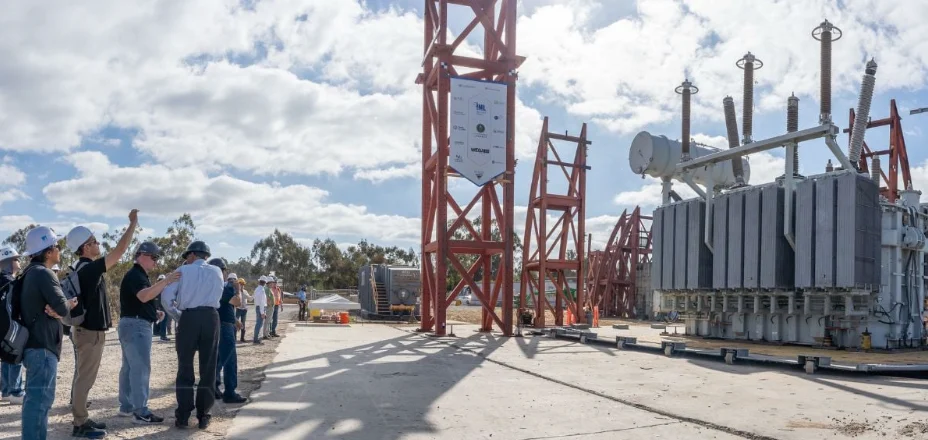
In an unprecedented stress test designed to safeguard the backbone of the United States’ electrical infrastructure, researchers from the Idaho National Laboratory (INL) recently conducted a groundbreaking experiment by subjecting a full-scale power transformer to simulated earthquake conditions. The test, performed at the University of California, San Diego’s (UCSD) world-renowned seismic research facility, marks the first time that a critical component of this magnitude and complexity has been pushed to its physical limits to gather empirical data on seismic resilience.
The subject of the experiment was a 230-kilovolt (kV) three-phase power transformer, a massive piece of equipment manufactured by Siemens Energy. Weighing hundreds of thousands of pounds and filled with insulating oil, these transformers serve as the vital junctions of the U.S. Bulk Power System, stepping voltage up or down to ensure electricity can travel across vast distances and safely enter homes, hospitals, and industrial centers. Because these units are among the most expensive, heaviest, and most difficult-to-replace components in the entire grid, their failure during a natural disaster represents a catastrophic risk to national security and public safety.
The Engineering Challenge: Protecting the Grid’s Heavyweights
Power transformers are the "silent giants" of the modern world. A single 230-kV unit can cost millions of dollars and require a lead time of several years to manufacture and deliver. According to industry data, the current global supply chain for large power transformers is under immense strain, with replacement timelines often exceeding five years due to specialized labor requirements and material shortages.
In the event of a major earthquake, such as those predicted for the Cascadia Subduction Zone or the San Andreas Fault, the simultaneous loss of multiple transformers could leave entire regions without power for months. Unlike smaller components that can be air-freighted or stocked in warehouses, these units require specialized rail cars and heavy-haul trucking for transport, making rapid recovery nearly impossible if the transportation infrastructure is also damaged.
Bjorn Vaagensmith, INL’s principal researcher on the project, emphasized the stakes involved in the testing. “We’re trying to protect a critical, hard-to-replace piece of equipment that keeps the power on during a disaster,” Vaagensmith stated. “If the transformer goes down, so does the hospital, the water system, everything downstream of it.”
The Testing Facility: The World’s Most Powerful Simulator
To replicate the violent forces of a high-magnitude earthquake, the research team utilized the Large High-Performance Outdoor Shake Table (LHPOST) at UC San Diego. Managed by the Jacobs School of Engineering, the LHPOST is recognized as the world’s most powerful earthquake simulator.
The table recently underwent a significant upgrade to provide "six-degree-of-freedom" motion, meaning it can move up and down, side to side, and back and forth, while simultaneously rolling, pitching, and yawing. This 6DOF capability is essential for simulating the complex, multi-directional ground movements experienced during real-world seismic events. With a payload capacity of 20 meganewtons and a roofless outdoor setting, the facility allowed the team to mount the massive Siemens Energy transformer—complete with its radiators, bushings, and internal oil—without the height restrictions of an indoor laboratory.
John McCartney, a professor at the Jacobs School of Engineering and principal investigator at the site, noted that the facility provided "unparalleled opportunities" for the test. The outdoor configuration was particularly important because it allowed for the use of large-scale cranes to position the 224 MVA transformer, which stands several stories tall when fully assembled with its high-voltage bushings.
Technical Objectives and Methodology
While industry standards for seismic design currently exist, they are often based on theoretical models and smaller-scale component testing rather than full-scale empirical evidence. The INL-led experiment sought to address three primary questions that remain unanswered by current engineering codes:
- Fluid-Structure Interaction: How does the massive volume of insulating oil inside the transformer tank behave during a quake? The "sloshing" effect of the oil can create internal pressures and dynamic loads that may compromise the tank’s structural integrity.
- Bushing and Radiator Stability: The bushings (tall, porcelain or composite insulators on top of the unit) and external radiators are the most protruding and fragile parts of the system. The test aimed to observe how these components vibrate and whether their connection points are prone to shearing.
- Predictive Model Validation: By comparing the physical results of the shake test with computer-generated simulations, engineers can refine the software used to design future transformers, ensuring they are not over-engineered (which wastes money) or under-engineered (which risks failure).
Alexander Hackl of Siemens Energy, who observed the testing firsthand, highlighted the importance of this data for future manufacturing. “Seeing how a transformer behaves under realistic seismic conditions allows us to compare engineering assumptions with actual performance, deepen our understanding of complex effects, and further improve our predictive models,” Hackl said.
A Chronology of Collaboration
The road to this seismic test involved years of planning and a massive coalition of public and private partners. The project was technically led by the Idaho National Laboratory, but it required the expertise and funding of several federal and academic entities.
The timeline of the project reflects a growing national priority to secure the energy sector:
- Planning Phase: Initial conceptualization began several years ago as part of the Department of Energy’s (DOE) focus on "Natural Hazards" and "Transformer Resilience."
- Partnership Formation: INL coordinated with the DOE Office of Cybersecurity, Energy Security, and Emergency Response (CESER) and the Office of Electricity (OE).
- Logistics and Assembly: Siemens Energy provided the 224 MVA 230 / 69 kV transformer. Transporting and assembling the unit on the shake table at UCSD took weeks of precision engineering.
- The Seismic Event: In early October 2024, the shake table was activated, subjecting the unit to a battery of shocks ranging from minor tremors to the equivalent of high-magnitude "design-level" earthquakes.
- Data Analysis: Following the physical tests, the team began the process of analyzing data from hundreds of sensors, including accelerometers, strain gauges, and high-speed cameras.
Strategic and Policy Context
The testing aligns with broader federal mandates to improve the resilience of U.S. infrastructure. Specifically, the project supports the objectives of the executive order "Achieving Efficiency Through State and Local Preparedness." This policy aims to ensure that the U.S. economy and critical services can withstand dynamic global threats, whether they are man-made or natural.
Andrew McClure, Director of CESER, underscored the mission’s importance. “Safeguarding America’s critical energy infrastructure against all hazards, including cyber and physical, is central to CESER’s mission,” McClure said. “This groundbreaking testing gives us essential empirical data to strengthen high-voltage grid components before a major earthquake strikes.”
The involvement of WEGAI Research and the University at Buffalo further expanded the academic scope of the project. Jon Bender, principal engineer at WEGAI Research, noted that the seismic substation design committee had raised concerns about transformer vulnerability for decades. “Even so, this experimental work wasn’t possible until INL, CESER, and OE joined the team,” Bender said.
Global Implications and Future Standards
The impact of this research extends far beyond the borders of the United States. Regions with high seismic activity, including the West Coast of North America, Japan, Chile, and New Zealand, rely on similar transformer technology. Utilities in these areas have historically struggled to balance the cost of seismic hardening with the necessity of grid reliability.
By making the results of this test public through the DOE’s Office of Scientific and Technical Information, the researchers aim to influence international industry standards, such as those set by the Institute of Electrical and Electronics Engineers (IEEE). If the data reveals that certain attachment methods or bushing designs are more resilient, these findings could be integrated into the global manufacturing process, leading to a more robust international power grid.
Analysis: The Cost of Prevention vs. The Cost of Failure
From a fact-based analytical perspective, the investment in this testing represents a proactive shift in utility management. Traditionally, grid infrastructure has been managed through a "fail and fix" mentality. However, the specialized nature of large power transformers makes this approach untenable in the modern era.
The "Replacement Strategy" for a single large transformer involves:
- Cost: $2 million to $10 million per unit.
- Weight: Often exceeding 200 tons (400,000 lbs).
- Logistics: Requires "Schnabel" rail cars, of which only a few dozen exist in North America.
- Installation: Requires weeks of on-site assembly, oil filling, and testing.
By investing in empirical testing now, the DOE and its partners are essentially buying insurance against a multi-billion-dollar disaster. The data gathered at UCSD will allow utilities to implement targeted retrofits—such as flexible connectors or base isolation systems—that can keep existing transformers operational even after a major quake.
As the data from the October test is processed and published in peer-reviewed journals, the energy industry will move one step closer to a future where a massive earthquake does not necessarily mean a darkened city. For the researchers at INL and the engineers at Siemens, the "shaking" of the grid’s most expensive component was not just a spectacle of power, but a rigorous step toward a more resilient civilization.
