

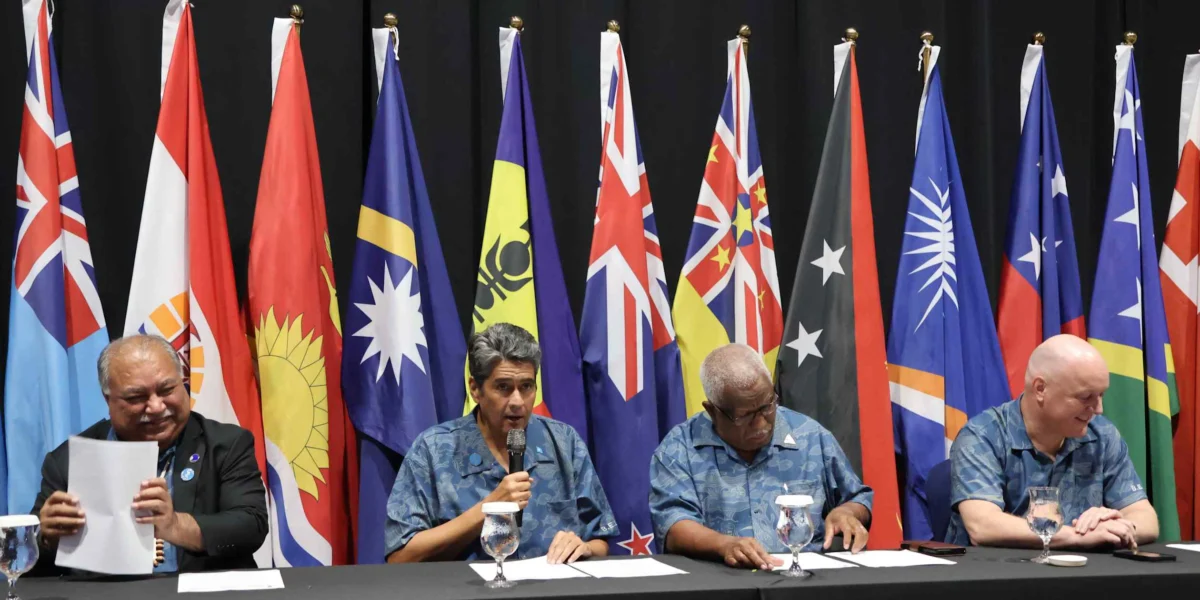
KOROR, Palau — Pacific island leaders collectively expressed concern on Thursday over a Chinese missile test launch in July that had divided the region, marking a significant moment of unified apprehension following weeks of internal debate. The statement, issued at the close of the annual Pacific Islands Forum (PIF) summit in Koror, Palau, underscored the delicate geopolitical balancing act faced by these nations as major global powers intensify their strategic interests in the Pacific.
The missile test, conducted by the People’s Republic of China (PRC) in late July, involved the deployment of intermediate-range ballistic missiles into the South China Sea. While Beijing described the exercise as routine and aimed at enhancing combat readiness, the timing and location of the launch sparked alarm throughout the Indo-Pacific, including among the island states that form a critical geopolitical theatre. The tests occurred amidst escalating tensions between China and Taiwan, as well as heightened competition for influence between China and the United States and its allies in the region.
For many Pacific island nations, the July missile test was not merely a distant geopolitical event; it represented a tangible manifestation of increasing militarization and potential instability in their immediate neighbourhood. The vast maritime territories of these island states, which constitute some of the largest exclusive economic zones (EEZs) globally, are increasingly becoming focal points for naval exercises and strategic posturing. The presence of advanced missile technology, even in a test capacity, raises concerns about potential miscalculations, accidental escalation, and the broader implications for regional security and the safety of maritime routes.
The Pacific Islands Forum, the region’s premier intergovernmental organization, serves as a crucial platform for member states to articulate common positions on critical issues. However, the July missile test exposed a degree of divergence within the Forum. While some members, particularly those with strong security ties to the United States and its allies, voiced immediate alarm, others, often more economically reliant on China, adopted a more measured approach. This internal division was a key factor in the discussions held during the Palau summit, with leaders striving to forge a unified stance that reflects the diverse interests and perspectives of the Forum’s 18 member states.
Background: A Shifting Geopolitical Landscape
The Pacific Islands have historically been a region of strategic importance, particularly during the Cold War. However, in recent years, the region has witnessed a resurgence of geopolitical competition, driven by China’s expanding economic and military influence. Beijing’s Belt and Road Initiative (BRI) has seen significant investments in infrastructure across the Pacific, fostering closer economic ties but also raising concerns about debt sustainability and potential strategic dependencies. Simultaneously, the United States and its allies, including Australia, New Zealand, and Japan, have ramped up their engagement, seeking to counter China’s growing assertiveness and reinforce existing security partnerships.
This intensified competition has placed Pacific island nations in a complex position. Many of these countries, despite their small populations and economies, control strategically vital sea lanes and vast ocean territories. Their decisions on security cooperation, trade, and diplomatic alignment have significant implications for the broader Indo-Pacific balance of power. The July missile test by China, therefore, landed amidst this already heightened geopolitical sensitivity, amplifying existing anxieties.
Chronology of Events and Reactions
The sequence of events leading to the unified statement at the PIF summit provides insight into the regional dynamics.
- Late July 2026: China conducts a series of missile tests in the South China Sea, reportedly involving multiple types of ballistic missiles, including intermediate-range systems. Initial reports suggest the tests were conducted in areas designated as military exercise zones.
- Early August 2026: News of the missile tests begins to circulate widely, triggering reactions from various international actors. The United States and its allies express concern, viewing the tests as a provocative act that undermines regional stability.
- Mid-August 2026: Within the Pacific Islands Forum, initial reactions begin to emerge. Sources close to several island nations indicate that discussions commence among leaders and their foreign ministries. Some nations, such as those with existing security agreements with the US, express strong condemnation. Others, however, signal a need for more information and a cautious approach to avoid alienating China, a significant economic partner.
- Late August 2026: Preparations for the annual Pacific Islands Forum summit in Palau intensify. Bilateral meetings and informal consultations among leaders focus heavily on the implications of the Chinese missile tests and the need for a coordinated regional response. Diplomatic efforts are reportedly underway to bridge the differences in perspective.
- September 3, 2026: At the press conference concluding the PIF summit, a joint statement is issued by leaders, collectively voicing concern over the missile tests. While specific details of the internal deliberations are not publicly disclosed, the unified message signifies a successful effort by the Forum to present a common front on a contentious issue.
Supporting Data and Regional Dynamics
The Pacific Islands Forum comprises 18 member states: Australia, Cook Islands, Federated States of Micronesia, Fiji, Kiribati, Nauru, Niue, New Zealand, Palau, Papua New Guinea, Republic of the Marshall Islands, Samoa, Solomon Islands, Tonga, Tuvalu, and Vanuatu. The region’s strategic significance is amplified by its geography. The vast expanse of the Pacific Ocean is crisscrossed by vital shipping lanes, and the island nations’ EEZs encompass significant portions of the world’s tuna fisheries, a crucial economic resource for many.
China’s economic footprint in the region has grown substantially over the past two decades. According to data from the Lowy Institute, Chinese lending to Pacific island countries rose significantly between 2006 and 2018, although the pace of new lending has slowed in recent years. Despite this, China remains a major trading partner and a significant source of development assistance for many of these nations.
Conversely, traditional partners like Australia, New Zealand, and the United States, along with Japan, are also increasing their engagement through security dialogues, development aid, and climate change initiatives. This complex web of relationships creates a challenging environment for island leaders, who must balance their national interests with the need for regional solidarity. The missile tests, in this context, present a stark reminder of the external pressures shaping the region’s geopolitical landscape.
Official Responses and Diplomacy
While the exact statements from individual leaders during the summit’s closed sessions remain private, the collective statement released on September 3rd offers a clear indication of the consensus reached. The phrasing of "concern" suggests a measured but firm diplomatic stance. It acknowledges the event’s significance without resorting to outright condemnation, a strategy likely employed to maintain dialogue with China while signaling the region’s unease.
Sources close to the Forum Secretariat indicated that the discussions were robust, reflecting the diverse strategic orientations of member states. It is understood that representatives from nations with closer security ties to Western powers pushed for a stronger denunciation. However, leaders from countries with more significant economic ties to China advocated for a more diplomatic approach to avoid jeopardizing development prospects. The final statement represents a compromise, a testament to the diplomatic efforts to achieve a unified voice.
Baron Waqa, the Secretary-General of the Pacific Islands Forum Secretariat, speaking at the press conference, emphasized the importance of peace and stability in the Pacific. His remarks, alongside those of Palau President Surangel Whipps Jr., Solomon Islands Foreign Minister Rick Houenipwela, and New Zealand Prime Minister Chris Luxon, highlighted the shared aspiration for a secure and prosperous region, free from the threat of external conflict.
The United States, a Dialogue Partner of the PIF, has consistently voiced its opposition to destabilizing military activities in the South China Sea. While not directly commenting on the PIF’s statement, US officials have reiterated their commitment to freedom of navigation and overflight and have urged all parties to exercise restraint.
Broader Impact and Implications
The unified concern expressed by Pacific island leaders over the Chinese missile tests has several significant implications:
- Reinforcement of Regional Agency: The ability of the PIF to forge a common position, despite internal differences, demonstrates the growing agency of Pacific island nations in shaping their own security narrative. It signals that these nations are not merely passive recipients of great power competition but active participants with their own interests and concerns.
- Geopolitical Signaling: The statement serves as a subtle but clear signal to global powers that the Pacific is not a region to be unilaterally dominated or militarized without regional consideration. It underscores the collective desire for a peaceful and stable environment conducive to sustainable development.
- Economic vs. Security Dilemma: The situation highlights the ongoing dilemma faced by many island nations: balancing economic development, often facilitated by China, with security concerns arising from China’s military activities. The PIF’s unified stance suggests that security considerations are increasingly taking precedence, or at least demanding equal footing, in their foreign policy calculations.
- Potential for Increased Diplomacy: The unified approach may embolden Pacific island nations to engage in more direct diplomatic dialogue with China regarding its military activities in the region. It also provides a stronger mandate for regional leaders to advocate for de-escalation and adherence to international norms.
- Impact on Future Engagements: The consensus reached at the PIF summit is likely to influence how island nations engage with major powers in future security dialogues and infrastructure development projects. There may be a greater emphasis on transparency, risk assessment, and alignment with regional security interests.
The Chinese missile tests, while a specific event, serve as a potent symbol of the complex geopolitical currents flowing through the Pacific. The unified concern articulated by the Pacific Islands Forum leaders at the Palau summit underscores the region’s determination to navigate these challenges with a collective voice, advocating for peace, stability, and self-determination in an increasingly contested maritime domain. The coming months will reveal how this unified stance translates into tangible diplomatic actions and influences the broader trajectory of great power competition in the Pacific.
