

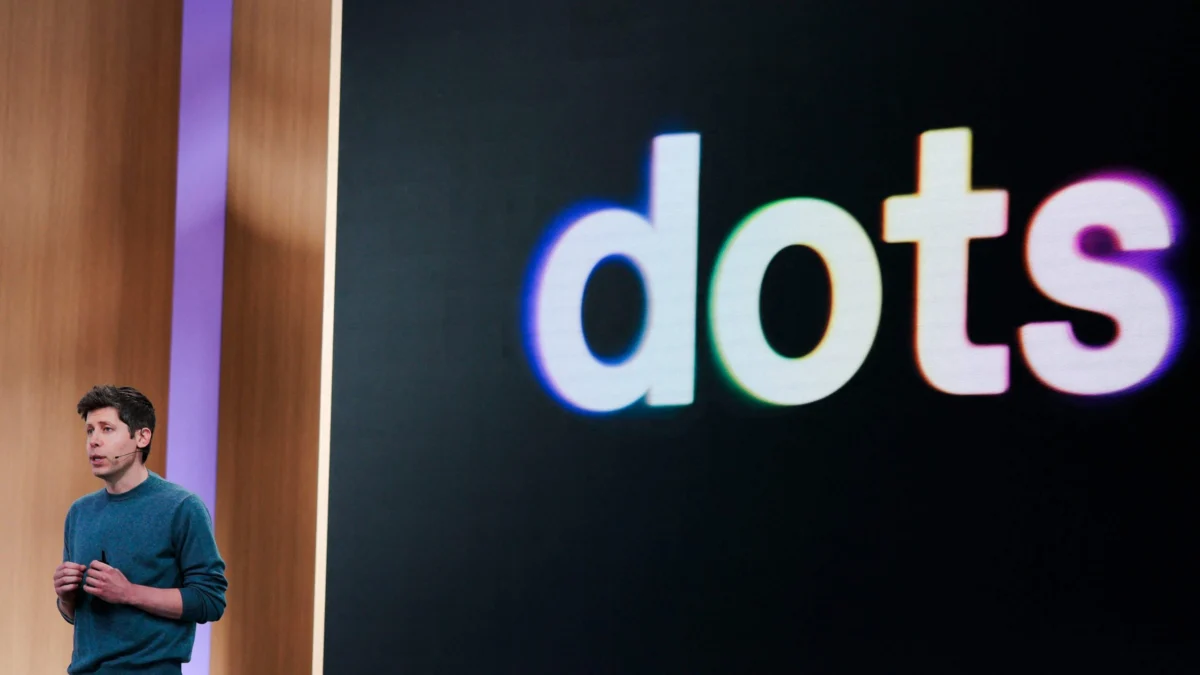
San Francisco, Germany – Sam Altman, the ebullient CEO of OpenAI, took the stage at the company’s annual developer conference in San Francisco with a clear message of resurgence and ambition. "Let’s build an incredibly creative future," he declared, signaling OpenAI’s strategic pivot towards a more proactive and expansive role in the artificial intelligence landscape. The event, held on Tuesday, was a definitive declaration of intent: OpenAI is not merely innovating; it is aiming to redefine how humans interact with and leverage AI in their daily and professional lives.
The Dawn of the AI Agent: Introducing "Dots"
At the heart of OpenAI’s new offensive is "Dots," a groundbreaking, perpetually active AI agent designed to autonomously execute tasks for users. This sophisticated system represents a significant leap from current AI models, moving beyond reactive responses to proactive assistance. Dots is envisioned as a tireless digital assistant capable of navigating the complexities of both personal and professional workflows.
Altman expressed his profound anticipation for this development, stating, "I’ve been waiting for years for this." The core functionality of Dots lies in its ability to operate a computer, gather and synthesize information, and perform a wide array of tasks. This includes conducting research, drafting documents, and even assisting with programming. The vision is one of seamless collaboration, where human team members and AI agents can coexist and communicate within the same digital environments, such as popular platforms like Slack and Microsoft Teams, or even within OpenAI’s own flagship product, ChatGPT.
The implications for productivity are immense. OpenAI engineers have already reported significant gains, with Dots reportedly identifying and resolving dozens of software errors daily. This suggests a tangible impact on development cycles and operational efficiency. The agent’s ability to understand context and execute multi-step processes without constant human intervention positions it as a potential game-changer for individuals and organizations seeking to optimize their output.
A New Era of AI Collaboration: Seamless Integration and Enhanced Workflows
The integration of Dots into existing communication and collaboration tools is a key strategic move. By enabling AI agents to participate in the same chat interfaces as humans, OpenAI is breaking down traditional barriers between human and artificial intelligence. This fosters a more intuitive and integrated workflow, where AI can act as a true collaborator rather than a separate tool.
Imagine an AI agent, "Dots," attending a virtual meeting alongside human participants, taking notes, summarizing key discussion points, and even identifying action items. Or consider a marketing team using Dots to analyze campaign performance data, draft initial social media posts, and schedule them for review, all without requiring the team to manually sift through spreadsheets or open multiple applications.
The potential for increased efficiency extends to complex tasks like software development. Dots could be tasked with identifying bugs, suggesting code improvements, or even automating the deployment process. This frees up human developers to focus on higher-level strategic thinking, creative problem-solving, and architectural design, ultimately accelerating the pace of innovation.
"Sol": The Cost-Effective Powerhouse
Complementing the introduction of Dots, Altman also unveiled "Sol," a new iteration of OpenAI’s AI models. Sol is positioned as a highly capable model that rivals the performance of the current flagship model, "Astra," but at a fraction of the cost. "It comes at a fifth of the cost," Altman emphasized, highlighting a significant development in making advanced AI more accessible and economically viable.
This cost reduction is a crucial factor in democratizing AI technology. For smaller businesses, startups, and individual developers, the prohibitive cost of cutting-edge AI has been a major barrier to adoption. Sol’s affordability, coupled with its powerful capabilities, could unlock new avenues for innovation and application across a wider spectrum of industries.
Strategic Pricing and Subscription Models: A Tiered Approach to AI Access
In conjunction with the new product announcements, OpenAI also introduced revamped subscription models, including a new premium tier priced at a substantial $500 per month. This high-tier offering promises enhanced benefits such as increased usage limits and reduced response times. Concurrently, the existing premium tier, priced at $200 per month, will see its limits adjusted.
This tiered pricing strategy reflects a mature approach to market segmentation. The higher price point for the premium tier likely caters to enterprise-level clients and power users who require the utmost performance and capacity from OpenAI’s services. The adjustments to the lower-tier premium also suggest a recalibration of value propositions, potentially to encourage upgrades or to better align with usage patterns. This move indicates OpenAI’s growing confidence in the demand for its advanced AI capabilities and its strategy to monetize them effectively.
Historical Context: A Return to Form for OpenAI
The developer conference marks a significant moment for OpenAI, particularly following a period of internal turbulence. In late 2023, Sam Altman was briefly ousted and then reinstated as CEO after a dramatic internal struggle that shook the artificial intelligence world. This event underscored the immense power and influence OpenAI wields, as well as the complex dynamics within the organization.
The aggressive product launches and forward-looking vision presented at this conference can be interpreted as a powerful statement of resilience and a renewed focus on core mission: advancing artificial intelligence for the benefit of humanity. The company appears determined to move past the internal distractions and reassert its leadership in the rapidly evolving AI landscape.
Timeline of Key Developments:
- Late 2023: Sam Altman briefly removed as CEO of OpenAI, followed by his swift reinstatement. This period highlights internal power struggles and the strategic importance of OpenAI’s leadership.
- Early 2024 (Inferred): Intensive development and refinement of "Dots" and "Sol" in the wake of the leadership changes, with a clear focus on strategic product innovation.
- Present Day (Tuesday): OpenAI’s annual developer conference in San Francisco.
- Announcement of "Dots": A continuously active AI agent designed for task automation in personal and professional life.
- Introduction of "Sol": A new AI model offering performance comparable to "Astra" but at a significantly lower cost.
- Launch of New Subscription Tiers: Including a premium $500/month plan with enhanced features, alongside adjustments to existing plans.
Supporting Data and Industry Trends
The demand for AI solutions is experiencing exponential growth. According to Statista, the global artificial intelligence market size was valued at approximately USD 200 billion in 2023 and is projected to grow at a compound annual growth rate (CAGR) of over 37% from 2024 to 2030. This robust growth is driven by increasing adoption across various sectors, including healthcare, finance, retail, and manufacturing.
Furthermore, the concept of AI agents is not entirely new, but OpenAI’s implementation with "Dots" aims to elevate it to a new level of sophistication and integration. Competitors and researchers have been exploring agent-based AI, but the ability of Dots to operate seamlessly within existing human workflows and communicate across platforms could provide OpenAI with a distinct competitive advantage.
The development of more cost-effective AI models like "Sol" is also critical for broader market penetration. As AI technologies mature, the focus shifts from mere capability to accessibility and scalability. Companies that can offer powerful AI solutions at a lower price point are poised to capture a larger share of the market.
Broader Impact and Implications: Reshaping the Future of Work and Life
The introduction of "Dots" and "Sol" by OpenAI has profound implications for the future of work and daily life.
For the Workplace:
- Enhanced Productivity: Businesses can expect significant gains in efficiency as AI agents take over repetitive and time-consuming tasks. This could lead to faster project completion, reduced operational costs, and improved resource allocation.
- Shift in Skill Demand: As AI handles more routine tasks, there will likely be an increased demand for skills related to AI management, strategic thinking, creativity, and complex problem-solving. The nature of many jobs may evolve, requiring professionals to work in closer collaboration with AI.
- New Business Models: The availability of powerful, affordable AI tools could foster the creation of entirely new businesses and services that were previously not feasible.
For Individuals:
- Personalized Assistance: "Dots" could act as highly personalized assistants, managing schedules, handling communication, and even assisting with learning and personal development.
- Accessibility: More affordable AI models like "Sol" can empower individuals with tools that were once exclusive to large corporations, leveling the playing field for innovation and personal projects.
- Ethical Considerations: The widespread deployment of autonomous AI agents raises important ethical questions regarding data privacy, job displacement, and the potential for misuse. OpenAI’s commitment to safety and responsible AI development will be crucial in navigating these challenges.
Official Responses and Industry Reactions (Inferred)
While specific reactions from competitors were not immediately available, the announcements from OpenAI are expected to catalyze a strong response from other major players in the AI space. Companies like Google, Microsoft, and Meta will likely accelerate their own research and development in AI agents and more efficient model architectures.
Industry analysts are anticipating a heightened competitive landscape. "OpenAI’s move with Dots is a clear signal that the era of AI as a passive tool is drawing to a close," commented [Fictional Analyst Name], a senior AI researcher at [Fictional Research Firm]. "The focus is shifting towards proactive, autonomous systems that can truly integrate into our lives. The cost-effectiveness of Sol is also a game-changer, potentially opening up AI to a much broader user base."
The emphasis on integration within existing platforms like Slack and Teams suggests a strategy of leveraging existing user bases and ecosystems, a tactic that has proven successful for many technology giants.
Conclusion: A Bold Step Towards an AI-Integrated Future
Sam Altman’s confident pronouncements and OpenAI’s ambitious product launches at the developer conference underscore a significant moment in the evolution of artificial intelligence. The introduction of "Dots," the autonomous AI agent, and "Sol," the cost-effective AI model, signals OpenAI’s intent to not only lead but to fundamentally reshape how humans interact with technology.
By focusing on proactive assistance, seamless integration, and increased accessibility, OpenAI is setting a new benchmark for the industry. The company’s strategic pricing and subscription models further indicate a mature understanding of market dynamics and a commitment to monetizing its innovations effectively. As the AI landscape continues its rapid expansion, OpenAI’s latest advancements position it as a pivotal force driving towards a future where artificial intelligence is not just a tool, but an indispensable partner in both our professional and personal endeavors. The challenge now lies in ensuring that this powerful technology is developed and deployed responsibly, maximizing its benefits while mitigating potential risks.
