

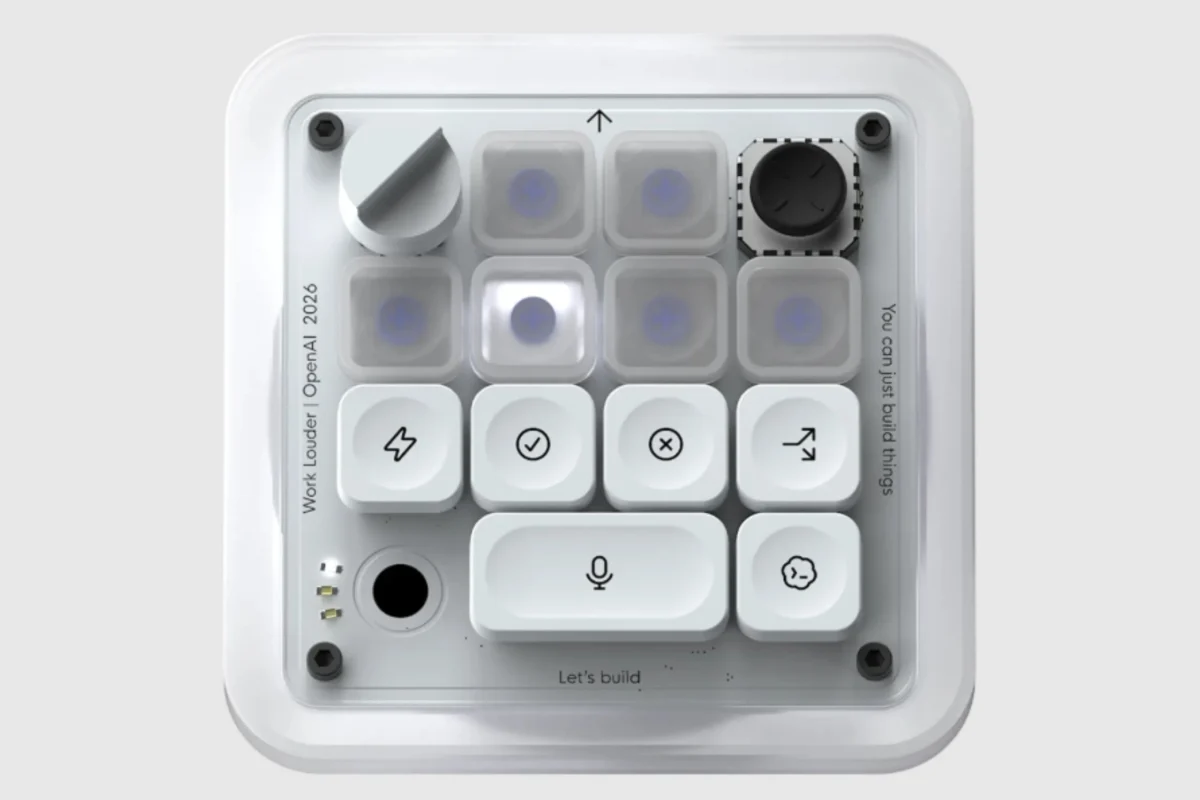
OpenAI, the vanguard of artificial intelligence research and development, marked a significant departure from its software-centric origins last week with the launch of its Micro keypad, its inaugural foray into the hardware market. Developed in a strategic collaboration with Work Louder, a designer specializing in bespoke mechanical keyboards and macropads, Micro is an intricately crafted, compact device designed to augment user interaction with ChatGPT and its agentic coding tool, Codex. Positioned as an artisanal workplace novelty, the device has generated a bifurcated response: a segment of tech enthusiasts and power users express keen interest in its potential to streamline AI workflows, while a broader audience remains somewhat perplexed by its utility and positioning. This launch, however, does not occur in a vacuum, unfolding against a backdrop of escalating legal challenges and speculative reports regarding OpenAI’s more ambitious hardware projects, underscoring a pivotal moment in the company’s trajectory.
The introduction of Micro into the consumer market is inextricably linked to a period of heightened scrutiny and legal entanglements for OpenAI. Just weeks prior to the keypad’s unveiling, the tech giant Apple initiated a high-profile lawsuit against the AI lab, alleging trade secret theft. This legal action, which promises to be a protracted and complex battle, casts a long shadow over OpenAI’s expanding ambitions, particularly in the hardware domain. The lawsuit’s specifics, while still developing, reportedly revolve around intellectual property related to AI development and possibly hardware design, given Apple’s own extensive portfolio in both areas. Analysts suggest that such legal battles could significantly impact OpenAI’s valuation, investor confidence, and its capacity to recruit top talent, especially from competitors like Apple. The timing is particularly poignant, as it coincides with OpenAI’s pivot towards more tangible consumer products, signaling a direct competitive stance against established tech giants.
Adding another layer to this complex narrative are persistent rumors of a separate, more substantial smart home product currently under development at OpenAI. Reports suggest this device is a screenless speaker, engineered to seamlessly integrate with ChatGPT, much like Micro. What has particularly "raised eyebrows" within the industry is the revelation that a significant portion of the development team for this rumored smart home device comprises former Apple engineers. This detail not only intensifies the narrative around potential intellectual property conflicts but also explains the distinctly "Apple-coded" aesthetic observed in Micro’s packaging and design philosophy. The pursuit of a smart home device indicates a strategic vision by OpenAI to embed its AI capabilities directly into the fabric of daily life, moving beyond desktop and mobile interfaces to create a pervasive AI presence. This broader hardware strategy, encompassing both niche productivity tools and mass-market consumer devices, signals OpenAI’s intent to become an end-to-end technology provider rather than solely a foundational AI model developer.
Until the legal landscape clears and OpenAI’s more ambitious hardware ventures fully materialize, Micro stands as the tangible manifestation of the company’s hardware aspirations. This "funky little keypad" is, by all accounts, engineered with a specific demographic in mind: the dedicated "code monkeys" and tech industry professionals who extensively leverage AI in their daily workflows. A test unit provided to TechCrunch offered immediate insights into its physical attributes and potential appeal. Upon first handling, the device’s robust construction is immediately apparent. Its substantial weight and solid build quality suggest durability, leading some to humorously note its potential to double as an upscale paperweight if its primary AI accessory function doesn’t resonate broadly. This physical sturdiness, often associated with premium mechanical keyboards, aligns with the expectations of its target audience, who frequently invest in high-quality peripherals.
Beyond its tactile presence, Micro’s packaging strategy mirrors a deliberate design philosophy. Housed in an immaculate white box with a sleek, minimalist aesthetic, the packaging draws immediate comparisons to Apple’s iconic product presentations. This choice is not coincidental; it communicates a commitment to premium design, user experience, and perhaps, a subtle nod to the design pedigree of some of its new hardware team members. This "Apple-coded" approach is a calculated move to position Micro within a segment of the market that values sophisticated design and perceived quality. The visual cues extend to the device’s layout, which features six frosted "agent" keys positioned at the top of the pad. These keys are fully customizable, allowing users to program them to execute specific, complex tasks within ChatGPT or its specialized agentic coding environment, Codex. Below these, six "command" keys offer further control over the AI programs, enabling functions like sending commands, initiating dictation, or toggling between active agents. Connectivity options are standard, offering both the convenience of Bluetooth for wireless setups and the reliability of a USB cable connection.
One of Micro’s most touted features is its integrated voice dictation button. This functionality represents a direct attempt to enhance the efficiency of AI interaction by allowing users to verbally input requests directly to ChatGPT. The process is straightforward: users hold down the dictation button, articulate their query or command, and then tap a dedicated "send" button to transmit their request to the AI. This hands-free input method is designed to reduce reliance on traditional typing, potentially accelerating workflows for coders, writers, and other professionals who frequently engage with generative AI. Further enhancing its utility, Micro offers extensive customization options accessible directly within the ChatGPT interface via a dedicated "Micro" tab. Here, users can fine-tune various settings, from adjusting the brightness of the key backlighting to meticulously assigning specific commands and projects to each of the programmable keys. This level of personalization is crucial for a niche device, allowing users to tailor Micro precisely to their individual workflow needs and preferences.

Despite its innovative features and premium design, Micro’s reception from its intended "hard-core coders" and the broader tech community has been largely lukewarm, if not outright critical. Online forums, particularly Reddit threads dedicated to artificial intelligence and mechanical keyboards, have seen a preponderance of negative reviews. One Reddit user famously dismissed Micro as "a prank and not a real product," encapsulating a sentiment shared by many who found its utility questionable given the existing landscape of productivity tools. Other commentators in these communities expressed skepticism that "serious coders" would integrate such a device into their workflow, citing a lack of truly novel functionality that couldn’t be achieved through software shortcuts or more versatile existing macropads.
The financial aspect of Micro has been a significant point of contention. Priced at $230, the device faces stiff competition from a burgeoning market of cheaper DIY macropads and off-the-shelf alternatives that offer comparable, if not superior, customization and functionality. An independent review from the outlet Aftermath was particularly scathing, with its title, "OpenAI’s expensive macropad feels engineered to piss me off specifically," highlighting the frustration over its perceived value proposition. This review, along with many others, questioned whether the premium price tag was justified for a device that, to many, offered limited new capabilities beyond what a well-configured software setup could provide. The critique often centers on the idea that for $230, users expect a transformative experience or a unique feature set that significantly outperforms existing solutions, a bar that Micro, for many, fails to clear.
A recurring theme in initial user feedback and reviews is the presence of a learning curve associated with Micro. While the concept of a dedicated AI control surface is appealing, new users often require a significant investment of time to fully understand its operational nuances and integrate it effectively into their routines. The device incorporates a color-coded feedback system for its buttons: white signifies an idle agent, blue indicates active processing or "thinking," green denotes task completion, and red signals an error. While intuitive once learned, this system requires memorization, as does the mapping of specific projects and commands to individual keys. This initial cognitive load poses a barrier to entry, prompting many to question the fundamental value proposition: "Why would I spend a week learning how to program and operate this thing when I already know how to use my computer’s mouse and keyboard?" This question cuts to the core of Micro’s challenge, as it must demonstrably offer a substantial efficiency gain to justify the investment in both cost and learning time for a user base already adept with conventional interfaces.
Ultimately, the utility and enjoyment derived from Micro appear to correlate directly with an individual’s engagement with ChatGPT. For casual users who interact with AI sparingly, the device likely offers little compelling value. The investment in a specialized peripheral for infrequent use becomes difficult to justify. However, for "ChatGPT power users"—individuals who rely heavily on AI for coding, content generation, data analysis, or other intensive tasks—Micro’s appeal might be considerably higher. For this segment, the ability to swiftly switch between various AI agents, execute complex commands with a single button press, and leverage voice dictation could genuinely enhance productivity and streamline their workflow. Combined with an appreciation for "vintage-looking hardware with clicky buttons," a demographic often found within the mechanical keyboard enthusiast community, Micro could represent a worthwhile, albeit niche, purchase for those with $230 to spare. For such users, the device might not just be a tool but a delightful addition to their personalized tech setup, potentially brightening their workday with its unique tactile and functional experience.
Beyond the immediate product reception, Micro’s launch carries significant implications for OpenAI’s strategic direction and the nascent AI hardware landscape. As its first physical product, Micro could be viewed as a market test, a means for OpenAI to gauge consumer interest in dedicated AI hardware and gather crucial feedback on physical interaction paradigms. It may also serve as a brand extension, signaling OpenAI’s ambition to move beyond purely software services and establish a physical presence in the burgeoning AI ecosystem. This move positions OpenAI not just as a developer of foundational models, but as a potential innovator in user interface and experience for AI.
The broader AI hardware market is currently in a state of rapid evolution, with various companies experimenting with different form factors and interaction models. Devices like the Humane AI Pin and the Rabbit R1 have recently captured headlines, each attempting to redefine how users interact with AI in a mobile or ambient context. Micro, while different in its desktop-centric approach, contributes to this diversification, suggesting that the future of AI interaction might involve a spectrum of specialized devices rather than a single dominant form factor. For the developer community, the introduction of dedicated hardware like Micro could signal new opportunities for creating AI agents and tools optimized for physical controls, potentially fostering a new wave of innovation in AI-enhanced productivity.
In conclusion, OpenAI’s Micro keypad represents a bold, yet controversial, initial step into the hardware domain. Launched amidst significant legal challenges and a backdrop of more ambitious hardware rumors, Micro’s reception has been mixed, reflecting its niche appeal and a challenging price point. While its sturdy build, Apple-esque design cues, and advanced customization options cater to a specific segment of tech enthusiasts and ChatGPT power users, the device faces an uphill battle in convincing a broader audience of its necessity over existing software solutions. As OpenAI navigates its legal battles and continues to explore its hardware ambitions, Micro stands as a fascinating case study in the evolving relationship between artificial intelligence, physical products, and user interaction, hinting at a future where AI might be as much about tactile experience as it is about intelligent algorithms.
