

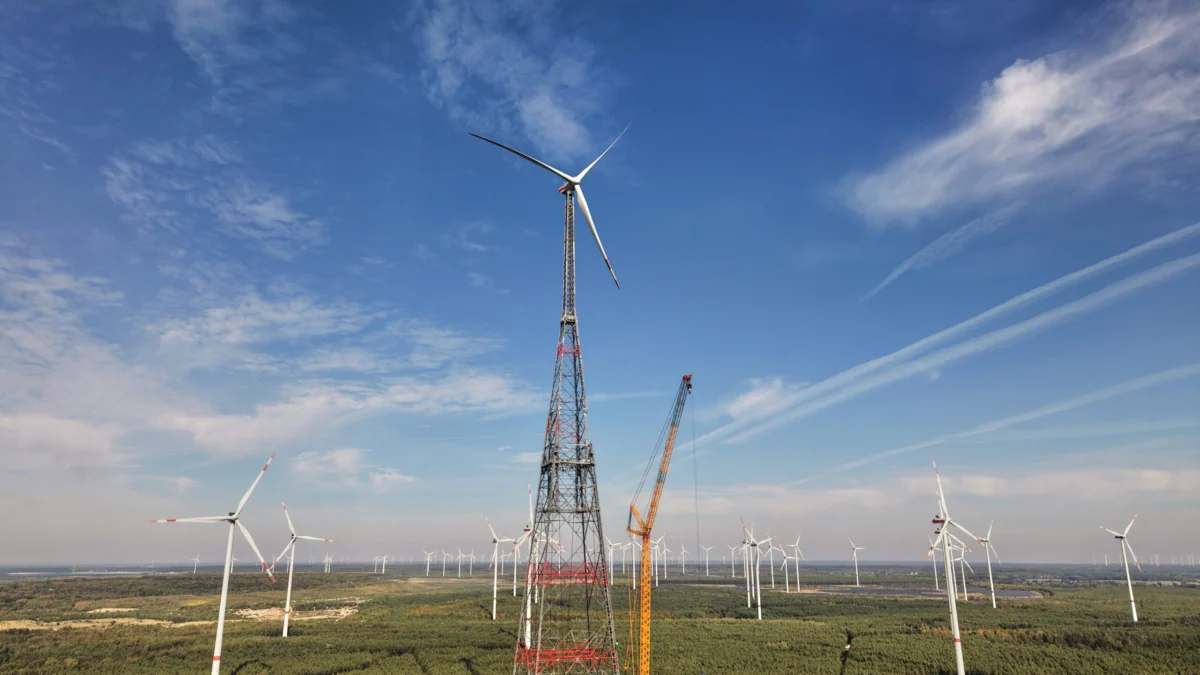
The skyline of Lusatia, a region in eastern Germany once defined by the sprawling craters of open-cast lignite mines, has been irrevocably altered by a feat of modern engineering that signals a new era for global renewable energy. Rising 365 meters (1,197 feet) above the municipality of Schipkau, a newly completed wind turbine prototype now stands as the tallest structure of its kind in the world. Developed by the Dresden-based engineering firm Gicon, the colossal tower surpasses the height of the Eiffel Tower in Paris (330 meters) and nearly rivals Berlin’s iconic Television Tower, which remains Germany’s tallest building at 368 meters.
This massive installation is not merely a record-breaking monument; it represents a strategic pivot in wind energy technology. By reaching altitudes previously untapped by onshore wind farms, the turbine aims to capture stronger, more consistent air currents that exist high above the earth’s surface. The prototype reached its full height in early October 2026 and is currently undergoing final internal wiring and system checks ahead of its official inauguration scheduled for November 19, 2026.
Engineering a Giant: Technical Specifications and Design
The Schipkau turbine is a departure from conventional wind power designs in both scale and structure. While modern onshore turbines typically feature a hub height—the distance from the ground to the center of the rotor—of approximately 100 to 150 meters, the Gicon prototype boasts a hub height of 300 meters (984 feet). When the rotor blades reach their highest vertical point, the total tip height reaches 365 meters.
To support such an immense structure, engineers utilized a high-stability lattice tower design rather than the traditional tubular steel towers found in smaller models. This lattice approach allows for greater height with a more efficient use of materials, providing the necessary rigidity to withstand the increased wind loads at high altitudes while minimizing the footprint on the ground.
Jochen Grossmann, Chief Executive of Gicon, emphasized that the primary motivation for the project is the "height-yield relationship." According to Grossmann, the wind at 300 meters is significantly more stable and powerful than at lower levels. "At 300 meters, we have such constant and strong wind that we can produce more than twice as much electrical energy as with the same facility at today’s heights," Grossmann stated during a site briefing. This increased consistency means the turbine can operate at high capacity for a greater number of hours per year, effectively narrowing the gap between intermittent renewable sources and "baseload" power generation.
Chronology of Development and Regional Context
The development of the world’s tallest turbine is the culmination of years of research and regional planning. The site in Schipkau, located southeast of Berlin, was selected for its existing infrastructure and the region’s historical commitment to energy production.
- 2022–2024: Planning and environmental impact assessments were conducted. Given the unprecedented height, the project required specialized permits regarding aviation safety and structural integrity.
- Late 2024: Groundbreaking and foundation work began. The foundation for a 365-meter structure requires specialized concrete and steel reinforcement to manage the leverage exerted by the wind at the summit.
- 2025 – mid-2026: Construction of the lattice tower proceeded in stages. The modular nature of the lattice design allowed for assembly on-site using high-capacity cranes.
- October 1, 2026: The final rotor assembly was completed, and the turbine reached its maximum height.
- October–November 2026: Installation of internal electrical systems, sensors, and grid connection hardware.
- November 19, 2026: Scheduled official inauguration and commencement of the data-gathering phase.
The location in Lusatia is deeply symbolic. For decades, this region was the heart of East Germany’s coal industry. As Germany moves toward its goal of ending coal-fired power generation by 2038, Lusatia is undergoing a massive economic structural change. The transition from extracting carbon-heavy lignite to harvesting high-altitude wind energy serves as a blueprint for the "Energiewende" (energy transition) occurring across the country.
The "Two-Story" Wind Farm Concept
Beyond the individual performance of the prototype, Gicon is proposing a revolutionary approach to land use: the "two-story" wind farm. One of the primary obstacles to the expansion of wind energy in densely populated countries like Germany is the scarcity of suitable land and local opposition to new sites.
Grossmann’s vision involves installing these ultra-tall turbines within existing wind farms. Because the taller turbines capture wind at 300 meters, their rotors do not interfere with the airflow of shorter, conventional turbines located at 150 meters. This allows for a vertical stacking of energy production on the same parcel of land.

"Existing sites could be expanded into ‘two-story’ wind farms," Grossmann explained. By doubling the energy output of a single plot of land without expanding the geographic footprint of the farm, developers can mitigate land-use conflicts and maximize the efficiency of existing grid connections. Gicon plans to use the data from the Schipkau prototype to develop a small pilot farm consisting of three to five additional ultra-tall turbines to prove the commercial viability of this multi-level harvesting strategy.
Supporting Data: Germany’s Shifting Energy Mix
The inauguration of the Schipkau turbine comes at a critical juncture for Germany’s energy policy. Following the 2022 energy crisis sparked by the invasion of Ukraine and the subsequent loss of Russian natural gas, Germany accelerated its transition to renewables. In 2023, the country took the controversial step of decommissioning its final three nuclear power plants, placing even more pressure on the wind and solar sectors to fill the void.
The most recent data from the Federal Statistical Office (Destatis) highlights the progress made. In the first half of 2026, renewable energy sources accounted for 59.1% of the total electricity produced in Germany. Wind power remains the dominant force in this sector, contributing 29.4% of the nation’s total power supply.
However, to meet the federal government’s target of 80% renewable electricity by 2030, the rate of onshore wind expansion must increase. The current fleet of turbines often faces periods of low production during "Dunkelflaute" (dark doldrums)—periods with little sun or wind. High-altitude turbines like the one in Schipkau are seen as a technical solution to this problem, as high-altitude winds are less susceptible to the fluctuations experienced at lower elevations.
Economic and Environmental Implications
The move toward taller turbines carries significant economic implications. While the initial capital expenditure for a 365-meter lattice tower is higher than that of a standard turbine, the Levelized Cost of Energy (LCOE) is expected to be lower over the long term. This is due to the projected doubling of energy yield and the increased capacity factor. If a turbine can produce power for 4,000 to 5,000 hours a year instead of the typical 2,500 to 3,000 hours, the return on investment becomes significantly more attractive for utility companies.
From an environmental perspective, the project has drawn both interest and scrutiny. Advocates point out that fewer turbines are needed to produce the same amount of power, reducing the total industrial impact on the landscape. Conversely, the sheer height of the structure raises concerns regarding bird and bat migratory patterns. Gicon has stated that the prototype is equipped with advanced sensor technology to monitor wildlife interactions, data that will be crucial for the regulatory approval of future high-altitude farms.
Furthermore, the visual impact of a structure taller than the Eiffel Tower is a point of contention in local planning. However, in Lusatia, where the landscape has already been shaped by massive mining equipment and industrial activity for over a century, local acceptance has been relatively high compared to more pristine regions of Germany.
Looking Ahead: The Future of High-Altitude Wind
The Schipkau prototype is intended to be the first of many. If the data gathered over the next year confirms Grossmann’s projections of doubled energy yields, it could trigger a global shift in onshore wind design. Engineering firms in China and the United States are also exploring taller designs, but the Gicon project currently holds the lead in operational height.
As the inauguration on November 19 approaches, the energy industry will be watching closely. The success of this project could redefine the limits of onshore wind power, turning "two-story" farms from a theoretical concept into a standard for the industry. For Germany, the tower is a symbol of resilience and innovation—a high-tech sentinel standing over a former coal field, pointing toward a carbon-neutral future.
The integration of such massive structures into the national grid will require further upgrades to transmission infrastructure, a challenge the German government is currently addressing through the "Netzausbau" (grid expansion) initiatives. Nevertheless, the completion of the world’s tallest wind turbine marks a definitive milestone in the global effort to harness the atmosphere’s kinetic energy more effectively and sustainably.
