

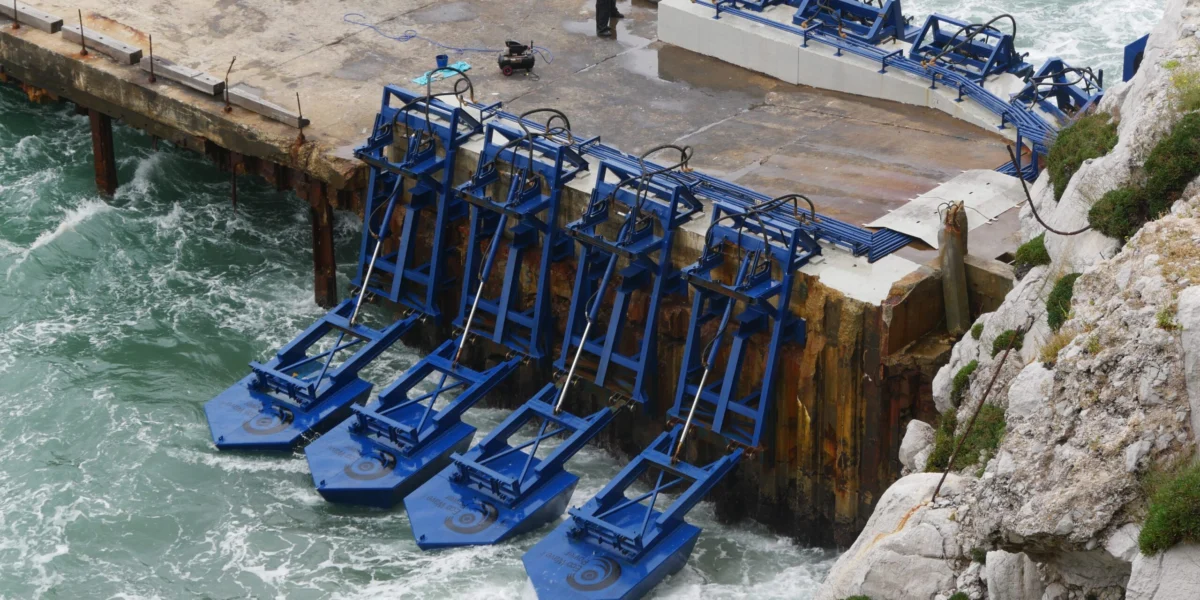
In a significant stride for the marine energy sector, Eco Wave Power Global AB, a leading onshore wave energy technology company, has announced the successful conclusion of the first phase of its sophisticated digital twin development program. Conducted in collaboration with the German firm AI engineering GmbH, the initiative leverages advanced artificial intelligence and high-fidelity physics simulations to optimize the conversion of ocean kinetics into grid-ready electricity. This milestone marks a pivotal shift in how renewable energy developers utilize "digital intelligence" to mitigate the inherent unpredictability of marine environments, positioning wave energy as a viable, data-driven alternative to traditional renewables.
Technical Foundations of Phase 1: Bridging Physics and Machine Learning
The first phase of the collaboration focused on the creation of a comprehensive physics-based digital model designed to replicate the complex interactions between ocean waves and Eco Wave Power’s proprietary floater technology. Unlike offshore wave energy systems that often face prohibitive maintenance costs due to deep-water environments, Eco Wave Power’s system is designed for onshore or nearshore deployment, typically attached to existing man-made structures such as breakwaters, piers, or jetties.
During this initial stage, engineers developed simulations that accounted for a multitude of variables, including wave loading, floater kinematics, structural stress distribution, and potential energy yield. These simulations were conducted across a vast array of sea states, from calm conditions to extreme storm events. By integrating initial machine-learning capabilities, the team was able to begin the process of energy and load forecasting, which is essential for grid stability and the longevity of the physical hardware.
A critical component of Phase 1 was the evaluation of the model’s "transferability." Eco Wave Power intends to use this digital framework to assess future deployment sites globally. By inputting localized bathymetric and meteorological data into the digital twin, the company can predict system performance before a single bolt is tightened on-site. This predictive capability is expected to significantly reduce the engineering risks and capital expenditures associated with scaling wave energy installations.
Strategic Integration with the NVIDIA Ecosystem
The technological backbone of this project is heavily supported by the NVIDIA Inception program, a premier incubator for startups transforming industries through AI and data science. Both Eco Wave Power U.S. and AI engineering GmbH are active members of this program, granting them access to cutting-edge accelerated computing tools.
The digital twin initiative utilizes the NVIDIA Omniverse platform, an OpenUSD-based environment that enables developers to build and operate industrial metaverse applications. By using Omniverse for visualization and simulation workflows, the teams can create photorealistic and physically accurate representations of wave energy arrays. Furthermore, the project employs NVIDIA Warp, a Python framework designed for high-performance GPU-accelerated simulation, to handle the complex fluid dynamics required to model the "free-surface" interactions of waves.
This reliance on high-fidelity simulation is not merely for visualization; it serves a functional engineering purpose. Wave energy is widely regarded as one of the most difficult engineering challenges in the renewable sector because it involves non-linear fluid dynamics and high-impact structural forces. The NVIDIA-accelerated computing infrastructure allows the project to process these massive datasets in real-time, providing insights that were previously computationally too expensive to obtain.
The Evolution of Eco Wave Power: A Chronological Perspective
The completion of Phase 1 is the latest entry in a timeline of steady growth for Eco Wave Power. Founded in 2011 by Inna Braverman, the company has moved from conceptual designs to pilot projects and now toward commercial-scale operations.
- 2011–2015: Initial R&D and the construction of a small-scale pilot plant in Ukraine, followed by a larger test site at the Port of Jaffa, Israel.
- 2016: The company launched its first grid-connected wave energy array in Gibraltar, a project that provided over 15,000 hours of continuous operation data.
- 2019–2021: Eco Wave Power went public on the Nasdaq First North in Stockholm and later on the Nasdaq Capital Market in the United States, raising capital to fund its global expansion.
- 2023: The company completed the installation of its EWP-EDF One project at the Port of Jaffa and began the assembly of its first U.S. project at the Port of Los Angeles.
- 2024: The partnership with AI engineering GmbH was formalized, leading to the current success of the Phase 1 digital twin program.
This progression demonstrates a clear trajectory from proving the physical viability of the technology to refining its economic and operational efficiency through digitalization.
Supporting Data: The Untapped Potential of Wave Energy
The move toward AI-optimized wave energy comes at a time when the global community is searching for "baseload-like" renewable sources. While solar and wind have seen massive adoption, their intermittency remains a challenge for grid operators. Wave energy offers a higher energy density and more consistent availability than wind or solar.
According to the International Energy Agency (IEA), the theoretical global potential for ocean energy is estimated to be around 8,000–80,000 TWh/year. For context, the entire world’s annual electricity consumption is approximately 23,000 TWh. By capturing even a small fraction of this energy, wave power could theoretically meet a substantial portion of global demand. However, the high "Levelized Cost of Energy" (LCOE) has historically hindered the sector. Eco Wave Power’s digital twin strategy is specifically designed to drive down this LCOE by optimizing maintenance schedules and increasing the "capacity factor" of their units through predictive AI.
Official Responses and Industry Leadership
Inna Braverman, Founder and CEO of Eco Wave Power, emphasized the symbiotic relationship between the physical and digital worlds in her recent statements. "We are building the digital intelligence around our physical technology," Braverman noted. "Our goal is to increasingly predict system performance, optimize our technology before deployment, and learn faster from every project we build. We believe this can help us improve engineering decisions and ultimately create increasingly intelligent wave energy systems."
PD Dr.-Ing. habil. Stefan Adami, Co-Founder and General Manager of AI engineering GmbH, highlighted the complexity of the task. "Wave energy combines complex free-surface fluid dynamics and structural motion," Adami explained. "Our approach allows us to link high-fidelity simulation with operational data to better understand energy capture and structural loading across a wide range of sea states."
Industry analysts suggest that this partnership is a bellwether for the broader renewable energy sector. As hardware becomes more standardized, the primary competitive advantage for energy companies will likely shift toward proprietary software and AI models that can squeeze every possible kilowatt-hour out of environmental assets.
Strategic Implications: Powering the AI Revolution with Wave Energy
One of the most intriguing aspects of Eco Wave Power’s roadmap is the proposed synergy between wave energy and AI data centers. The rapid expansion of generative AI and large language models (LLMs) has led to an unprecedented surge in electricity demand from data center facilities. Many of these centers are located near coastal regions for ease of logistics and access to cooling water.
Eco Wave Power sees a unique opportunity to provide "behind-the-meter" renewable energy directly to these facilities. By using the digital twin to forecast energy production, data center operators could potentially coordinate their most power-intensive computing tasks with periods of high wave activity. This "demand-response" integration would reduce the strain on the traditional power grid and lower the carbon footprint of AI infrastructure.
The company is currently in discussions with several data-center developers to explore the feasibility of this model. This includes the development of secure settlement mechanisms to ensure that the electricity supplied is accurately measured, verified, and settled using transparent digital ledgers.
Future Outlook and Phase 2 Objectives
With the foundation of Phase 1 firmly in place, Eco Wave Power and AI engineering GmbH have established a clear roadmap for the next stages of development. Phase 2 is expected to focus on integrating real-world operational data from Eco Wave Power’s existing sites—such as the Port of Jaffa and the upcoming Port of Los Angeles installation—into the digital twin. This "closed-loop" system will allow the AI to compare simulated predictions with actual physical performance, refining its accuracy over time.
The ultimate goal is to reach a stage of "AI-driven operation," where the system can autonomously adjust its floater positions or hydraulic settings in response to incoming wave patterns to maximize efficiency and protect the structure from damage.
As the global energy transition accelerates, the integration of AI and marine energy represents a sophisticated frontier. By digitizing the ocean’s power, Eco Wave Power is not only seeking to harness a neglected natural resource but is also providing a blueprint for how the next generation of renewable energy systems will be managed: through a precise, data-driven, and highly intelligent digital mirror of the physical world.
