

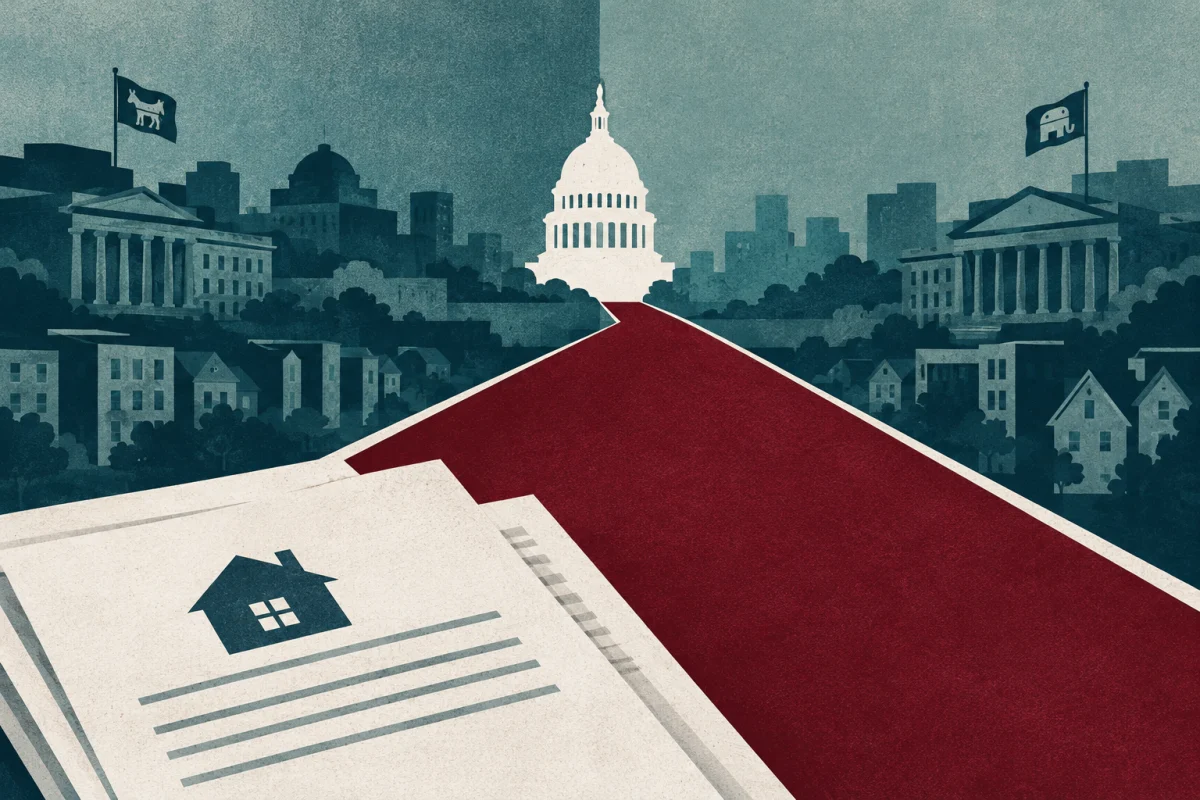
The landscape of American housing policy faces a complex new reality as the federal government prepares for a period of divided power, with the Democratic Party securing control of both the House of Representatives and the Senate while the Republican Party, led by President Donald Trump, maintains control of the White House. This political realignment occurs at a critical juncture for the United States real estate market, which has been characterized by record-high home prices, volatile mortgage rates, and a chronic shortage of inventory. Despite the inherent friction of a split government, industry leaders and policy experts suggest that the sheer magnitude of the housing affordability crisis may compel a rare era of bipartisan cooperation. Housing and mortgage industry stakeholders are now navigating a legislative environment where any significant reform will require a delicate balance of Democratic priorities in Congress and the executive authority of the Trump administration.
Voters across the nation signaled on Tuesday night that economic concerns, specifically the rising cost of living, were their primary motivation at the polls. With housing costs often representing the largest single expenditure for American households, the pressure on lawmakers to deliver tangible relief is immense. Isaac Boltansky, head of public policy at Pennymac, noted that the election results underscore a clear mandate for affordability. He pointed toward the "ROAD to Housing Act" as a foundational framework that could serve as a springboard for future legislation. Boltansky and other advocates are calling for a "ROAD to Housing 2.0" package, a comprehensive legislative effort aimed at expanding homeownership opportunities and ensuring that families can remain in their homes amid economic shifts.
A Chronology of Housing Policy and the Road to 2025
The current state of housing policy is the result of years of mounting pressure. In the lead-up to the 2024 elections, the housing market faced a "perfect storm" of challenges. Following the COVID-19 pandemic, a surge in demand met a decade-long under-supply of new construction, driving prices to historic highs. By 2023, the Federal Reserve’s aggressive interest rate hikes to combat inflation pushed mortgage rates above 7%, further squeezing prospective buyers. In response, various legislative efforts were introduced, most notably the "Retiring Outdated Administrative Demands (ROAD) to Housing Act." This legislation sought to modernize federal housing programs, reduce regulatory barriers to construction, and increase transparency within the Department of Housing and Urban Development (HUD).
As the 2024 campaign season intensified, both parties were forced to address the "lock-in effect," where homeowners with low-interest mortgages from the 2020-2021 era refused to sell, fearing the higher rates of the current market. This stagnation in the secondary market further depleted inventory. The Democratic capture of both chambers on Tuesday night represents a shift in the legislative agenda, but the requirement for a presidential signature means that any Democratic-led bill must incorporate Republican priorities, such as deregulation and private-sector incentives.
Supporting Data: The Economic Reality of the Housing Shortage
The urgency for legislative action is supported by stark economic data. According to recent reports from the National Association of Realtors (NAR) and Zillow, the United States faces a housing supply deficit estimated at between 4.5 million and 5.5 million units. This shortage has contributed to a 40% increase in median home prices since early 2020. Furthermore, data from the Mortgage Bankers Association (MBA) indicates that while mortgage applications have fluctuated, the "affordability index" remains at its lowest point in decades.
Closing costs have also emerged as a significant hurdle, with the average homebuyer now paying nearly $7,000 in fees and taxes at the time of purchase, excluding the down payment. In the rental market, nearly half of all U.S. renters are considered "cost-burdened," spending more than 30% of their income on housing. These data points have created a political environment where inaction is no longer viable for either party. The MBA has released a policy road map designed to address these specific metrics by easing tri-merge credit report requirements, aligning loan-level price adjustments (LLPAs), and potentially lowering the annual mortgage insurance premium for Federal Housing Administration (FHA) loans.
Industry Responses and Bipartisan Overtures
The reaction from the mortgage and real estate industry has been one of cautious optimism, emphasizing the necessity of a "common sense" approach. The Mortgage Bankers Association issued a statement highlighting that housing transcends partisan lines, expressing a readiness to work with the Trump administration to lower costs. This sentiment was echoed by Scott Norman, CEO of the Texas Mortgage Bankers Association, who characterized the shift in power as a natural evolution of the American democratic system. Norman emphasized that the "borrowed gavel" in Washington provides an opportunity for a fresh look at policies that may have become stagnant under previous leadership.
However, the American Land Title Association (ALTA) reminded policymakers that affordability cannot come at the expense of security. ALTA pointed to the rise of sophisticated wire fraud and deed theft schemes that target homeowners. As the government looks to streamline the home-buying process, ALTA argues that consumer protection and the integrity of property rights must remain central to the conversation. They contend that fraud is inherently "unaffordable," and any policy that weakens the title and closing process could lead to long-term instability in the market.
The Friction Between Executive and Legislative Power
While Congress holds the power of the purse and the ability to draft laws, the executive branch remains the primary driver of regulatory implementation. Tim Rood, founder and CEO of Impact Capitol, noted that the Democratic majorities in the House and Senate will control the agendas for the House Financial Services and Senate Banking Committees. This gives them the power to investigate federal agencies, shape spending negotiations, and potentially block or delay Trump’s nominees for key positions.
A primary point of contention is the leadership of the Consumer Financial Protection Bureau (CFPB). The nomination of Brian Johnson to lead the bureau is now considered at risk. Legal analysts suggest that Democrats may use Johnson’s confirmation as a bargaining chip to secure representation in other financial agencies or to protect existing consumer regulations. This "contested implementation calendar" means that mortgage executives should not expect a rapid overhaul of the rules. Instead, the focus will likely be on which existing policies can be successfully funded and defended against legal challenges.
One specific area of interest is the "loan originator compensation rule." Lenders have long sought changes that would allow for greater flexibility in how loan officers are paid, particularly in competitive or distressed markets. While there is some bipartisan interest in allowing lenders to "claw back" compensation in certain scenarios to protect consumers, the path to a coordinated agreement remains uncertain.
Broader Impact: Geopolitics, Inflation, and Interest Rates
The future of housing policy is also inextricably linked to broader economic and geopolitical variables. Jake Krimmel, a senior economist at Realtor.com, highlighted the impact of the ongoing conflict in the Middle East on domestic mortgage rates. The Democratic platform has been increasingly vocal about seeking a resolution to the Iran conflict, which has been a persistent source of inflationary pressure via global oil markets. A resolution that stabilizes oil supplies could lead to a decrease in the Consumer Price Index (CPI), potentially allowing the Federal Reserve to be more aggressive in cutting interest rates. Lower interest rates would provide immediate relief to the mortgage market, though they could also trigger a surge in demand that further inflates home prices if the supply issue is not addressed simultaneously.
Furthermore, the "fiscal trajectory" of the United States remains a concern for the bond market. Isaac Boltansky warned of a looming debt ceiling confrontation in 2027. The bond market’s reaction to federal spending and debt levels has a direct and immediate impact on the 10-year Treasury yield, which serves as a benchmark for 30-year fixed-rate mortgages. A Democratic Congress and a Republican White House must find a way to manage the national deficit to prevent a spike in yields that would render housing even more unaffordable.
Implications for the Future of Housing Reform
As the new Congress prepares to convene in January, the "Neighborhood Homes Investment Act" is being cited as a potential starting point for bipartisan cooperation. This act would provide tax credits to developers to build or rehabilitate homes in distressed communities where the cost of construction exceeds the eventual market value. By bridging this "appraisal gap," the policy aims to revitalize neighborhoods and increase the supply of entry-level homes—a goal shared by both the Democratic focus on social equity and the Republican focus on private-sector investment.
The coming months will determine whether the "mandate to focus on pocketbook issues" results in legislative breakthroughs or political gridlock. While the ideological divide between a Trump-led White House and a Democratic Congress is significant, the shared political risk of a worsening housing crisis provides a powerful incentive for compromise. For the mortgage industry, the message is clear: the rules of the game may not be rewritten overnight, but the pressure to innovate and lower costs has never been higher. The "ROAD to Housing 2.0" may be the only viable path forward in a Washington that is more divided than ever, yet united by the inescapable reality of an unaffordable housing market.
