

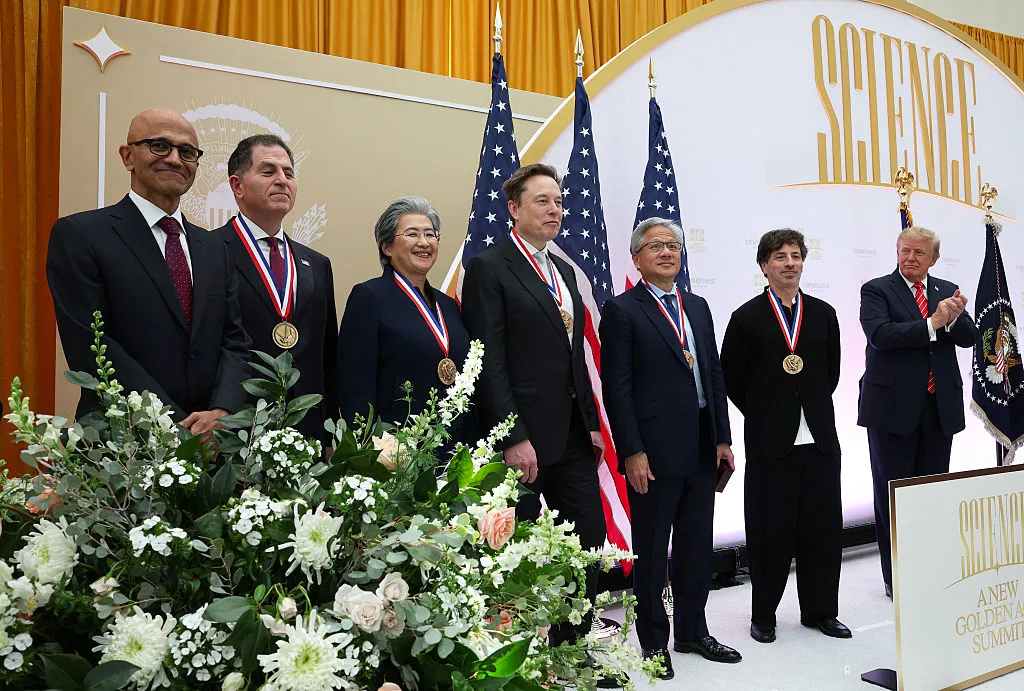
On Thursday, October 8, 2026, at precisely 3:33 PM PDT, the White House hosted the much-anticipated "Golden Age of American Innovation Summit," a gathering intended to celebrate the pinnacle of technological and scientific achievement in the United States. During the event, President Donald J. Trump bestowed the nation’s highest scientific and technological honors – the National Medal of Science and the National Medal of Technology and Innovation – upon a select group of prominent figures from the tech industry. However, the glittering ceremony was immediately overshadowed by revelations of extensive financial contributions from the awardees and their affiliated entities to the Trump administration and its related political efforts, totaling nearly $6 billion.
The National Medal of Science, established by Congress in 1959, is administered by the National Science Foundation and recognizes individuals who have made outstanding contributions to knowledge in the physical, biological, mathematical, engineering, or social and behavioral sciences. This year’s recipients included titans of innovation: Elon Musk, CEO of Tesla and SpaceX; Jensen Huang, co-founder and CEO of NVIDIA; Sergey Brin, co-founder of Alphabet (Google); and Lisa Su, CEO of Advanced Micro Devices (AMD). The National Medal of Technology and Innovation, created in 1980 and administered by the Department of Commerce, honors those who have made outstanding contributions to America’s economic, environmental, and social well-being through the development and commercialization of technological products, processes, and concepts. This esteemed award was presented to Michael Dell, Chairman and CEO of Dell Technologies, and Satya Nadella, CEO of Microsoft.
The announcement of these awards, typically a moment of bipartisan pride and scientific recognition, quickly became a focal point of scrutiny due to the unprecedented scale of political donations linked to the honorees. According to an investigation by The New Republic, the collective contributions from these individuals and their corporate entities to causes and funds associated with President Trump and his administration reached an staggering figure close to $6 billion. This sum reportedly included donations to the President’s inauguration fund, contributions towards the upkeep and events at the White House ballroom, significant funding to pro-Trump Super PACs, and a substantial pledge of $6.25 billion by Michael and Susan Dell specifically for the "Trump Accounts," an administration-backed savings program for children. This financial nexus immediately raised questions about the impartiality of the award selection process and the potential for political influence to sway what are intended to be merit-based recognitions.
The Prestigious Awards: A History of Merit
The National Medal of Science and the National Medal of Technology and Innovation represent the highest civilian honors for scientific and technological achievement in the United States. Historically, these medals have been awarded to distinguished scientists, engineers, and inventors whose groundbreaking work has advanced human knowledge, spurred economic growth, or improved public welfare. Past recipients often include Nobel laureates, pioneering researchers, and visionary engineers whose contributions are widely recognized by the global scientific community. The selection process traditionally involves rigorous peer review and recommendations from expert committees, aiming to ensure that the awards are granted purely on the basis of scientific and technological merit, free from political considerations. The integrity of these awards is paramount to their prestige, serving as a beacon for future generations of innovators.
Profiles of the Honorees and Their Impact
Each of the awarded executives represents a transformative force in their respective fields:
- Elon Musk: As the visionary behind Tesla and SpaceX, Musk has redefined industries from automotive to aerospace. His work on electric vehicles, battery technology, reusable rockets, and satellite internet constellations (Starlink) has pushed the boundaries of what is technologically feasible, inspiring a new era of innovation and space exploration. His ventures also include Neuralink, focused on brain-computer interfaces, and The Boring Company, aiming to revolutionize urban tunneling.
- Jensen Huang: Under Huang’s leadership, NVIDIA has become a dominant force in graphics processing units (GPUs), which are not only essential for gaming but have also become the backbone of artificial intelligence and high-performance computing. His foresight in recognizing the potential of parallel processing for AI has positioned NVIDIA at the forefront of the global AI revolution, enabling advancements in fields from medical imaging to autonomous driving.
- Sergey Brin: Co-founder of Google, Brin played a pivotal role in developing the search engine that transformed how the world accesses information. Beyond search, his influence extends to numerous innovations within Alphabet, including advancements in artificial intelligence, self-driving cars (Waymo), and various other frontier technologies that have fundamentally reshaped modern society.
- Lisa Su: As CEO of AMD, Dr. Su is credited with orchestrating a remarkable turnaround of the semiconductor giant. Her strategic vision and focus on high-performance computing and graphics have led to significant market share gains against competitors, particularly in critical areas like data centers, gaming, and advanced processors. Her leadership has made AMD a formidable player in the global technology landscape.
- Michael Dell: The founder of Dell Technologies, Dell revolutionized the personal computer industry through direct-to-consumer sales and later expanded his company into a global leader in enterprise solutions, cloud computing, and cybersecurity. His contributions have been instrumental in making computing accessible and scalable for businesses and individuals worldwide.
- Satya Nadella: Since taking the helm at Microsoft, Nadella has transformed the company’s culture and strategic direction, emphasizing cloud computing (Azure), artificial intelligence, and a renewed focus on productivity and collaboration tools. Under his leadership, Microsoft has experienced significant growth and re-established its position as a leading innovator in the technology sector.
President Trump, in his address at the summit, lauded the honorees, stating that they had helped "pioneer an incredible future for America." He further asserted, "because of them, we will always be on top. No one else can compete with us," echoing a consistent theme of American technological supremacy under his administration. The President’s remarks underscored a narrative that framed these individuals’ successes as direct contributions to national strength and global competitiveness.
The Unprecedented Nexus of Philanthropy and Policy
The financial ties between the awardees and the Trump administration have ignited a fierce debate regarding the perceived politicization of national awards. The reported $6 billion in donations is a sum that dwarfs typical political contributions and spans various facets of the administration’s political and charitable ecosystem.
- Inauguration Fund: Contributions to a presidential inauguration committee are common but are often subject to scrutiny regarding transparency and the use of funds. Large donations from tech executives to Trump’s inauguration fund could be seen as an early attempt to curry favor with the incoming administration.
- White House Ballroom: Donations towards White House functions or renovations, while sometimes framed as philanthropic support for national heritage, can also be viewed as a means for donors to gain proximity and influence with the executive branch.
- Pro-Trump Super PACs: Super PACs (Political Action Committees) can raise and spend unlimited amounts of money to support or oppose political candidates, as long as they do not coordinate directly with campaigns. Donations to these entities are a direct form of political advocacy, allowing wealthy donors to significantly impact elections and policy debates. AMD’s contribution to a pro-Trump Super PAC, for instance, signals a clear alignment with the administration’s political agenda.
- "Trump Accounts" for Children: The $6.25 billion pledge from Michael and Susan Dell to fund the "Trump Accounts," described as the administration’s savings program for children, represents a massive philanthropic commitment directly linked to a presidential initiative. While presented as a charitable endeavor, the sheer scale of the donation and its direct connection to a government program could be interpreted as a means of fostering goodwill and influence with the White House. Critics argue that such large, politically-aligned donations could create an environment where access and recognition are perceived as commodities, rather than earned purely on merit.
The H-1B Program Controversy and Microsoft’s Unique Position

Perhaps the most glaring point of contention arose with Satya Nadella’s award. His recognition came immediately after the Trump administration had indefinitely suspended Microsoft from the H-1B program. The H-1B visa program allows U.S. employers to temporarily employ foreign workers in specialty occupations, typically requiring a bachelor’s degree or higher in a specific field. It is a critical talent pipeline for the U.S. technology sector, enabling companies like Microsoft to hire highly skilled foreign professionals when domestic talent is perceived to be scarce.
The administration’s suspension of Microsoft from this program was a significant punitive measure, likely driven by its broader "America First" immigration policies, which sought to restrict foreign labor and prioritize American workers. The specific reasons for Microsoft’s indefinite suspension were not fully detailed, but such actions typically stem from concerns about compliance, wage practices, or the perceived impact on the American workforce.
The timing of Nadella’s award, directly following a major policy decision that negatively impacted his company’s operational capabilities, created a jarring juxtaposition. Observers questioned whether the award was a genuine recognition of Nadella’s contributions or a complex political maneuver. Some speculated it could be a "carrot and stick" approach – a public honor to acknowledge innovation while simultaneously enforcing strict immigration policies that impact the same industry. This dynamic further fueled the narrative of politicization, suggesting that even high-profile awards could be integrated into a broader strategy of reward and punishment by the administration.
Reactions and Critiques from Across the Spectrum
The announcement and its accompanying revelations drew swift reactions from various quarters:
- White House Defense: White House press secretary, in an inferred statement, defended the awards, emphasizing the "unparalleled contributions" of the recipients to American innovation and economic prosperity. The administration likely highlighted the honorees’ roles in job creation, technological leadership, and national security, reiterating President Trump’s vision of an "incredible future for America." Any suggestion of political influence was likely dismissed as unfounded speculation, with officials maintaining that selections were based on established criteria.
- Scientific Community Concerns: Many within the scientific and academic communities expressed dismay. Organizations dedicated to upholding scientific integrity and independent research voiced concerns that the perceived political ties could tarnish the reputation of the National Medals. Critics argued that such events could erode public trust in scientific institutions and lead to a perception that merit can be bought, rather than earned through genuine discovery and innovation. They called for greater transparency in the selection process and a strict separation of scientific recognition from political fundraising.
- Political Opposition: Democratic lawmakers and watchdog groups seized upon the opportunity to criticize the administration, accusing it of leveraging prestigious national honors for political gain. They highlighted the appearance of a quid pro quo, where substantial financial support was seemingly rewarded with public accolades. Calls for congressional investigations into the award selection process and campaign finance regulations were anticipated.
- Awardees’ Response (Inferred): While the executives would likely express gratitude and humility for the recognition, their public statements would undoubtedly focus on their companies’ contributions to technology and the economy, steering clear of any direct engagement with the political donation controversy. They would emphasize the hard work of their teams and the broader impact of innovation on society.
Broader Implications for Scientific Integrity and Tech-Government Relations
The events of October 8, 2026, carry significant implications for the integrity of national awards, the relationship between government and the technology sector, and the future of innovation policy in the United States.
Firstly, the incident risks undermining the credibility of the National Medal of Science and the National Medal of Technology and Innovation. If these awards are perceived as being influenced by political donations rather than purely by scientific and technological merit, their long-standing prestige and motivational power could diminish. This erosion of trust could have lasting effects on how these honors are viewed both domestically and internationally.
Secondly, the episode highlights the increasingly complex and often fraught relationship between Big Tech and the U.S. government. Tech companies are not only economic powerhouses but also significant political actors, with vast resources to influence policy through lobbying and donations. This event underscores the potential for such influence to extend even to areas traditionally considered apolitical, like scientific recognition. It raises questions about the ethical boundaries of corporate philanthropy when it converges with political interests, and whether the pursuit of national honors can become entangled with financial patronage.
Finally, the juxtaposition of promoting "American innovation" while simultaneously restricting skilled foreign talent through policies like the H-1B suspension presents a policy paradox. The tech industry thrives on a global talent pool, and restrictive immigration policies can hamper innovation and competitiveness. The incident involving Nadella and Microsoft brings this tension into sharp relief, suggesting a potential disconnect between the administration’s rhetoric of fostering innovation and the practical implications of some of its policies.
In conclusion, the Golden Age of American Innovation Summit, intended as a celebration of American ingenuity, has instead ignited a national debate about the integrity of its highest scientific and technological honors. The unprecedented scale of financial contributions from the awardees to the Trump administration has cast a long shadow over the ceremony, raising profound questions about the intersection of wealth, power, and prestige in contemporary American politics. As the dust settles, the long-term impact on the credibility of these awards and the public’s perception of the tech industry’s role in government will undoubtedly be a subject of ongoing scrutiny and discussion.
