

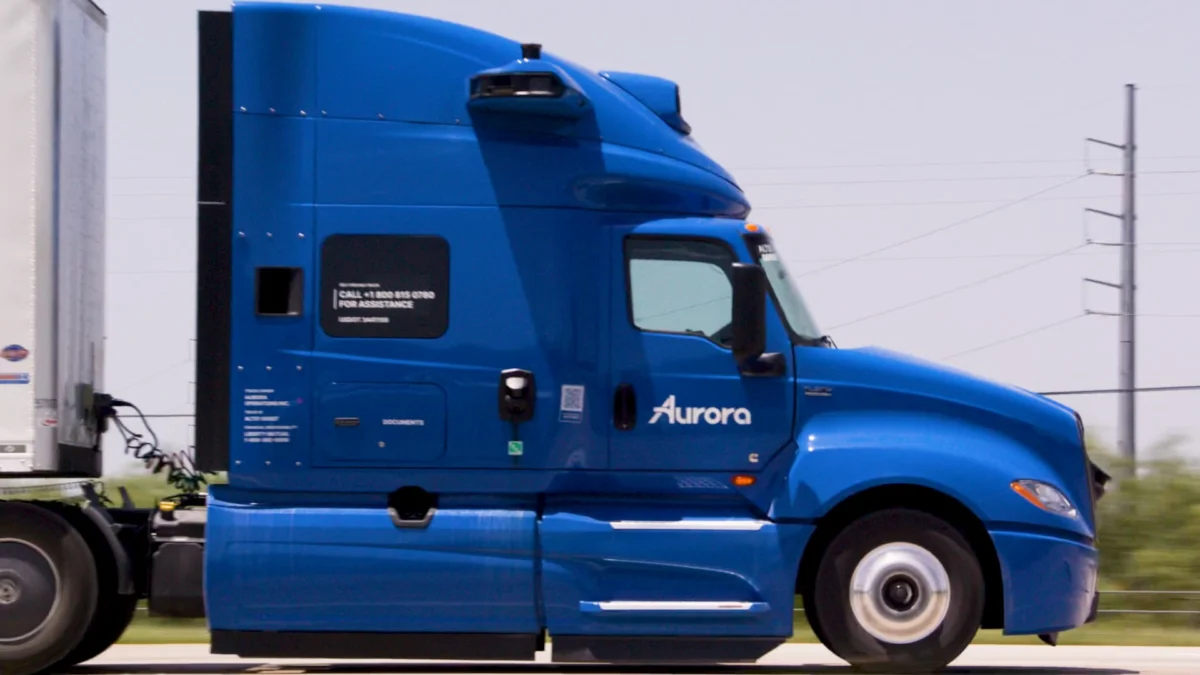
The vast, sprawling interstates of Texas, particularly the bustling I-45 corridor connecting Houston and Dallas, and the extensive I-20 stretch between Fort Worth and El Paso, are renowned as some of the nation’s busiest arteries for commercial freight. Along these critical routes, a silent revolution in transportation is unfolding, led by companies like Aurora Innovation, which is now operating fully autonomous semi-trucks, moving goods without a human behind the wheel. This marks a significant milestone in the journey towards an automated logistics future, transforming how goods are transported across the country.
Aurora Innovation’s autonomous trucks are not merely advanced cruise control systems; they represent a sophisticated integration of cutting-edge artificial intelligence and sensor technology. "It’s using lasers, radar, and cameras to look all around it and see the other cars, see the other trucks on the road, and figure out how to drive safely," explained Chris Urmson, Aurora’s founder and CEO, during a three-hour ride with CNBC’s Phil LeBeau in the cab of one of these driverless vehicles. This multi-modal sensor suite, often referred to as Lidar, Radar, and Camera (LRC), provides a 360-degree environmental perception, allowing the Aurora Driver system to accurately detect objects, predict their movements, and navigate complex traffic scenarios with precision. Lidar, using pulsed laser light, creates detailed 3D maps of the surroundings, while radar excels in detecting objects and their velocities through adverse weather conditions. High-resolution cameras, meanwhile, offer crucial visual data, identifying lane markings, traffic signs, and the semantic context of the road. The fusion of data from these diverse sensors creates a robust, redundant perception system designed to exceed human capabilities in vigilance and reaction time.
The Economic Imperative: Efficiency and Cost Savings
The push for autonomous trucking is heavily driven by compelling economic factors. Aurora currently operates a fleet of 20 driverless trucks and plans to aggressively scale this to 200 by the end of the year, signaling a clear trajectory towards major growth. The company’s core value proposition revolves around enhanced operational efficiency and substantial cost reductions compared to traditional human-driven semis.
Urmson articulated several key advantages: "We can help them [truck operators] save on fuel economy. We can move goods more quickly and then we can fill the need when they can’t hire amazing drivers for their teams." Autonomous trucks, through optimized driving patterns, consistent speeds, and predictive analytics, can significantly improve fuel efficiency by minimizing harsh braking and acceleration. Furthermore, unlike human drivers who are bound by stringent federal Hours of Service (HOS) regulations – typically limiting driving to 11 hours within a 14-hour workday, followed by a mandatory 10-hour off-duty period – autonomous trucks have the potential to operate for up to 20 hours a day, dramatically increasing asset utilization and speeding up delivery times. This extended operational window directly addresses the "move goods more quickly" promise, offering a significant competitive edge in time-sensitive logistics.
Financial analysts have corroborated these projections. Ravi Shanker, a transportation analyst with Morgan Stanley, estimates that "an autonomous fleet should be nearly 7.5X as profitable as a human-driven fleet today." This staggering figure underscores the transformative potential of automation in the trucking sector. Bank of America further breaks down the cost differentials, estimating that "Aurora services will cost ~$0.85 per mile versus approximately $1.30 per mile for human driver wages and benefits, before considering indirect labour costs." These direct savings on labor, coupled with potential reductions in insurance premiums (as accident rates are projected to decrease with autonomous systems), maintenance costs (due to smoother driving), and improved asset utilization, paint a clear picture of the economic benefits. Aurora’s "driver as a service" business model, where customers pay by the mile, is designed to make these cost efficiencies directly accessible and attractive to shipping and freight customers.
Addressing the Truck Driver Shortage Crisis
One of the most pressing challenges facing the U.S. freight industry is a persistent and growing shortage of qualified truck drivers. The American Trucking Associations (ATA) has consistently highlighted this issue, projecting a shortage that could reach 160,000 drivers by 2030. Factors contributing to this crisis include an aging workforce, the demanding lifestyle of long-haul trucking, difficulties in recruiting younger drivers, and the relatively low entry barrier for less regulated driving roles. This shortage directly impacts supply chain reliability, increases shipping costs, and creates bottlenecks in the movement of goods. In this context, autonomous trucks emerge not merely as a cost-saving measure but as a critical solution to maintain and enhance freight capacity. By "filling the need when they can’t hire amazing drivers," autonomous vehicles offer a scalable, reliable alternative to human labor for long-haul routes, allowing human drivers to focus on more complex, local, or specialized deliveries.
Chronology of Aurora’s Journey and the Autonomous Landscape
Aurora Innovation’s journey into autonomous trucking is part of a broader, accelerating trend in the automotive and technology sectors. Founded in 2017 by industry veterans Chris Urmson (who previously led Google’s self-driving car project), Sterling Anderson (former head of Tesla Autopilot), and Drew Bagnell (from Uber’s Advanced Technologies Group), Aurora quickly positioned itself as a leader in Level 4 autonomous driving technology.
- 2017-2020: Early Development and Partnerships: Aurora initially focused on developing a universal self-driving platform, the Aurora Driver, applicable to various vehicle types, including passenger cars and trucks. Key partnerships were forged, including with Volkswagen and Hyundai, to integrate their technology into passenger vehicles.
- 2020: Strategic Shift to Trucking: Recognizing the immense market potential and clearer regulatory pathways for autonomous freight, Aurora made a strategic pivot to prioritize trucking. This decision was influenced by the more predictable nature of highway driving compared to complex urban environments, and the immediate economic need in the logistics sector.
- 2021: Public Road Testing and Milestones: Aurora began testing its AV technology on public roads in Texas, initially with human safety operators behind the wheel. These early tests were crucial for data collection and system refinement. The company acquired Uber’s Advanced Technologies Group (ATG), significantly boosting its talent pool and technology stack.
- 2022: Fully Driverless Operations Begin: Aurora achieved a major milestone by initiating fully driverless commercial pilot hauls for partners like FedEx and Werner Enterprises, primarily on the Dallas-Houston corridor. These operations, while still under strict supervision, demonstrated the commercial viability of their technology.
- 2023-Present: Expansion and Commercialization Focus: The company has continued to expand its driverless operations in Texas, logging over 3 million miles in total since 2021, with an increasing proportion being fully autonomous. The current fleet of 20 driverless trucks on I-45 and I-20 represents a significant step towards full commercial deployment, with the target of 200 trucks by year-end underscoring their aggressive scaling strategy.
Aurora is not alone in this burgeoning market. Competitors like Kodiak AI, Gatik, and Tesla are also making significant strides. Kodiak AI focuses on long-haul autonomous trucking, emphasizing a modular hardware and software approach. Gatik specializes in "middle-mile" logistics, operating autonomous box trucks for fixed, repeatable routes between distribution centers and retail locations. Tesla, with its much-anticipated Semi, aims for an integrated electric and autonomous solution, leveraging its vast data from its passenger vehicle fleet. The Department of Transportation estimates there are approximately 3.5 million Class 8 semi-trucks on the road in the U.S., and while only a fraction are autonomous today, the market is growing exponentially, with Wall Street analysts predicting a multi-billion-dollar industry within the decade. Projections from various market research firms suggest the global autonomous trucking market could reach tens of billions of dollars by the early 2030s, driven by technological advancements, regulatory support, and the relentless pursuit of efficiency.
Challenges and the Human Element
Despite the technological advancements and compelling economic arguments, the path to widespread autonomous trucking is not without its skeptics and challenges. Chris Urmson readily acknowledges this, particularly concerning the safety of driverless trucks traversing highways at 65 or 70 mph. "We’ve got millions of miles of experience," he asserts, emphasizing the rigorous validation process. "We put this through 15 million tests before we put it out on the road." This includes extensive simulation testing, closed-course proving ground tests, and real-world public road operations, initially with safety drivers and progressively moving to fully driverless modes. The industry’s focus on safety is paramount, as a single incident could severely impact public trust and regulatory approval.
Beyond safety, the human element presents a more nuanced challenge. Sean Wu, CEO of the online shipping marketplace uShip, voices a common concern: "The drivers do more than just move the rig. There is judgment. There is customer service. There is protection." Wu highlights the multifaceted role of a human truck driver, which extends beyond mere vehicle operation. Drivers often act as problem-solvers on the road, troubleshoot minor mechanical issues, ensure cargo security, manage delivery logistics with clients, and provide critical customer service at pickup and drop-off points. While autonomous systems excel in driving tasks, replicating this broader suite of human skills and judgment remains a complex hurdle, particularly for the "last mile" of delivery or in unforeseen circumstances. This suggests a future where human drivers might transition to roles focused on these non-driving tasks, collaborating with autonomous systems rather than being entirely replaced.
Regulatory Landscape and Future Implications
The regulatory framework for autonomous vehicles is still evolving, posing another significant challenge. Currently, a patchwork of state-level regulations exists, with some states, like Texas, being more permissive for testing and deployment, while others maintain stricter controls. The lack of a unified federal framework creates complexity for companies aiming for national deployment. Federal agencies, including the National Highway Traffic Safety Administration (NHTSA) and the Federal Motor Carrier Safety Administration (FMCSA), are actively studying and developing guidelines, but comprehensive legislation and standards are still years away. Standardized safety metrics, certification processes, and liability frameworks will be crucial for scaling autonomous operations.
The broader implications of autonomous trucking are profound, extending beyond just the logistics industry.
- Supply Chain Transformation: Autonomous trucks could fundamentally reshape supply chains, enabling faster, more predictable, and potentially more resilient freight networks. This could lead to shifts in warehousing strategies, port operations, and distribution models.
- Job Market Impact: While driver shortages are a reality, the long-term impact on the 3.5 million existing truck driving jobs is a significant societal concern. This will necessitate investments in retraining programs for displaced drivers, focusing on roles in remote vehicle supervision, maintenance, logistics coordination, or other sectors. New jobs related to the autonomous trucking ecosystem, such as sensor technicians, AI trainers, and cybersecurity experts, will also emerge.
- Infrastructure: The widespread adoption of autonomous trucks might necessitate investments in "smart" infrastructure, such as dedicated autonomous lanes or enhanced digital communication along highways, though current systems are designed to operate on existing infrastructure.
- Environmental Impact: Autonomous trucks, with their potential for optimized driving and platooning (where trucks drive in close formation to reduce aerodynamic drag), could contribute to reduced fuel consumption and lower emissions, aligning with broader sustainability goals.
The On-Road Experience: A Glimpse into the Future
The firsthand account from the CNBC reporter during the freight run in Palmer, Texas, offers a tangible glimpse into this future. What stood out was the uneventful nature of the three-hour journey on I-45. "The truck pulled off the highway once for less than a minute to reset the hazard lights which had come on for some unknown reason. Otherwise, over the course of three hours on I-45, we saw more than a few double takes from truck drivers passing by who looked twice when they saw nobody behind the wheel." This mundane, yet deeply significant, experience underscores the reliability and maturity of the technology. The minor anomaly of the hazard lights resetting speaks to the ongoing testing and refinement, while the reactions of human drivers highlight the novelty and the impending paradigm shift. For Urmson, it represented "another 200 miles where Aurora’s autonomous driving technology has delivered a shipment," adding to the cumulative 3 million miles logged since 2021. The shift from safety operator-backed miles to fully driverless operations is a crucial metric in their progress.
Financially, Aurora, like many pioneering technology companies, is in a heavy investment phase. After losing more than $800 million in 2025, the company is targeting positive free cash flow in 2028, a goal contingent on a substantial increase in the number of autonomous trucks on the road and successful commercialization. "We’ve been able to put out timelines and we’ve basically hit those timelines," Urmson affirmed, expressing confidence in their strategic execution and technological roadmap.
As Aurora Innovation continues to expand its driverless fleet across the critical freight corridors of Texas, it is not just moving goods; it is steering the entire logistics industry towards a future defined by automation, efficiency, and potentially, unprecedented reliability. While challenges in safety, regulation, and societal integration remain, the wheels of autonomous trucking are undeniably in motion, promising to redefine the very concept of freight transportation.
