

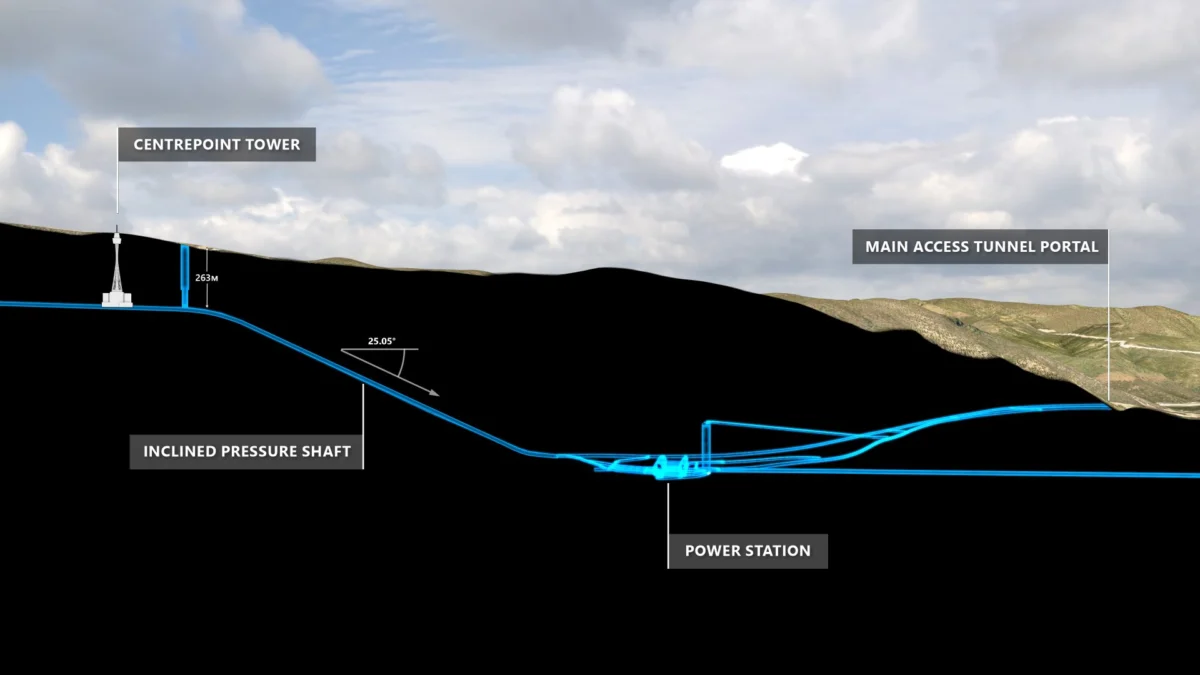
The Australian government-owned energy corporation Snowy Hydro has officially revised the budget for its flagship Snowy 2.0 pumped hydro expansion, revealing that the total project cost could now escalate to as much as A$25 billion. This announcement follows a comprehensive project review and cost reassessment conducted by the principal contractor, Future Generation Joint Venture (FGJV). The updated figures represent a monumental increase from the original A$2 billion estimate provided at the project’s inception in 2017, underscoring the extreme technical and economic challenges associated with building one of the world’s most ambitious renewable energy storage systems.
In addition to the financial surge, the timeline for the project’s delivery has been pushed further into the future. While previous estimates suggested a commissioning date in December 2028, Snowy Hydro now anticipates that the project will not be fully operational until late 2029. This delay has significant implications for the Australian National Electricity Market (NEM), which is currently undergoing a rapid transition away from coal-fired power toward a grid dominated by intermittent wind and solar generation.
The Financial Trajectory of Snowy 2.0
The cost reassessment, which was finalized after months of rigorous analysis, sets a "target cost" of A$22.2 billion. However, Snowy Hydro management has factored in a contingency buffer, acknowledging that the final price tag could reach A$25 billion. This figure encompasses the "uniqueness, risk, and technical complexity" of the project, which involves boring massive tunnels through the hard rock of the Snowy Mountains to connect two existing reservoirs, Tantangara and Talbingo.
The financial journey of Snowy 2.0 has been one of consistent upward revisions. When the project was first announced by the Turnbull government in 2017, it was marketed as a relatively affordable way to "future-proof" the Australian grid. By 2019, the estimated cost had grown to approximately A$5.1 billion. The latest leap to A$25 billion reflects not only local construction difficulties but also a global environment of high inflation, supply chain disruptions, and a significant shortage of specialized labor and engineering expertise.
Snowy Hydro CEO Dennis Barnes described the cost increase as "disappointing" but maintained that the project remains essential for the country’s energy security. He argued that a "project reset" initiated in 2023 was a necessary step to prevent even more catastrophic financial outcomes. According to Barnes, the move away from a fixed-price contract—a model he claimed was never suitable for a project of this scale and geological uncertainty—likely saved the project from total collapse under the weight of contractor claims.
Technical Milestones and Geological Hurdles
Despite the financial and scheduling setbacks, Snowy Hydro reports that physical construction is progressing. As of the latest update, machine tunneling for the project is approximately 65% complete. This involves the use of massive Tunnel Boring Machines (TBMs) designed to carve out the high-pressure shafts and access tunnels required for the system. Furthermore, the excavation of the underground power station cavern is roughly 90% complete. This cavern, located nearly 800 meters underground, will eventually house six reversible Francis pump-turbines.
The technical complexity of the project cannot be overstated. One of the primary drivers of the recent cost blowouts has been the "design immaturity" present during the initial investment phase. Engineers have had to adapt to unforeseen geological conditions that were not fully understood when the project was greenlit.
A notable example of these challenges is the TBM "Florence," which became stuck in soft ground and faced significant delays. The machine’s struggle to navigate the complex strata of the Snowy Mountains became a symbol of the project’s difficulties, requiring specialized remediation work to stabilize the surrounding environment before tunneling could resume. These "construction complexities" have prevented the principal contractor, FGJV, from meeting its original productivity targets, further driving up labor and equipment costs.
A Chronology of Australia’s Largest Renewable Project
To understand the current state of Snowy 2.0, it is necessary to look at the timeline of its development:
- March 2017: Prime Minister Malcolm Turnbull announces Snowy 2.0, estimated at A$2 billion with a 2021 completion date.
- December 2018: The project receives its final investment decision (FID).
- April 2019: The main contract is awarded to Future Generation Joint Venture (FGJV), a consortium including Webuild, Lane Construction, and Clough.
- 2020-2022: Construction begins, but geological issues and the COVID-19 pandemic lead to the first major delays and cost increases.
- December 2022: TBM Florence becomes stuck, halting progress on a critical section of the tunnel for several months.
- August 2023: Snowy Hydro announces a "project reset," shifting from a fixed-price contract to an "incentivized target cost" model to keep the contractor on-site.
- February 2024: Detailed cost reassessments begin to circulate, hinting at a figure above A$12 billion.
- Current Update: Snowy Hydro confirms a potential A$25 billion total cost and a late 2029 completion target.
Strategic Importance to the National Electricity Market
Despite the staggering costs, energy analysts and the Australian government continue to highlight the strategic necessity of Snowy 2.0. The project is designed to provide 350,000 megawatt-hours (MWh) of energy storage—enough to power three million homes for a week. In a grid that is increasingly reliant on variable wind and solar power, "deep storage" of this magnitude is viewed as the "holy grail" of energy stability.
Unlike short-duration lithium-ion batteries, which typically provide two to four hours of storage, Snowy 2.0 can provide continuous high-output power for days or even weeks if needed. This capacity is critical for periods of "renewable droughts"—extended intervals where wind speeds are low and cloud cover reduces solar output.
The project will provide 2,200 MW of dispatchable capacity, helping to fill the gap left by the scheduled retirement of major coal-fired power stations like Eraring and Liddell. Without the storage capacity provided by Snowy 2.0, the Australian grid would likely face increased volatility in energy prices and a higher risk of load-shedding events during peak demand periods.
Official Responses and Political Implications
The federal government, led by Energy Minister Chris Bowen, has remained supportive of the project while acknowledging the frustration surrounding its costs. The government views Snowy 2.0 as a non-negotiable component of its plan to reach 82% renewable energy by 2030. In recent statements, officials have emphasized that the cost of failing to build the project—resulting in potential grid instability and higher long-term energy prices—would far outweigh the current construction price tag.
However, the opposition and various industry critics have pointed to Snowy 2.0 as a cautionary tale of government-led infrastructure. Critics argue that the lack of transparency in the early stages and the failure to conduct adequate geological surveys led to a "sunk cost" fallacy, where the government felt compelled to keep funding the project regardless of the price.
Energy market participants are also concerned about the impact of the 2029 delay. With coal plants closing, there is a narrow window to bring new firming capacity online. The delay in Snowy 2.0 may necessitate the accelerated deployment of smaller-scale battery projects or gas-fired "peaker" plants to ensure the lights stay on in the late 2020s.
Broader Implications for the Global Energy Transition
The challenges facing Snowy 2.0 are not unique to Australia. Large-scale pumped hydro projects worldwide, from Europe to North America, often face significant cost overruns and multi-year delays due to their reliance on complex underground engineering. The Snowy 2.0 experience serves as a case study for other nations considering massive hydro-storage investments.
One of the key takeaways for the industry is the shift in contracting strategies. Snowy Hydro’s move from a fixed-price contract to a more flexible, risk-sharing model reflects a growing realization that "mega-projects" are too unpredictable for traditional commercial arrangements. While the new model protects the project from being abandoned, it also shifts more of the financial risk onto the taxpayer and the energy consumer.
Furthermore, the project highlights the "green premium" associated with the energy transition. As countries race to decarbonize, the demand for specialized equipment, engineering talent, and raw materials has skyrocketed, leading to global cost escalations that were not anticipated five years ago.
Future Outlook: Navigating the Final Years of Construction
As Snowy Hydro moves toward the 2029 commissioning date, the focus will remain on maintaining tunneling momentum and completing the underground power station. The corporation has stated that the current cost estimate of A$25 billion is robust and accounts for the known risks, but in a project of this scale, further surprises are always a possibility.
The next two years will be critical as the project enters its most intensive phase of mechanical and electrical installation. The successful integration of the six massive turbines into the underground cavern will be a feat of engineering that requires precision and stability.
Ultimately, the success of Snowy 2.0 will be judged not just by its final cost, but by its performance over the next half-century. If it can provide the promised 350,000 MWh of storage and stabilize a carbon-free grid, the A$25 billion investment may eventually be seen as a necessary, albeit expensive, foundation for Australia’s energy future. For now, however, the project remains a stark reminder of the immense financial and physical hurdles on the path to a renewable energy economy.
