

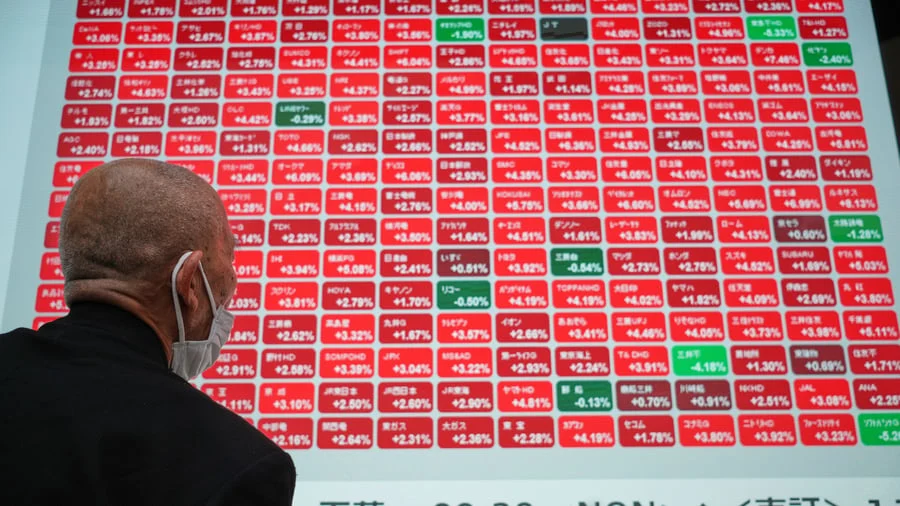
Asian stock markets experienced a significant upswing on Tuesday, mirroring the positive momentum seen on Wall Street. The optimistic sentiment was largely driven by a notable decline in oil prices and burgeoning hopes for a de-escalation of tensions in the Middle East. This shift in investor confidence followed a statement from U.S. President Donald Trump on Monday, indicating a temporary halt to further military strikes against Iran. The confluence of these factors provided a much-needed boost to market sentiment across the region.
Geopolitical Détente Fuels Market Optimism
The recent developments in the Middle East have significantly bolstered hopes for a swift resolution to the ongoing conflict, according to market analysts. Nick Twidale, Chief Market Strategist at ATFX Global, commented on the prevailing mood, stating, "The recent developments bring closer the hope for a swift end to the conflict in the Middle East." However, Twidale also cautioned about the potential for market overreaction. "The risk now is that markets may have moved too far and too fast," he noted. "Any hint of a breakdown in negotiations could lead to a significant price surge, as traders would quickly reprice the geopolitical risk premium."
The initial trigger for this renewed optimism was President Trump’s announcement on Monday that the United States would refrain from immediate further military action against Iran. This statement came after a period of heightened concern over potential escalation following incidents involving oil tankers and drone attacks in the strategically vital Strait of Hormuz, a key chokepoint for global oil supply. The U.S. had previously imposed sanctions and taken a more assertive stance, leading to anxieties about a wider regional conflict that could disrupt energy markets. Trump’s measured response, at least for the time being, has provided a critical window for diplomatic efforts and has been interpreted by many as a sign of a more cautious approach.
Investors Eye U.S. Inflation Data Amidst Market Volatility
Investors in Asian markets are also closely monitoring upcoming U.S. inflation data. These figures are expected to provide crucial insights into the future direction of interest rates by the U.S. Federal Reserve. Persistent inflation concerns have been a backdrop to global market sentiment, with the potential for interest rate hikes influencing investment decisions across asset classes.
Kazuaki Shimada, Chief Strategist at IwaiCosmo Securities, described the recent gains in the Nikkei index as a "surprise." He elaborated, "The gains were limited, however, as investors were reluctant to bet on the Nikkei surpassing the 61,000-point mark." This indicates a degree of caution among investors, who are not yet fully convinced of a sustained rally and are seeking further confirmation from economic indicators.
The Nikkei experienced a sharp decline of nearly six percent on Friday, a move that had unsettled markets. This downturn was partly attributed to concerns surrounding artificial intelligence (AI) stocks. Following the midterm elections in the U.S., where Democrats achieved a significant victory, there were worries that the U.S. Congress might curb investments in AI. This sentiment had a ripple effect on technology-focused companies, including those in Asia that are heavily invested in or supply components to the AI sector.
Key Sectors See Mixed Performance Amidst Shifting Sentiments
Despite the broader market uplift, individual sector performance showed a varied picture. Among the notable gainers in Asia were technology investor SoftBank Group, which saw its stock surge by an impressive 13.9 percent. Semiconductor giants Advantest and Tokyo Electron also registered significant gains, rising by 4.93 percent and 4.6 percent, respectively. The Japanese memory chip manufacturer Kioxia experienced a remarkable jump of 9.2 percent.
These gains in the technology and semiconductor sectors occurred even as Nvidia, a leading U.S. chip designer, saw its shares fall by 4.2 percent overnight on Wall Street. This decline in Nvidia’s stock was reportedly linked to a controversy involving its CEO, Jensen Huang. However, Shimada from IwaiCosmo Securities suggested that the market’s perception of this issue might be localized. "The market sees the impact of the issue as being limited to Nvidia so far, rather than affecting the broader industry," he stated. This suggests that while Nvidia’s specific situation might be a concern, the underlying demand for AI-related products and technologies remains robust, allowing other players in the sector to benefit from the overall market optimism.
On the downside, automotive giant Toyota Motor recorded a loss of 0.8 percent, while soy sauce producer Kikkoman saw a more substantial decline of 10.7 percent. These movements highlight that the market’s focus is not solely on geopolitical events, but also on company-specific news and sector-specific trends.
China’s Export Surge Driven by AI Product Demand
In a significant development that underscores the global impact of technological advancements, China’s exports experienced a substantial surge in October, largely propelled by a booming demand for artificial intelligence (AI) products. According to data released by the General Administration of Customs on Tuesday, outbound shipments rose by an impressive 35.2 percent compared to the same month last year. This figure surpassed the expectations of Reuters-polled economists, who had forecast an increase of 33.5 percent.
Even more striking was the performance of China’s imports, which surged by a remarkable 41.6 percent. This significantly outpaced the 32 percent growth anticipated by analysts. This robust import growth suggests a strong domestic demand within China, potentially driven by the very industries that are fueling its export boom. For context, in September, China’s exports had grown by 36.3 percent, and imports by 31 percent, indicating a sustained period of strong trade performance.
This sustained export growth has placed China’s trade surplus on track to exceed one trillion U.S. dollars for the second consecutive year. This significant surplus is a testament to China’s growing role as a global manufacturing hub and its increasing dominance in key technological sectors. The demand for AI-related products, ranging from advanced semiconductors to AI-powered consumer electronics and industrial equipment, appears to be a major driver of this export performance. As global companies increasingly integrate AI into their operations and product offerings, China’s manufacturing capabilities have positioned it to be a primary supplier.
Analysis of Implications: A Delicate Balancing Act
The current market environment presents a delicate balancing act for investors. The easing of geopolitical tensions in the Middle East has provided a much-needed reprieve, allowing markets to focus on economic fundamentals. The decline in oil prices, directly linked to reduced fears of supply disruptions, is a positive development for economies worldwide, potentially curbing inflationary pressures and boosting consumer spending.
However, the cautionary notes from market strategists about the speed and extent of market movements are valid. Geopolitical situations can change rapidly, and any renewed flare-up of tensions could quickly reverse the current optimism. The market’s sensitivity to such events means that a substantial geopolitical risk premium could be swiftly reintroduced.
Furthermore, the upcoming U.S. inflation data will be a critical determinant of future monetary policy. If inflation proves to be more persistent than anticipated, it could lead to more aggressive interest rate hikes by the Federal Reserve, potentially dampening global economic growth and impacting asset prices. The interplay between geopolitical stability, inflation trends, and central bank policies will continue to shape market sentiment in the coming weeks and months.
The robust performance of China’s exports, particularly in AI-related products, highlights a significant structural shift in the global economy. It underscores the increasing importance of technology and innovation in driving international trade. While this presents opportunities for growth, it also raises questions about global supply chain resilience and the concentration of manufacturing in specific regions. The sustained strong trade surplus for China also has implications for global trade balances and currency valuations.
In conclusion, the Asian markets’ positive performance on Tuesday reflects a complex interplay of factors. While the de-escalation of geopolitical tensions and robust Chinese trade data provide a strong foundation for optimism, underlying economic uncertainties and the potential for renewed volatility mean that investors will need to remain vigilant and closely monitor evolving global dynamics. The coming period will likely be characterized by a careful navigation of these competing forces as markets seek a clearer path forward.
