

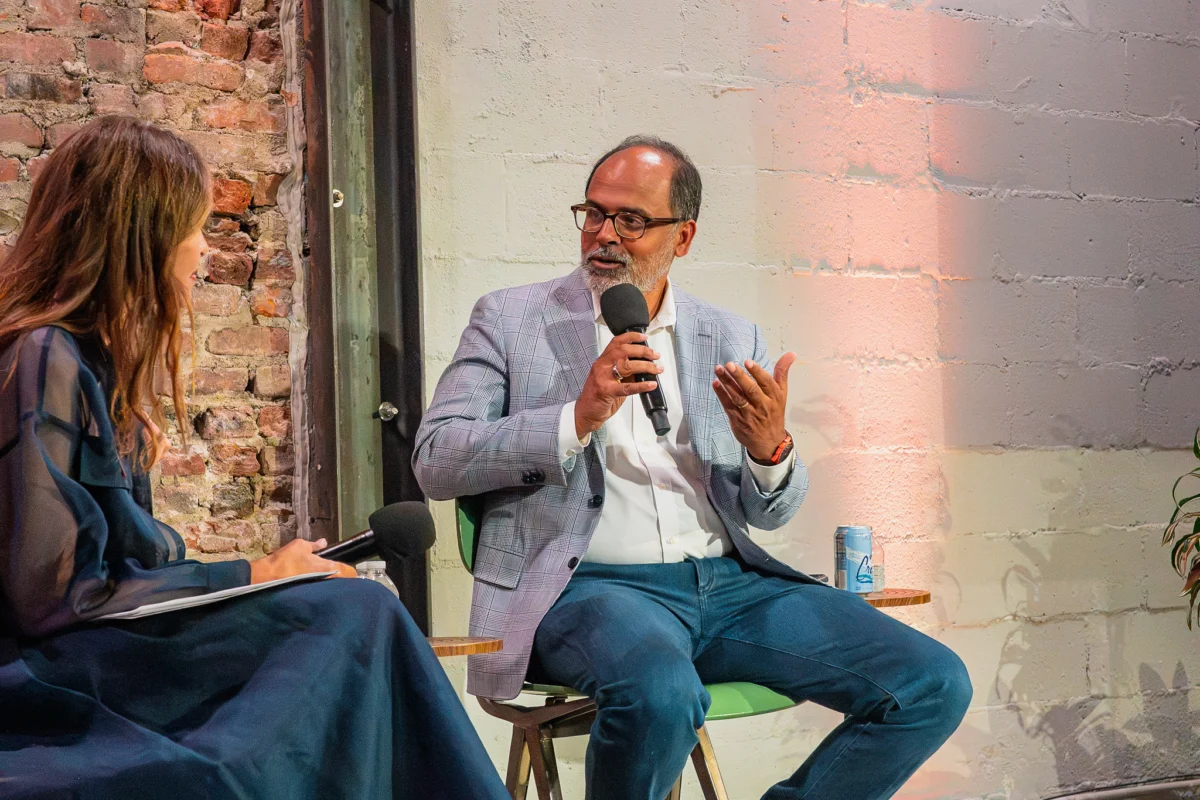
Deven Parekh, a driving force behind the formidable investment firm Insight Partners for 26 years, offered a rare glimpse into the strategies and philosophies that have cemented the firm’s status as a venture capital heavyweight. In a candid sit-down with TechCrunch at its prominent StrictlyVC event held on Thursday night in New York, Parekh articulated Insight Partners’ distinctive approach: a preference for allowing its robust portfolio to speak for itself rather than engaging in the often-loud public discourse favored by many contemporary VCs. The discussion covered a broad spectrum of critical topics, from the existential risks and transformative potential of artificial intelligence to the firm’s diversified investment strategy, the evolving landscape of venture valuations, and the paramount importance of liquidity for limited partners (LPs).
Insight Partners: A Quiet Giant in the Venture Landscape
With an impressive $90 billion in assets under management, Insight Partners operates with a comparatively understated public profile, a deliberate choice, according to Parekh. "Every venture capitalist thinks they’re an expert on everything now – epidemiology during COVID, geopolitics during the Iran war. I’m not sure we’re all experts on everything," Parekh remarked, contrasting Insight’s philosophy with the increasing trend of VCs becoming public commentators. "Our attitude has been: Let the portfolio do the talking. We’re investing in founders and companies. We have to communicate enough that people know who we are, but our performance should speak for itself – and that’s driven by the portfolio, not by us being loud."
This philosophy underpins Insight Partners’ comprehensive investment strategy, which spans early-stage, growth equity, buyouts, and secondaries. Rather than adhering to fixed allocations, the firm’s approach is temporal and global, adapting to market conditions. Parekh explained that analyzing their last seven funds would reveal varying percentages across investment stages. For instance, the current high-interest rate environment, unreceptive debt markets for software, and reduced exit multiples have made major buyouts less attractive, with Insight not having executed a significant buyout since 2024. This strategic flexibility allows Insight to pivot and capitalize on opportunities across the market cycle.
AI: Balancing Transformative Potential with Emerging Risks
The conversation delved deeply into the prevailing discourse surrounding artificial intelligence, particularly the recent concerns voiced by researchers regarding AI safety. Referencing Jacob Coxon, a former Anthropic researcher whose warnings about "self-improving AI" and potential catastrophic outcomes made headlines, Parekh shared his perspective, aligning it with that of fellow VC Keith Rabois, who had dismissed the researcher’s concerns earlier at the event.
Parekh acknowledged the inherent risks associated with advanced AI, such as the potential for non-state actors to leverage open-source models for biological weapons. However, he emphasized a more optimistic outlook, highlighting the profound positive societal impacts. "There’s an even higher probability we get a massive decrease in the time it takes to develop new drugs and cure diseases. I’ll take that bet," he asserted. Drawing on his experience as a board member at NYU Langone, Parekh cited AI’s "amazing" capabilities in processing patient data, enabling predictions like a 25% chance of a heart attack for an unsuspecting patient.
He contextualized AI risks within a broader historical framework, noting that "every generation has new risks, and somehow, over time, the world still raises living standards." Furthermore, he underscored AI’s critical role in addressing future societal challenges, particularly in healthcare. "We’re going to need AI to scale healthcare – the population is aging and there aren’t enough medical professionals to go around." This balanced view positions AI as a powerful tool for progress, albeit one that requires careful management of its inherent challenges.
Navigating the Volatile Venture Landscape: Valuations and Geographic Shifts
Parekh expressed concerns about the current trajectory of venture valuations, drawing parallels to the frothy market conditions of 2021, which "didn’t end well." He noted that while follow-on rounds traditionally command higher prices due to increased data and reduced risk, the rapid pace of current deals often means "almost no incremental data, so you’re paying more without reducing risk."
Insight’s strategic response to this environment has been to increasingly "go earlier," leveraging its "scale fund" to make smaller initial bets – typically $20-25 million checks instead of $500 million – and then aggressively doubling down on successful ventures. The firm’s investment in Wiz serves as a prime example: "With Wiz, we wrote a Series A and kept writing checks, so our gain was much larger than if we’d stopped at the first check. And if Wiz hadn’t worked out, it would have barely dented a fund our size," Parekh explained. This strategy allows for significant upside capture while mitigating the downside risk associated with individual early-stage investments.
The discussion also touched upon the evolving geographic distribution of talent. While Parekh believes that "talent has gone flat globally," allowing Insight to pursue opportunities like Legora in Stockholm (ultimately lost to General Catalyst), he observed a unique concentration of AI infrastructure talent in San Francisco. This observation was reinforced by his 23-year-old son, also a VC, who is relocating to the Bay Area, convinced that "you can’t invest in AI without being there." However, Parekh noted that talent density varies by vertical, citing Ramp as a financial services company with talent concentrated in New York, suggesting that "vertical AI investing can be more geographically diverse than pure AI infrastructure."
Competitive Investments and the Ethics of Rival Holdings
A particularly intriguing aspect of Insight Partners’ portfolio is its investment in rival AI powerhouses, OpenAI and Anthropic, a practice that was once considered taboo in venture capital. Parekh clarified that the internal debate was less about the conflict itself and more about the stage of investment. "It’s very stage-dependent," he explained. "Khosla did OpenAI’s Series A, and there’s no way they could have then invested in Anthropic, and if we’d done Anthropic’s Series A, we likely couldn’t have done OpenAI either."
Parekh argued that at later stages, without board representation or governance control, investing in competing companies effectively becomes "just buying a great stock." He posited that OpenAI was initially seen as the dominant consumer play and Anthropic as having a clear enterprise strategy, though this distinction is "shifting in real time." The sheer scale of capital required by these companies – needing to raise $30-100 billion – means they "stopped being able to dictate exclusivity." He emphasized that at the Series A/B stage, Insight maintains strict information-sharing restrictions and avoids investing in directly competing entities, though he acknowledged that "some founders are sensitive even to 2% revenue overlap."
Looking ahead, Parekh shared Insight’s cautious stance on "physical AI" or robotics, which he described as "still largely science projects." While acknowledging their potential to become real businesses, he noted that such investments involve a dual bet: "on when robotics adoption happens, layered on top of a bet on whether it happens at all." For now, Insight is "watching, but we’re not there yet."
Concentration Risk, Liquidity, and the IPO Wave
The conversation addressed the growing concern among LPs regarding concentration risk, especially given that OpenAI and Anthropic reportedly absorbed roughly half of all VC dollars in the first half of the year. Parekh confirmed that Insight is "not overly concentrated," thus it’s not an issue for their firm. However, as an LP in other funds, he revealed hearing pitches for funds "raising their entire fund in a month" with a literal pitch of "35-40% of this fund is going into one of those two companies." While he doesn’t doubt the potential of these companies, he stressed that "this business has always rewarded diversification over a long horizon." For a firm like Insight, on its 13th fund, the perspective is "in terms of ten funds, not one." While concentrated strategies employed by firms like Founders Fund and Thrive have yielded exceptional results, Parekh underscored that they remain "exceptions who execute that well."
A critical theme that emerged was the importance of liquidity for LPs, measured by Distributed to Paid-in Capital (DPI). Parekh warned that "many first- and second-time funds won’t raise a next fund because they didn’t prioritize liquidity." He advises fund managers to "take your basis out anyway" even if an investment is projected to triple further, because "LPs want to know you can turn positions into cash; that’s the job." Insight itself, as one of the largest LPs in its own funds, was "guilty of this early on," but has since prioritized liquidity, returning "more than $20 billion to LPs through strategic sales and IPOs" over the past two years, with several billion more anticipated.
This focus on liquidity aligns with the thesis put forth by VC Elad Gill, who argues for a "narrow window" – perhaps 6 to 12 months – during which a company’s valuation may never be higher, and founders should consider selling. Parekh confirmed that Insight "always having that conversation" with founders, though he humorously noted, "founders listen to me about as much as my kids do." He advises de-risking by selling 10 or 20% when offers come at "frothy valuations," cautioning that while "valuations are rising so fast people assume the trend continues, you can’t compound $40 billion at 50% every two months for two years without becoming the world economy. That math doesn’t work."
The impending IPOs of Anthropic and OpenAI, with SpaceX also expected to go public within a similar timeframe, represent a significant moment for the industry. Parekh highlighted Anthropic’s remarkable growth, surpassing Salesforce in valuation at just four years old. While these behemoth IPOs (each potentially north of a trillion dollars in market cap) are expected to be absorbed by the market, the real question for the industry, according to Parekh, is "when the next tier of companies goes public, and what bar that sets." He anticipates "more of these IPOs over the next 18 months," suggesting a re-calibration of public market expectations.
The Inevitable Boom-Bust Cycle and Strategic Portfolio Management
The cyclical nature of capital flows in venture capital was another point of reflection. Parekh likened LP behavior to individual investors: "We all do this in our personal lives – stay out of an expensive market until we can’t stand it anymore, and pile in right when we should be pulling back." He noted that "everyone wanted in before 2021, pulled back after, and now the same LPs are piling back in," driving a boom-bust cycle that is "hard to avoid." This dynamic has led to the proliferation of mega venture-growth funds, with $6 to $10 billion funds becoming common where they were once rare.
In terms of portfolio management, Parekh discussed the varied timelines for investments, from rapid successes like Wonderful (an enterprise AI agent platform that reached a $5 billion valuation in less than two years) to 2021 investments that took "three or four years before finding product-market fit." Insight conducts rigorous portfolio reviews, examining hundreds of companies over several days, not just focusing on large positions but actively seeking "inflection points worth doubling down on, buying secondary in, or in some cases pulling back from."
The story of Armis, a security company, perfectly illustrates Insight’s flexible and persistent strategy. Initially losing the deal to Sequoia, Insight maintained the relationship with a small $5 million check. Eighteen months later, they acquired the entire cap table, including Sequoia’s stake, for a nine-figure sum, eventually selling Armis to ServiceNow for $7 billion. This exemplifies Insight Partners’ core philosophy: "Sometimes you make money with small checks, sometimes with big ones. The goal is finding the best founders in the best markets."
Parekh’s insights at the TechCrunch StrictlyVC event painted a comprehensive picture of a firm that, despite its immense scale, remains grounded in a pragmatic, performance-driven approach. In an era where venture capital often conflates public presence with success, Insight Partners continues to prove the enduring power of quiet conviction and strategic diversification.
