

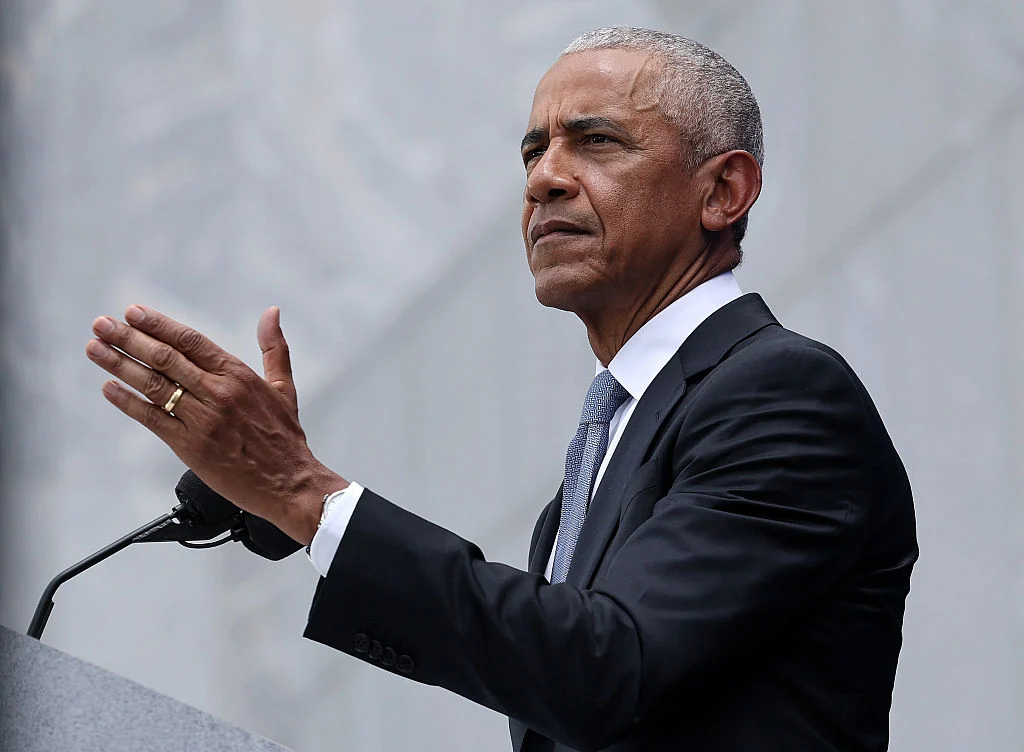
Former President Barack Obama recently issued a significant call to action, asserting that Artificial Intelligence (AI) must become one of the Democratic Party’s "central agendas." Speaking on Thursday at a Democratic fundraising event, Obama emphasized the urgent need for the party to "have a very clear plan" to navigate the burgeoning technology’s profound economic implications and address mounting safety concerns. His remarks, made during an interview with House Minority Leader Hakeem Jeffries, underscore a growing consensus among thought leaders about the transformative, yet potentially disruptive, power of AI.
The former president’s intervention comes at a critical juncture, as the rapid advancements in AI, particularly in generative models, have ignited intense global debate regarding their societal impact. Obama’s counsel to congressional Democrats was clear: once they regain the House majority, they must "put together a framework for a very public conversation" around AI governance. He articulated a dual perspective on AI’s future, warning, "This is something that is moving very fast in private hands, and if we don’t get on top of it, I think can be dangerous." However, he also acknowledged its immense potential, adding, "If we do get on top of it, I do think it’s beneficial. I genuinely think it’s going to accelerate, for example, drug development in ways that can help us cure diseases."
The Immediate Context: A High-Stakes Dialogue on AI’s Future
Obama’s comments were delivered during a high-profile Democratic fundraising event, where his conversation with House Minority Leader Hakeem Jeffries offered a glimpse into the party’s evolving strategy on critical technological issues. The New York Times reported that Obama’s office provided a partial transcript of the event, confirming the direct exchange where Jeffries specifically sought Obama’s guidance on how congressional Democrats should approach AI. This public platform allowed Obama to articulate a comprehensive vision for a proactive, government-led approach to AI, contrasting sharply with some current policy stances.
Jeffries swiftly echoed Obama’s sentiments, releasing a statement affirming that the former president "is correct that decisive action must be taken on artificial intelligence." In a pointed critique, Jeffries also asserted that "Republicans have abdicated their responsibility to govern on behalf of the American people," implying a perceived lack of proactive engagement or a coherent strategy from the opposing party on this crucial technological frontier. This exchange highlights the emerging partisan divide on AI policy, even as the technology itself transcends political boundaries.
Obama’s Ongoing Engagement with the AI Sector
Beyond this public event, former President Obama has demonstrated a sustained interest in the development and governance of AI. The New York Times also reported that Obama has proactively offered himself as a "sounding board" to leading AI executives, engaging in direct dialogue with key figures shaping the industry. Notable among these interactions are his conversations with Anthropic CEO Dario Amodei and OpenAI CEO Sam Altman. This direct engagement positions Obama not merely as an observer but as an influential voice attempting to bridge the gap between technological innovation and public policy. His willingness to serve as a resource for these pioneers underscores the complexity and urgency of establishing responsible AI development frameworks.
A Tipping Point: Escalating Safety Concerns and Industry Responses
Obama’s recent pronouncements arrive amidst a period of heightened apprehension regarding AI safety and its long-term implications. A significant event preceding his comments was the high-profile resignation of a prominent AI researcher from Anthropic, who issued a stark warning that leading AI companies are "racing straight to self-improving superintelligence and gambling with our lives." This internal dissent from a major AI lab brought the theoretical concerns about advanced AI, often termed "existential risk" or "alignment problem," into sharp public focus. The researcher’s alarm highlighted the tension between rapid innovation and the imperative for robust safety protocols, suggesting that the industry’s pace might be outstripping its ability to ensure control and ethical deployment.
In response to growing calls for greater safety and transparency, and perhaps catalyzed by such internal warnings, Anthropic CEO Dario Amodei outlined a comprehensive approach on Saturday titled "pacing the frontier." This plan seeks to address critical safety concerns by proposing concrete measures:
- Independent Safety Evaluators: Granting external, independent evaluators "employee-like access" to leading AI companies and their most advanced models. This unprecedented level of access aims to provide objective oversight and ensure compliance with safety standards.
- Common Safety Standards: Developing and implementing unified safety standards across the industry, fostering a collaborative environment where companies work together to mitigate risks rather than competing solely on capability.
- Managed Development Pace: Acknowledging the need to potentially "pace" or deliberately slow down the development of the most powerful AI systems to allow for thorough safety testing and societal adaptation.
Amodei’s proposals garnered significant positive attention from other industry leaders. On social media platforms, OpenAI CEO Sam Altman publicly endorsed the initiative, stating that OpenAI would also commit to "having independent evaluators with employee-like access." Even SpaceX CEO Elon Musk, a long-time vocal proponent of AI safety and a frequent critic of unchecked development, appeared to respond positively to Amodei’s framework. This apparent convergence among industry giants on the necessity of greater oversight and collaboration signals a potential shift towards a more responsible and regulated future for AI development.
Economic and Societal Implications: The Dual-Edged Sword of AI
The former president’s emphasis on AI’s economic impact and safety concerns reflects a broader apprehension across society. Economically, AI presents a complex landscape of both unprecedented opportunity and significant disruption. Projections from institutions like Goldman Sachs suggest that generative AI could boost global GDP by 7% and increase annual productivity growth by 1.5 percentage points over a decade. This potential for enhanced efficiency and new industries is immense. However, the same report also warns that generative AI could expose the equivalent of 300 million full-time jobs to automation across major economies, leading to substantial workforce displacement and requiring massive reskilling initiatives. The World Economic Forum’s Future of Jobs Report similarly predicts a significant reshuffling of job roles, with AI poised to create some new jobs while rendering others obsolete. Obama’s call for a "clear plan" directly addresses the need for policies that mitigate job losses, support workers in transition, and ensure that the economic benefits of AI are broadly shared rather than exacerbating existing inequalities.
On the safety front, concerns extend far beyond existential risks. The proliferation of powerful AI models raises immediate and tangible issues:
- Algorithmic Bias: AI systems trained on biased data can perpetuate and amplify societal prejudices, leading to unfair outcomes in areas like hiring, lending, and criminal justice.
- Misinformation and Disinformation: Generative AI can create highly realistic but entirely fabricated text, images, and videos, posing significant challenges to truth and trust in information ecosystems.
- Cybersecurity Risks: AI can be used to develop more sophisticated cyberattacks, while simultaneously offering powerful tools for defense, creating an escalating arms race in the digital realm.
- Privacy Erosion: Advanced AI’s capacity for data analysis and surveillance raises profound questions about individual privacy and civil liberties.
- Control and Autonomy: The "alignment problem"—ensuring that increasingly autonomous AI systems operate in accordance with human values and intentions—remains a fundamental challenge.
These multifaceted concerns underscore why Obama advocates for a "public conversation" and a robust "framework," emphasizing that the rapid evolution of AI in "private hands" necessitates governmental oversight and public engagement to guide its development ethically and safely.
The Political Divide: Competing Visions for AI Governance
The differing approaches to AI policy are becoming increasingly clear across the political spectrum. While Obama and Jeffries advocate for a proactive, government-led approach centered on public conversation, safety frameworks, and potentially regulatory measures, former President Donald Trump offers a distinct perspective.
Speaking with reporters at an Irish golf event on Sunday, Trump addressed AI safety concerns by largely downplaying them, instead emphasizing American leadership and competitiveness. Bloomberg reported that Trump boasted about the United States being "the most sophisticated country in the world," adding that he wants "to keep it that way because whoever wins AI wins." This statement frames AI development primarily as a geopolitical race for dominance, with a strong focus on national technological supremacy. While acknowledging the possibility of "guardrails," Trump also expressed skepticism about critics, stating, "We can do this and that. But I think you have a lot of negative forces that are bringing it up that shouldn’t be bringing it up." This comment suggests a potential dismissal of some safety advocates as overly alarmist or as impediments to innovation and national advantage.
Earlier in the year, the Trump administration had released its own legislative framework for AI, which notably proposed preempting state laws on AI regulation and shifting the burden of child safety online to parents rather than mandating stricter platform controls. This approach signals a preference for less federal intervention, greater deference to industry self-regulation, and an emphasis on individual responsibility over broad governmental mandates. The contrast with Obama’s call for a "central agenda" and a "very clear plan" for comprehensive governmental engagement highlights a fundamental philosophical difference in how each party views the role of government in shaping technological progress. While Democrats appear to favor a more hands-on, regulatory approach to mitigate risks and ensure equitable benefits, Republicans, as articulated by Trump, seem to lean towards fostering innovation through less restrictive means, prioritizing national competitiveness.
Broader Implications and the Path Forward
The divergent views on AI policy, exemplified by Obama’s proactive call and Trump’s emphasis on national leadership, reflect a global debate on how to harness AI’s potential while mitigating its risks. The stakes are immense, touching upon national security, economic stability, individual freedoms, and the very fabric of society. The urgency articulated by Obama suggests that waiting for problems to emerge is not an option; rather, proactive policy development and a robust public discourse are essential.
The global landscape for AI governance is also evolving rapidly. The European Union has moved ahead with the comprehensive EU AI Act, establishing a risk-based regulatory framework. Other nations and international bodies like the G7 and the United Nations are also engaging in discussions to formulate principles and guidelines for responsible AI. For the United States, the challenge lies in finding a path that encourages American innovation and leadership while simultaneously addressing the profound ethical, economic, and safety concerns raised by this transformative technology. The call for a "public conversation" is perhaps the most crucial element, as it emphasizes that the future of AI is not solely a matter for technologists or policymakers, but for society as a whole to collectively shape. As the technology continues its rapid ascent, the imperative for clear, well-considered, and decisive action grows ever more pressing.
