

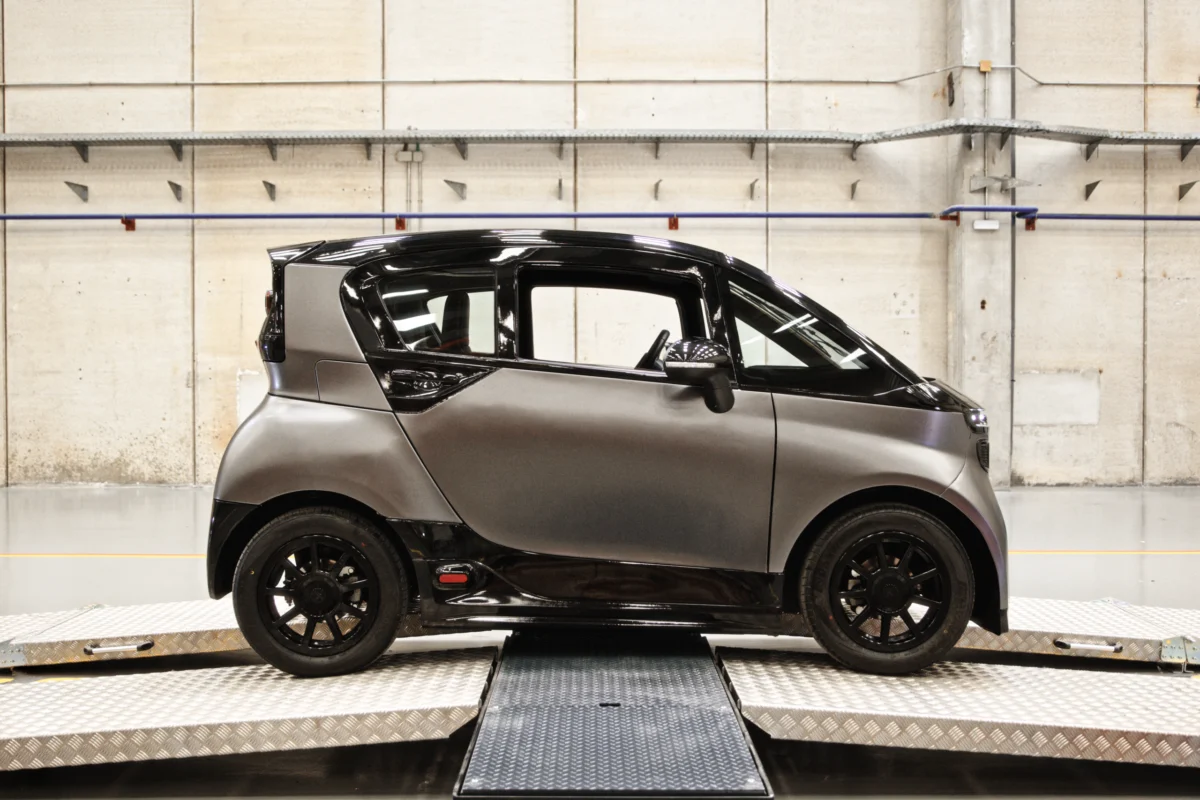
The urban landscapes of Europe are undergoing a profound transformation, with city dwellers increasingly opting for smaller, more agile vehicles to navigate congested streets and embrace sustainable mobility. This burgeoning appetite for microcars, once characterized by quaint Italian "yoghurt pots," has recently seen a significant shift, with the market largely ceding ground to a new wave of small electric vehicles (EVs predominantly from China. Even iconic ultracompact car brands like Smart, a pioneer in urban mobility, have relocated manufacturing to China, signaling a broader trend of production migration to Asia. Against this backdrop, a Spanish startup, Liux, is boldly stepping into the crowded market, not merely to compete, but to redefine the segment with its upcoming microcar, the Liux Big, built with an unwavering commitment to sustainability and a unique European identity.
The Evolving Landscape of European Urban Mobility
Europe’s dense cities, stringent emission regulations, and premium on parking space have long fostered a demand for compact vehicles. However, the advent of electric vehicle technology has catalyzed a new era for microcars, moving beyond traditional internal combustion engine (ICE) models to embrace zero-emission powertrains. This shift has coincided with a surge in offerings from Asian manufacturers, particularly those from China, which have leveraged their robust EV supply chains and cost-effective production capabilities to capture a substantial share of the burgeoning European micro-EV market. The rapid market penetration of these models, often offering competitive pricing and adequate urban range, has presented a formidable challenge to established European players and new entrants alike.
The transition of manufacturing hubs, exemplified by Smart’s move, underscores the globalized nature of the automotive industry and the economic pressures driving production decisions. While European brands continue to innovate, the reality of fully integrated, continent-wide supply chains remains a complex aspiration. It is within this intricate global web that Liux co-founder Antonio Espinosa de los Monteros made a striking observation to TechCrunch: "The idea of a European car does not exist." This statement, coming from the CEO of a startup making headlines for its "made in Spain" credentials, initially appears counterintuitive. However, it reveals a pragmatic understanding of the modern automotive ecosystem and Liux’s strategic approach to navigate it while upholding its core principle of sustainability. The company acknowledges that a completely sovereign European supply chain, especially for critical components like batteries, is currently unattainable. Instead, Liux aims to achieve sustainability and localized value creation within the existing global framework.
Liux’s Vision: Sustainability as a Strategic Imperative
Following in the innovative tracks of companies like Switzerland’s Microlino, Liux is carving out its niche with a distinct philosophy. The name of its upcoming microcar, the "Liux Big," is a deliberate irony. While physically small enough to park at a right angle to the curb, its moniker also reflects the oversized ambitions of a team determined to challenge conventions. This ambition extends beyond mere size, encompassing a holistic vision for environmental responsibility and localized economic impact.
The significance of Liux’s endeavor is underscored by its establishment of Spain’s first new car plant in over 30 years. This investment in domestic manufacturing represents a symbolic and tangible commitment to rejuvenating European industrial capacity in a sector increasingly influenced by global shifts. The facility, located in Azuqueca de Henares, approximately an hour’s drive from central Madrid, is more than just a production site; it’s a statement about the potential for localized, sustainable automotive production within Europe.

Liux’s "north star" is sustainability, a guiding principle that permeates every aspect of its design and manufacturing process. While acknowledging the current necessity of sourcing some components, such as batteries, from outside Europe, Liux has engineered its vehicle for maximum environmental benefit throughout its lifecycle. The Liux Big’s batteries, for instance, are designed not only for efficient charging but also for home integration, including compatibility with power generated from solar panels, promoting decentralized, renewable energy use. Furthermore, the vehicle is conceived for ease of maintenance, a direct counter to the planned obsolescence cycles prevalent in much of the modern automotive industry. This design choice aims to extend the car’s lifespan, reducing waste and resource consumption associated with frequent replacements.
Perhaps the most notable innovation lies in the Liux Big’s fiber body, crafted from a novel linen-based biocomposite. This pioneering material is not only derived from renewable resources but is also specifically engineered for ease of extraction and recycling at the end of the vehicle’s life. Espinosa elaborates on this commitment to circularity: "One thing that’s very clear for David and me is that recycling isn’t just a lab concept. You can recycle almost anything in a lab. What makes something recyclable has to do with how it’s built. When you build something, you have to try to preserve the integrity of the material and the components so that a second life is possible." This philosophy contrasts sharply with the complex, multi-material structures of many conventional vehicles, which often make comprehensive recycling challenging and uneconomical.
From Auara to Automotive: The Founders’ Journey and Strategic Pivot
The driving force behind Liux is a dynamic duo with complementary expertise. Antonio Espinosa de los Monteros brings a deep understanding of circular economy principles, honed during his previous venture, Auara. As co-founder of this Spanish B Corp, Espinosa championed the sale of natural mineral water in bottles that were both recycled and recyclable, achieving significant success before the brand was acquired by a larger entity, Corporación Hijos de Rivera. This experience instilled in him the practical challenges and rewards of implementing real-world circularity.
David Sancho, Liux’s other co-founder, is the engineering mastermind, specializing in electric vehicles capable of rivaling their gas-powered counterparts. His impressive portfolio includes the Bóreas, a hybrid supercar unveiled at the prestigious 24 Hours of Le Mans in 2017. This background highlights Sancho’s prowess in high-performance automotive design and engineering, a skill set he now applies to the unique constraints of microcars. After a professional divergence from his former partners, Sancho joined forces with Espinosa, pooling their diverse talents to establish Liux.
Their initial prototype, "The Animal," unveiled in 2022, was an ambitious fully electric five-seater SUV crafted almost entirely from recycled or plant-based materials. While innovative, the co-founders soon recognized that their odds of achieving Europe-wide homologation – the rigorous certification process required for vehicles to be sold across the continent – would be significantly higher with a smaller, more focused product. This pragmatic assessment led to a strategic pivot, shifting their focus from the larger SUV to the microcar segment, culminating in the development of the Liux Big. This decision reflects a keen understanding of market realities and regulatory pathways, prioritizing successful market entry and scalability.
Production Readiness and Market Entry
Fast forward to 2026, and Liux has achieved a critical milestone: Europe-wide homologation for the Liux Big. This certification paves the way for commercial sales, which the company anticipates will commence in the first half of the following year, likely 2027. The intervening period has seen Liux expand its operations significantly, growing its team to 65 employees and preparing to ramp up production across its three facilities in Spain.

The factory in Azuqueca de Henares, where TechCrunch conducted its visit, exemplifies Liux’s lean manufacturing philosophy. Beatriz Belda González, the Spanish-born engineer heading production, a veteran of BMW in Munich, explains that the plant, though modest in size, operates on principles inspired by Toyota’s "lean management." This approach focuses on efficiency and waste reduction, with the factory performing only the final assembly stages. Despite its compact footprint, Liux projects an impressive production capacity, aiming to reach 20,000 cars annually by 2030. This target, if achieved, would establish Liux as a significant player in the European microcar market.
The initial market response suggests considerable interest. More than 7,500 individuals have already joined the waiting list for a Liux Big. While joining does not require a fee, the list has provided valuable demographic insights for the startup. The most common profile among prospective buyers is a city dweller aged 55 to 60, indicating that the Liux Big will often serve as a household’s second car. This finding helps Liux refine its marketing strategies and product positioning.
Market Positioning and Value Proposition
The projected price tag for the Liux Big is set to be below €18,000 (approximately $21,000) before any potential EV subsidies. This positions it at the higher end of the microcar price spectrum, which includes more basic models like the Citroën Ami (starting around €7,990) or the Microlino (starting around €17,990). Liux aims to justify this premium through its superior sustainability credentials, enhanced safety features, and a more "car-like" driving experience that distinguishes it from more utilitarian micro-mobility solutions.
Espinosa acknowledges that while microcars might not entirely disrupt traditional car ownership patterns overnight, Liux is strategically picking its battles. Rather than attempting to predict the future trajectory of the market, the company is maintaining flexibility, keeping open the possibility of partnerships with B2B fleet management companies and firms specializing in autonomous vehicle technology. Such collaborations could unlock new avenues for growth and expand the utility of the Liux Big beyond private ownership.
Innovating Beyond Microcar Constraints
The microcar category, particularly the L7e classification (heavy quadricycles), presents unique engineering challenges related to weight and size limitations. Celso Fernández Llorens, Liux’s head of R&D, notes that despite these constraints, and the European authorities’ differentiation between ultralight L6e and slightly heavier L7e four-wheelers, many microcars remain fairly similar in design and functionality. Liux, however, has consciously pushed the boundaries of its L7e homologation to maximize utility and user experience.
Through a series of ingenious design decisions, Liux has managed to integrate a surprisingly spacious 260-liter trunk into the Liux Big, a significant advantage for urban errands and short trips. More broadly, the engineering efforts have focused on ensuring that users feel they are driving a legitimate car, rather than a mere two-wheeler. This focus extends crucially to safety. Sancho emphasizes that lightweight design should never compromise structural integrity, particularly concerning crashworthiness or vehicle stability during maneuvers.

Despite the fact that the L7e category does not mandate crash tests, Liux has proactively subjected the Liux Big to extensive testing, showcasing its capabilities in maneuvers such as slalom, braking, and general handling. TechCrunch was given a firsthand demonstration during a short ride and test drive of an upcoming off-road version, attesting to the vehicle’s robust performance characteristics. This voluntary commitment to safety testing underscores Liux’s dedication to delivering a high-quality, secure product that instills confidence in its drivers.
Future Outlook and Brand Identity
Liux’s initial model will be available in two urban versions: 15 kWh and 20 kWh, offering different ranges to suit varying user needs. A cargo version is also in the pipeline, catering to last-mile delivery services and businesses requiring compact utility vehicles. Given David Sancho’s background, the allure of developing a supercar remains a constant, albeit currently secondary, ambition. The company has explicitly stated on its LinkedIn page that it "doesn’t intend to be a one-car brand," hinting at a broader product roadmap in the future.
The €16 million (approximately $18.5 million) secured by Liux thus far, including vital European funding, will be instrumental in bringing the urban version of the Liux Big to market. The company plans to leverage partnerships with car dealerships across Europe to establish a robust sales and distribution network.
The Liux showroom itself offers a glimpse into the company’s meticulously crafted sales experience, as described by Ana Terrado Leyva, head of brand. Aesthetic choices like textile screens, interactive 3D models showcasing the Liux Big’s three color options (a notable expansion from Henry Ford’s "any color, as long as it’s black"), and a linoleum floor as a subtle nod to the linen-based biocomposite, all contribute to a distinct brand identity. These design elements are not merely decorative; they are strategic choices aimed at differentiating Liux from its predominantly Chinese competitors, emphasizing European design sensibilities, material innovation, and a holistic approach to sustainability.
In an era of increasing global homogeneity in manufacturing, Liux’s ambitious project represents a compelling counter-narrative. By focusing on sustainable materials, circular design principles, localized production, and a premium user experience, Liux is not just building a microcar; it is attempting to forge a new paradigm for automotive manufacturing in Europe. Perhaps, in the nuanced blend of global pragmatism and local innovation championed by Liux, the idea of a truly "European car," defined not by absolute sovereignty but by a distinctive commitment to values and quality, is indeed beginning to exist.
