

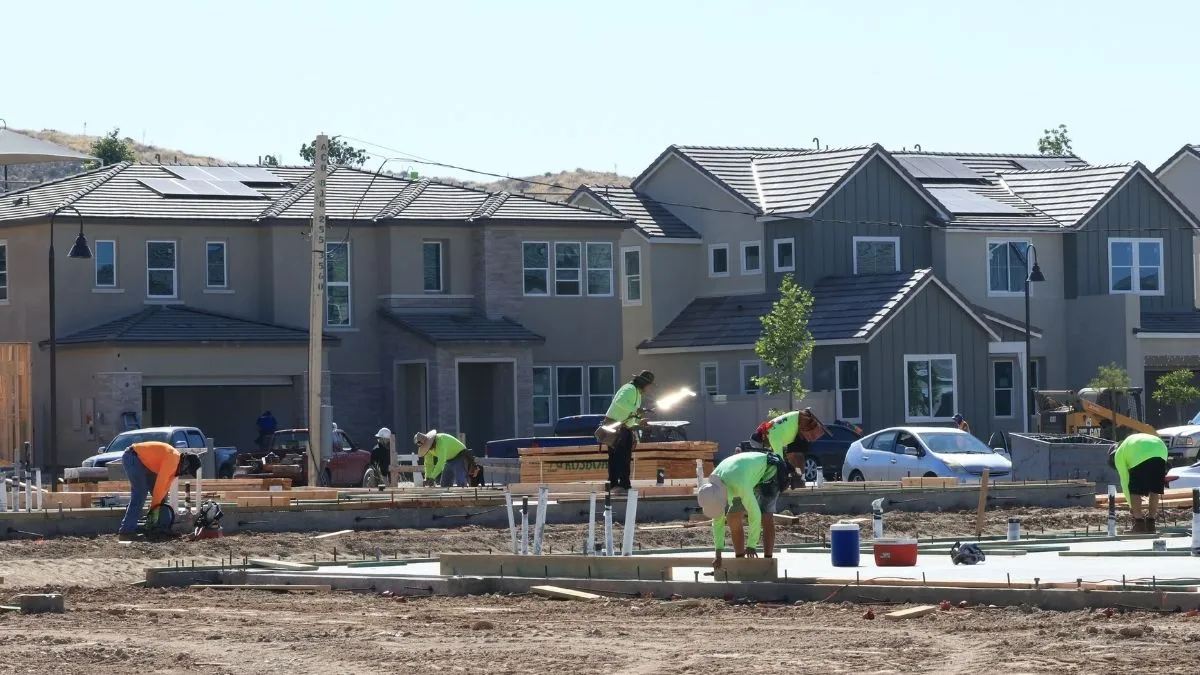
The residential construction industry is currently grappling with a wave of aggressive federal immigration enforcement that has disrupted job sites, inflated labor costs, and created an atmosphere of profound uncertainty across several U.S. markets. Earlier this week, an operation by U.S. Immigration and Customs Enforcement (ICE) at a construction site in Martinsburg, West Virginia, served as a stark illustration of an intensifying enforcement strategy that has left homebuilders struggling to maintain operations. According to eyewitness accounts from industry executives, the raid involved the use of drones and tactical equipment to secure the site, resulting in the detention of approximately 30 workers. This incident is not an isolated event but part of a broader, months-long escalation in enforcement that is pushing the American homebuilding sector to its financial and operational limits.
The impact of these operations is particularly acute in the Eastern Panhandle of West Virginia, a region roughly 60 miles northwest of Washington, D.C., which has seen a significant population influx in recent years. Builders in the area report that the frequency and intensity of raids have made it nearly impossible to staff essential trades. Many construction crews, fearing detention or profiling, have begun refusing to show up for work, causing a sharp contraction in the available labor pool. Despite repeated attempts by industry leaders to engage with state lawmakers and officials, the situation has continued to deteriorate, with executives describing the current environment as the most challenging they have faced in decades of development.
A Chronology of Escalating Enforcement
The current surge in ICE activity follows a specific timeline of policy shifts and funding increases throughout 2026. In January, the agency recorded 37,933 arrests, a figure that briefly stabilized in the following months as authorities recalibrated their field strategies. Between February and May, monthly arrests hovered around the 30,000 mark. However, the trajectory changed significantly in early June following the passage of a nearly $70 billion immigration enforcement bill by the U.S. Senate. This massive infusion of capital and resources provided the federal government with the mandate and the means to significantly expand field operations.
By June, monthly arrests climbed to 43,021, and by July, the figure reached a record-setting 49,571, according to data compiled by the Deportation Data Project at UC Berkeley and UCLA. The current administration has signaled that this is only the beginning, setting an internal target of 2,000 arrests per day. For the homebuilding industry—where immigrants comprise approximately 25% of the total workforce—this directive has translated into a direct hit on productivity. The enforcement has been most visible in states where local law enforcement agencies actively participate in the 287(g) program, a federal initiative that delegates immigration enforcement authority to state and local officers.
The Regional Impact: West Virginia and the Eastern Panhandle
In West Virginia, the enforcement strategy has evolved from periodic site visits to more systematic disruptions. Industry executives report that local sheriffs, state labor board officials, and federal agents are now coordinating efforts to monitor transit corridors. Checkpoints have been established at state borders and major intersections, specifically targeting vehicles associated with construction trades. This "dragnet" approach has had an immediate and cooling effect on the movement of labor across state lines.
The economic consequences for West Virginia builders have been severe. Framing costs, a major component of a home’s price, have reportedly tripled in the last 30 days. Subcontractors based in neighboring Maryland and Virginia are increasingly unwilling to cross the border into West Virginia, citing the risk of being detained for hours during routine traffic stops. Even delivery drivers transporting essential materials have been known to turn around at the state line rather than risk interaction with enforcement checkpoints.
To keep projects moving, some contractors have resorted to extreme and costly measures. These include flying in crews from as far away as Minnesota or Florida, providing them with hotel accommodations, and renting non-construction vehicles to transport them to sites to avoid detection. These "per diem" costs and logistical workarounds are being passed directly to the homebuilders, who are already struggling with high interest rates and a narrowing gap between construction costs and consumer affordability.
Profiling and the Human Cost of Enforcement
One of the most significant concerns raised by homebuilders is the reported lack of discernment in enforcement actions. While the stated goal of ICE is to target undocumented individuals, builders and contractors in Texas, Idaho, and Pennsylvania report that legal residents and even U.S. citizens are frequently caught in the crosshairs. There are numerous accounts of workers being detained for three to four hours simply because they did not have physical proof of residency on their person while working on a roof or a foundation.

In San Antonio, Texas, where nearly 1,600 workers were reportedly detained in a single week in July, the atmosphere has been described as one of "paralyzing fear." Nicholas Riley, owner of Driftwood Builders Roofing, noted that even his legal employees are reluctant to take jobs in certain areas. One of his workers, a legal immigrant, was recently held for several hours by authorities in San Marcos before being released. Such incidents leave workers "incredibly shaken," leading to a voluntary withdrawal from the workforce that further depletes the labor supply.
The fear is not limited to frontline laborers. Mario Guerrero, Executive Director of the South Texas Builders Association, recounted an instance where a female project manager—a U.S. citizen—was detained by ICE agents during a site visit. This pattern of what builders describe as profiling has created a "fragile" labor market where the loss of even one or two specialized workers can halt an entire project.
Economic Implications and Market Instability
The disruption of the construction labor force arrives at a time when the U.S. housing market is already under significant pressure. The shortage of skilled tradespeople in masonry, concrete, and framing has led to a doubling of average build times in some markets. In West Virginia’s Eastern Panhandle, builders who typically start 10 to 18 homes per month are now reporting as few as one start per month. Foundations are sitting idle for 45 days or longer as builders wait for framing crews that may never arrive.
This delay has a cascading effect on the financial health of building companies and the stability of home purchases. Many homes currently under construction are at risk of not closing because they cannot be finished within the timeframe specified in the buyers’ mortgage rate locks. For the homebuyer, this means uncertainty and the potential loss of a home; for the builder, it means a lack of liquidity and a threat to business solvency.
In Austin, Texas, the cost of framing labor alone has jumped by 25% to 50% in a single month. Because many builders are already operating on thin margins to keep homes affordable for buyers, these cost increases often cannot be fully passed on, forcing companies to absorb the losses. Industry analysts suggest that if the current pace of enforcement continues without a parallel solution for legal labor certification, many smaller and mid-sized construction firms may be forced into bankruptcy.
Official Responses and the Policy Outlook
The response from government officials has, thus far, been characterized by industry leaders as inadequate. In West Virginia, meetings between homebuilders and the governor’s office, the attorney general, and the Department of Labor have reportedly yielded little more than acknowledgments of the problem. There appears to be a disconnect between state-level economic goals—such as expanding the housing stock to accommodate a growing population—and the aggressive enforcement tactics being utilized on the ground.
At the federal level, the message remains consistent: enforcement will continue to escalate. Representatives from the homebuilding industry who attended recent hearings in Washington, D.C., report that the administration is prepared to "double or triple down" on its current strategy. This hardline stance suggests that the "bidding war" for legal labor will only intensify, potentially creating a permanent shift in the cost structure of American homebuilding.
As the industry moves forward, the focus is shifting toward the search for long-term policy solutions. Part 2 of this series will explore the push for legislative reforms and domestic efforts to build skilled construction labor capacity from within the U.S. population. However, for the builders currently watching their job sites sit empty and their costs soar, those solutions may not arrive in time to prevent significant structural damage to the industry. For now, the "culture of fear" remains the primary driver of the residential construction market in the most heavily targeted regions of the country.
