

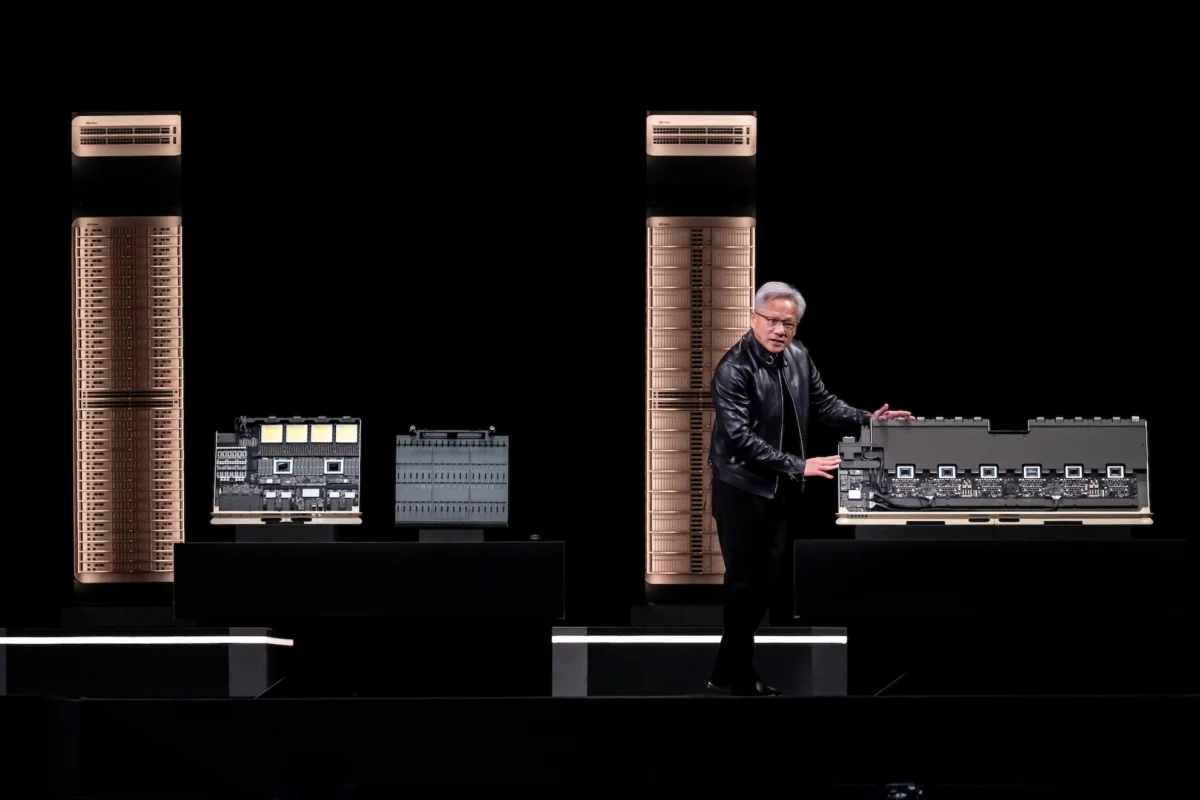
In a significant strategic move that underscores the escalating global demand for artificial intelligence infrastructure, Amazon and Nvidia announced on Wednesday an extensive expansion of their existing partnership. This landmark agreement includes a deal for Amazon to integrate an additional two million state-of-the-art Nvidia GPU chips into its Amazon Web Services (AWS) data centers, slated for deployment between 2027 and 2028. This monumental commitment is valued at an estimated tens of billions of dollars, although specific financial terms were not disclosed by either company.
The announcement, made during Nvidia’s quarterly earnings call, comes hot on the heels of a prior agreement just five months ago, where Amazon had committed to deploying over one million Nvidia GPUs across its AWS infrastructure starting this year. Nvidia indicated in a subsequent statement that "demand has exceeded those expectations," signaling an unprecedented surge in the need for AI-specific compute power. The new tranche of GPUs will include Nvidia’s latest and most powerful architectures, such as the Blackwell Ultra, Rubin, and Rubin Ultra GPUs, all designed to meet the intensive computational requirements for training and running advanced AI models.
The Accelerating AI Arms Race and Nvidia’s Indispensable Role
The rapid succession of these large-scale deals highlights the intensifying "AI arms race" among cloud providers, enterprises, and research institutions globally. As AI models become increasingly complex and data-hungry, the demand for specialized hardware capable of parallel processing — primarily GPUs — has skyrocketed. Nvidia, with its foundational CUDA software platform and market-leading GPU technology, has positioned itself as the undisputed kingpin in this domain. Its chips are the backbone of virtually every major AI development and deployment effort worldwide.
This expanded partnership is notable not merely for its sheer scale and the accelerated timeline of its growth, but also for its breadth. It transcends a simple procurement deal for more chips, evolving into a comprehensive technological integration across various facets of AWS’s operations. Nvidia confirmed that its advanced networking hardware, crucial for connecting thousands of GPUs into cohesive, high-performance computing systems, will also be integrated across AWS. Furthermore, the collaboration will extend to Nvidia’s open models, CPUs, data processing software, and even its robotics platform, signaling a deeper, more systemic alignment between the two technology giants.
Both companies attributed the decision to deepen their collaboration to "surging demand" emanating from a diverse ecosystem that includes burgeoning startups, established enterprises, cutting-edge AI labs, and even governmental entities. This widespread adoption underscores AI’s transition from a nascent technology to a critical operational imperative across industries.
AWS’s Dual Strategy: Partnership Amidst Internal Innovation
The deepened alliance with Nvidia unfolds against a fascinating backdrop of Amazon’s own significant investments in developing proprietary AI chips. AWS has been aggressively building its own silicon, particularly general-purpose CPUs and specialized AI accelerators, with a clear strategic objective: to lessen its dependence on external vendors like Nvidia and Intel, optimize costs, and tailor performance specifically for AWS workloads.
Amazon’s AI chief, Peter DeSantis, has publicly discussed plans for AWS to potentially sell its custom-designed Trainium chips — direct alternatives to Nvidia’s H100 or Blackwell chips for deep learning workloads — to other companies for data center deployment. Similarly, Amazon’s Arm-built Graviton CPU series has emerged as a formidable challenger to traditional server chips from Intel and AMD, demonstrating AWS’s ambition to compete at the foundational hardware layer. The company has boasted considerable success with its custom chip business, reporting on its last earnings call an annualized revenue run rate crossing $25 billion, bolstered by $225 billion in total commitments from influential AI labs such as Anthropic and OpenAI.
Despite these robust internal efforts and the potential for direct competition, the sheer scale of this new Nvidia deal unequivocally reaffirms Nvidia’s preeminent position in the AI chip landscape. It suggests that while AWS’s custom chips provide strategic advantages for specific workloads and cost efficiencies, the cutting-edge, general-purpose AI acceleration provided by Nvidia’s GPUs remains indispensable for the most demanding, frontier AI applications. This hybrid strategy allows AWS to leverage the best of both worlds: specialized internal solutions for scale and efficiency, and market-leading external solutions for raw power and rapid innovation.
Nvidia’s Broader Vision: Beyond GPUs
The expanded partnership also reveals Nvidia’s strategic push beyond its core GPU business into a more comprehensive ecosystem play. Beyond the two million GPUs, Nvidia plans to supply an unspecified number of its Vera CPUs to AWS, with some integrated alongside Rubin GPUs and others as standalone units, according to Nvidia CFO Colette Kress. This move underscores Jensen Huang’s ambitious vision for Nvidia’s CPU offerings, having previously boasted in May about identifying a "brand new $200 billion TAM" (Total Addressable Market) for the company’s CPU line.
Nvidia expects its Vera CPUs to be adopted by "every major hyperscaler, neocloud, AI lab, and system OEM," with initial shipments already underway to lead partners including Oracle and SpaceXAI. This signifies Nvidia’s intent to become a full-stack AI computing provider, offering not just the accelerators but also the central processing units, networking, and software necessary for complete AI infrastructure.
Expanding Horizons: Robotics and Enterprise AI
The collaboration between Amazon and Nvidia is not confined to data center compute alone; it is also extending into Amazon’s extensive logistics operations and its enterprise software offerings. Kress detailed Amazon’s plans to adopt Nvidia’s comprehensive physical AI stack to power its vast fleet of warehouse robots. This includes integrating Nvidia’s Omniverse (its simulation and digital twin platform), Cosmos (its world model platform), Isaac (its robotics development platform), and Jetson (computing hardware for robots and edge AI). This week, Nvidia further cemented its commitment to this space by introducing a new version of Jetson, designed as a more accessible robotics computer for "entry-level edge AI," indicating a scalable approach to robotics deployment.
On the enterprise software front, AWS will host Nvidia’s Nemotron family of open models on Amazon Bedrock, its managed foundation model platform, and SageMaker, its managed cloud service. This integration makes Nvidia’s advanced AI models readily available to AWS customers, further democratizing access to cutting-edge AI capabilities and fostering innovation across various business applications.
Nvidia’s Financial Triumphs and Future Outlook
The announcement of this expanded partnership coincided with Nvidia’s stellar second-quarter earnings report, which once again shattered analyst expectations. The company recorded sales of an astounding $96.2 billion for the quarter. Crucially, its data center revenue accounted for the vast majority of these sales, reaching $89 billion, representing a staggering 117% increase from the previous year. This phenomenal growth is a direct testament to the insatiable global demand for AI infrastructure, with Nvidia at its epicenter.
Looking ahead, Nvidia projected revenue to reach $108 billion in the third quarter, with contributions expected from its next-generation Rubin GPUs, which began production shipments this quarter. Investors are keenly observing Rubin’s initial sales figures as an indicator of sustained demand for Nvidia’s hardware into its next generation.
To meet this exploding demand and secure its market position, Nvidia has substantially ramped up its commitments to secure supply and manufacturing capacity. This commitment has surged to an unprecedented $279 billion, a significant increase from $119 billion just last quarter. This massive outlay includes an estimated $92 billion in projected spending for the remainder of the current fiscal year and an additional $87 billion earmarked for fiscal year 2028. Such aggressive investment underscores Nvidia’s confidence in the long-term growth trajectory of the AI market and its determination to control the supply chain necessary to fulfill future demand.
The Economic Engine of AI: "Profitable Tokens"
During the earnings call, Nvidia CEO Jensen Huang articulated his vision for the economic impact of AI, stating, "The thing that matters for the industry is that AI is now doing productive and useful work." He further elaborated, "AI is generating profitable tokens… If we had more compute, we could generate more profitable tokens, which results in more profit for all of the services. This is the exact phase where we’re at, which is the reason why everybody’s leaning in."
Huang’s "profitable tokens" analogy encapsulates the core economic driver behind the current AI boom: the ability of AI to create tangible value, drive efficiencies, and unlock new revenue streams across industries. This perspective justifies the massive investments in AI infrastructure, as companies seek to capitalize on these new profit opportunities.
Implications for the AI Landscape
This expanded partnership between Amazon and Nvidia carries profound implications for the entire technology ecosystem. For Nvidia, it solidifies its near-monopolistic control over the high-end AI accelerator market, providing long-term revenue visibility and further entrenching its CUDA ecosystem. For AWS, it ensures access to the cutting edge of AI hardware, crucial for maintaining its competitive edge in the fiercely contested cloud computing market, even as it continues to develop its own silicon.
The sheer scale of compute power being deployed by AWS, powered by Nvidia, will undoubtedly accelerate innovation in AI research and development. It will enable the training of even larger, more sophisticated models and facilitate the deployment of AI across a broader array of applications, from intelligent automation to advanced scientific discovery.
However, it also raises questions about market concentration and the challenges for competitors. While AMD and Intel are actively pursuing their own AI chip strategies, the colossal investments and deep integrations exemplified by this Amazon-Nvidia deal make it increasingly difficult for them to significantly erode Nvidia’s market dominance in the immediate future.
Ultimately, investors and industry observers will be closely watching to see if this unprecedented commitment to AI compute indeed translates as neatly into additional profits as Jensen Huang suggests. As hundreds of billions of dollars are poured into AI infrastructure, the ultimate success will hinge on the practical applications and economic returns generated by these powerful new capabilities. The Amazon-Nvidia alliance stands as a testament to the transformative power of AI and the foundational role of specialized hardware in shaping its future.
