

The landscape of modern education has shifted toward an increasingly complex environment where students are expected to juggle rigorous academic curricula, extracurricular commitments, and personal well-being. In this high-pressure atmosphere, time management has transitioned from a supplementary skill to a fundamental pillar of academic survival and professional readiness. Educational researchers and institutional experts agree that the ability to allocate one’s temporal resources effectively is the single most accurate predictor of a student’s long-term success, often outweighing standardized test scores or baseline cognitive metrics.

The Foundational Mechanics of Student Productivity
At the core of effective time management lies the transition from reactive to proactive planning. Most students operate in a state of "crisis management," responding only to the most immediate deadlines. To counter this, experts advocate for the implementation of the SMART criteria—Specific, Measurable, Achievable, Relevant, and Time-bound—for all goal-setting activities. By defining objectives with surgical precision, students reduce the cognitive load associated with ambiguity, allowing for more direct engagement with the task at hand.
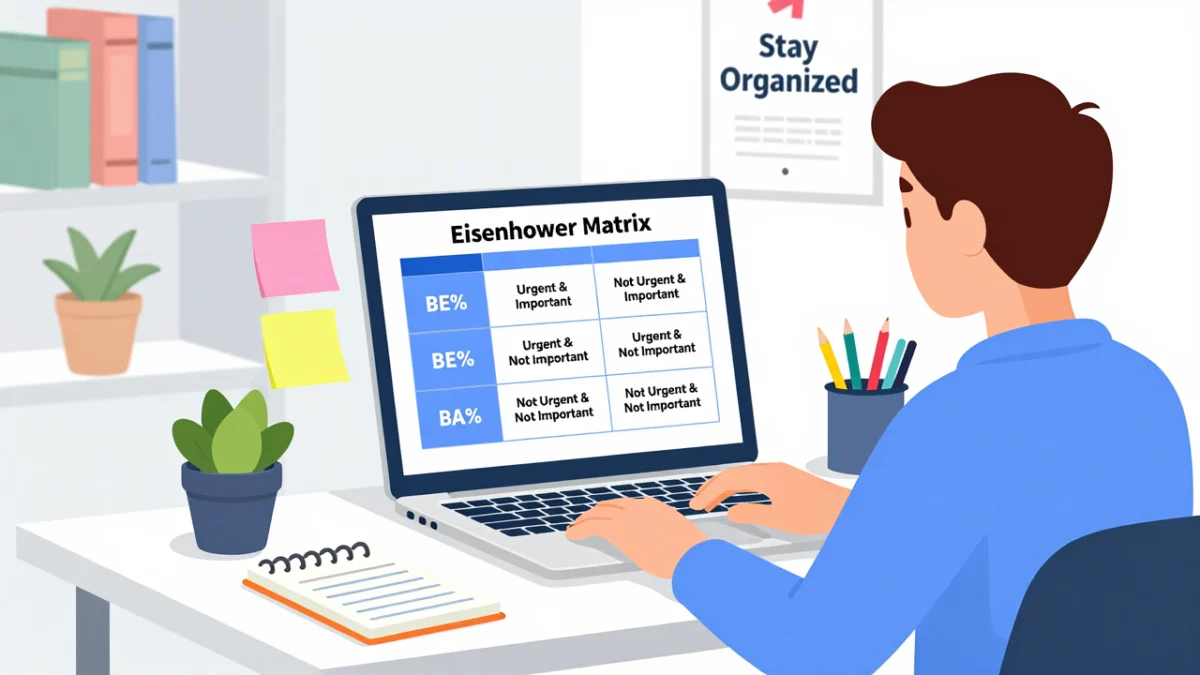
The Eisenhower Matrix serves as a secondary critical tool in this framework. Developed based on the decision-making principles of the 34th U.S. President, Dwight D. Eisenhower, the matrix categorizes tasks into four quadrants: urgent and important, important but not urgent, urgent but not important, and neither. Data suggests that high-achieving students spend the majority of their time in the "important but not urgent" quadrant, focusing on deep work and long-term preparation rather than putting out metaphorical fires.

A Chronological Roadmap for Implementation
The adoption of a sophisticated time management system is rarely successful when attempted overnight. Instead, a phased implementation strategy is recommended for students seeking to build lasting habits.
Phase 1: The Audit (Week 1)
Before a student can manage time, they must understand where it is currently being lost. This phase involves keeping a meticulous log of every activity for seven consecutive days. Modern tools such as Toggl Track or Clockify provide granular data on "time leaks," often revealing that students spend 20–30% more time on social media or non-productive digital browsing than they initially estimated.

Phase 2: System Architecture (Weeks 2-3)
Once the audit is complete, students must build their infrastructure. This involves the selection of a primary scheduling tool—whether a digital platform like Google Calendar or a traditional physical planner. The goal is to create a "centralized source of truth" where every academic deadline, social commitment, and self-care block is recorded.
Phase 3: Tactical Execution (Week 4 and Beyond)
With the schedule in place, the focus shifts to the mechanics of the study session. Techniques such as the Pomodoro Method—working in 25-minute intervals followed by 5-minute breaks—are introduced to maintain neurological freshness and combat the diminishing returns of marathon study sessions.

Supporting Data: The Cost of Poor Management
The consequences of failing to master these skills are documented in several longitudinal studies. Research from the American Psychological Association (APA) indicates that approximately 80% to 95% of college students engage in procrastination, with nearly 50% doing so consistently and problematically.
The impact on academic performance is quantifiable. Students who report low time-management skills consistently score lower on GPAs and standardized assessments compared to their organized peers. Furthermore, the correlation between poor time management and mental health is significant; students with unmanaged schedules report 35% higher levels of chronic stress and are more likely to experience symptoms of burnout before the conclusion of their sophomore year.

In contrast, a study conducted by the Journal of Educational Psychology found that students who utilized time-blocking and prioritized tasks saw a 15% to 25% increase in productivity and a measurable decrease in test-related anxiety. These students were also more likely to participate in high-impact extracurricular activities, such as internships and research assistantships, which are critical for post-graduation employment.
Institutional Responses and Expert Perspectives
University administrators and faculty members have begun to recognize that time management is a "soft skill" that requires hard instruction. Many leading institutions, including Harvard and Stanford, now offer dedicated workshops through their academic resource centers to address the time-management deficit.

"We see a direct link between a student’s ability to manage their calendar and their retention rates," states a director of student success at a major state university. "Students don’t usually fail because they aren’t smart enough; they fail because they get overwhelmed by the sheer volume of tasks and lose the ability to prioritize."
Student advocacy groups have also weighed in, noting that the rise of the "always-on" digital culture has made focus more difficult. They argue that institutional support must include teaching students how to set digital boundaries and manage "notification fatigue," which serves as a primary disruptor of the deep-work states required for academic excellence.

Advanced Strategies: Time Blocking and the Pomodoro Technique
To achieve peak productivity, students are increasingly turning to time blocking—a method where every minute of the day is assigned a specific task. Unlike a traditional to-do list, which only identifies what needs to be done, time blocking identifies when it will be done. This eliminates the "paradox of choice," where a student wastes time deciding which task to start.
Complementing this is the Pomodoro Technique, which leverages the brain’s natural attention spans. By working in short, intense bursts, students can maintain high levels of concentration. After four "Pomodoros," a longer break of 15–30 minutes is taken. This cycle prevents the mental exhaustion that often leads to "doom-scrolling" or other forms of digital procrastination.

The Role of Flexibility and Self-Care
A common pitfall in student time management is the creation of a schedule that is too rigid. Professional organizers emphasize the importance of "buffer time"—unallocated blocks of 15 to 30 minutes between major tasks. These buffers account for the inherent unpredictability of student life, such as a lecture running late or a complex assignment requiring more time than anticipated.
Furthermore, the integration of self-care is not a luxury but a biological necessity for cognitive function. Sleep deprivation, often seen as a badge of honor in academic circles, actually impairs the prefrontal cortex—the very part of the brain responsible for planning and impulse control. An effective time management strategy treats eight hours of sleep, regular exercise, and social interaction as non-negotiable appointments, recognizing that a well-rested brain is significantly more efficient than a fatigued one.

Accountability and Social Support
Human beings are inherently social creatures, and accountability often increases when a task is shared. Finding an accountability partner—a peer with similar academic goals—can provide the necessary external motivation to stick to a schedule. Weekly check-ins to review progress and adjust strategies create a feedback loop that reinforces positive habits. This social component also mitigates the isolation that can sometimes accompany intense periods of study.
Broader Impact: From the Classroom to the Career
The implications of mastering time management extend far beyond the attainment of a degree. In the modern workforce, employers rank "self-management" and "priority setting" among the top three most desirable traits in new hires. The transition from college to a professional environment is often jarring for those who relied on the forced structure of high school or the close supervision of parents.

By developing these habits during their academic years, students are effectively "future-proofing" their careers. They enter the job market with a proven ability to handle complex projects, meet deadlines, and maintain a work-life balance—skills that are essential in an era of remote work and increasing professional autonomy.
Conclusion: The Path Forward
Effective time management is an iterative process of trial, error, and refinement. It requires a commitment to self-reflection and the courage to abandon systems that are not producing results. As students move forward, the goal is not to fill every waking second with labor, but to manage time so effectively that they create space for the experiences that make the student journey meaningful. Through the strategic application of SMART goals, the Eisenhower Matrix, and disciplined execution, students can transform their academic experience from one of constant stress to one of purposeful achievement.
