

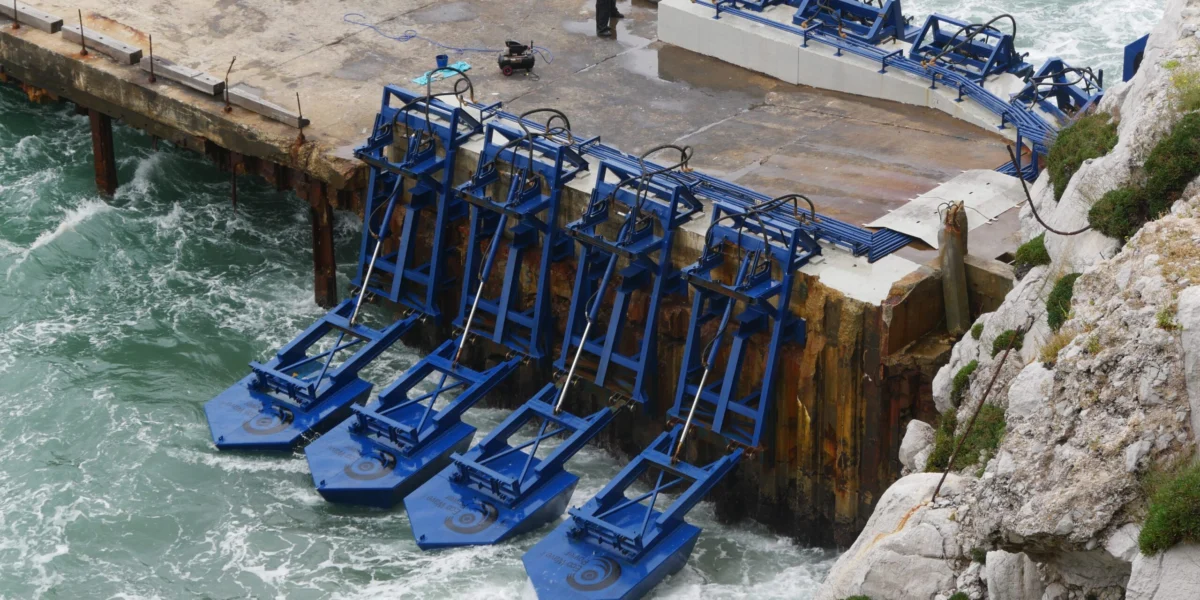
The transition toward a diversified renewable energy portfolio has reached a significant milestone in Southern Europe as Eco Wave Power Global AB, a leader in onshore wave energy technology, confirms the official start of infrastructure works for its inaugural megawatt-scale project. The project, situated in the coastal city of Porto, Portugal, has entered a critical execution phase following the commencement of rehabilitation efforts at the Barra do Douro breakwater by the Port Authority of Douro, Leixões, and Viana do Castelo (APDL). This development marks a pivotal shift for the wave energy sector, moving from small-scale pilot demonstrations toward grid-scale commercial viability.
The rehabilitation of the Barra do Douro breakwater is a prerequisite for the installation of the wave energy array. The maritime infrastructure had previously sustained damage during severe storm events, necessitating a comprehensive reinforcement and maintenance program. As the entity responsible for the structural integrity of the region’s port facilities, APDL is spearheading the repairs to ensure the breakwater can support the long-term operational demands of the 1 MW wave energy plant. Eco Wave Power has received formal updates confirming that these works are currently progressing on-site, specifically targeting the coastal segments designated for the installation of the company’s proprietary energy conversion equipment.
Strategic Significance of the Porto Installation
The Porto project represents the first phase of a broader strategic agreement between Eco Wave Power and APDL. Under the current memorandum of understanding, the collaboration envisions the potential expansion of wave energy capacity up to 20 MW across various sites managed by the port authority. The initial 1 MW installation serves as a proof-of-concept for megawatt-scale deployment, providing the necessary data to justify the scaling of the technology to its full 20 MW potential.
Portugal has long been identified as a primary market for ocean energy due to its extensive Atlantic coastline and consistent wave climate. The Portuguese government has established ambitious targets for offshore renewable energy, aiming to capitalize on its maritime heritage to drive the "Blue Economy." By integrating wave energy converters into existing man-made structures like breakwaters, Eco Wave Power offers a solution that aligns with Portugal’s dual goals of environmental conservation and energy independence.
Timeline and Executive Oversight
As the physical infrastructure at Barra do Douro undergoes reinforcement, Eco Wave Power’s leadership is preparing for a high-level diplomatic and technical mission to the region. Inna Braverman, the Founder and Chief Executive Officer of Eco Wave Power, is scheduled to travel to Porto in mid-August 2026. This visit is designed to synchronize the company’s installation schedule with APDL’s construction progress.
The primary objective of the August meeting is to establish a definitive completion timeline for the breakwater rehabilitation. Once the structural works reach a specific milestone of stability and safety, Eco Wave Power will be granted access to the site to begin the mechanical and electrical installation of the wave energy floaters and power stations. This coordination is essential to prevent logistical bottlenecks and to ensure that the sensitive hydraulic and electrical components are installed in a secure environment.
Furthermore, the visit will involve intensive consultations with a network of Portuguese subcontractors. These local firms are expected to handle critical aspects of the project, including:
- Civil Engineering: Designing the attachment points for the floaters on the breakwater wall.
- Steel Fabrication: Constructing the large-scale arms and floaters that capture wave motion.
- Hydraulic Systems: Installing the pistons and accumulators that convert mechanical motion into fluid pressure.
- Electrical Grid Connection: Managing the integration of the generated power into the local Portuguese electricity network.
Regulatory Alignment and Grid Connection
A significant administrative component of the project involves the extension of regulatory deadlines. APDL has agreed to provide a formal letter of support to Eco Wave Power to facilitate a request to the Portuguese authorities for an extension of the grid-connection deadline. This extension is necessary to align the project’s regulatory obligations with the reality of the infrastructure rehabilitation schedule.
In the renewable energy sector, grid-connection permits are often time-sensitive. Because the installation of the wave energy converters is dependent on the completion of the breakwater repairs—a process subject to maritime conditions and structural complexities—the extension ensures that the project remains in good standing with national energy regulators. This collaborative approach between the port authority and the technology provider highlights the institutional support for innovative maritime projects in Portugal.
Technical Advantages of Onshore Wave Energy
Eco Wave Power’s technology differs fundamentally from traditional offshore wave energy concepts. While many offshore systems utilize buoys or submerged turbines located miles from the coast, Eco Wave Power’s system is "onshore" or "near-shore," attached directly to man-made structures. This design philosophy offers several distinct advantages:
- Reduced Costs: By utilizing existing breakwaters, the company avoids the massive capital expenditures associated with specialized vessels, underwater cabling, and deep-sea anchoring.
- Simplified Maintenance: Technical teams can access the equipment on foot or via standard port vehicles, rather than requiring expensive offshore diving teams or remote-operated vehicles (ROVs).
- Durability: During extreme storm events, the floaters can be automatically lifted above the water level, protecting the system from the destructive forces of breaking waves—a common failure point for offshore devices.
- Environmental Impact: The systems are typically installed on structures that have already modified the coastline, resulting in minimal additional disruption to marine ecosystems.
Earlier this year, the company validated these advantages through the completion of a pilot program at the Port of Los Angeles in the United States. Conducted in collaboration with Shell International Exploration and Production, the Los Angeles pilot demonstrated that a wave energy system could be permitted and operated with a capital expenditure of less than $1 million. The project was successfully decommissioned after meeting its performance targets, proving that the technology could operate under real maritime conditions with "no significant environmental impact."
Global Expansion and Market Outlook
The progress in Portugal is part of a wider global expansion strategy for Eco Wave Power. In addition to the European and North American markets, the company recently concluded a feasibility study for a project at the Port of Ngqura in South Africa. That study, conducted alongside Africa Great Future Development Ltd (AGFDL), identified the technical potential for an 8.3 MW installation along the port’s existing breakwater.
The wave energy industry is currently at a crossroads, seeking to replicate the success of the offshore wind industry. According to industry analysts, the global wave energy market is poised for significant growth as decarbonization mandates tighten. The International Energy Agency (IEA) has previously noted that ocean energy has the potential to meet a substantial portion of global electricity demand if the technology can achieve cost-competitiveness through scale.
The Porto project is viewed by many in the industry as the litmus test for this scaling process. If Eco Wave Power can successfully transition from the sub-megawatt pilot phase to a functional 1 MW grid-connected plant in Portugal, it will provide a blueprint for other port authorities worldwide to transform their protective infrastructure into clean energy assets.
Implications for the Renewable Energy Landscape
The commencement of works at Barra do Douro is more than a construction update; it is a signal of the maturing "Blue Economy." For years, wave energy was relegated to the fringes of renewable energy discussions due to the harsh nature of the marine environment and the high cost of early prototypes. However, by focusing on modularity and the repurposing of existing infrastructure, companies like Eco Wave Power are lowering the barrier to entry.
The successful implementation of the 1 MW phase in Porto will likely trigger interest from other coastal nations looking to diversify their energy mix. As solar and wind power face occasional challenges related to land use and intermittency, wave energy provides a predictable and dense energy source that can operate around the clock.
As CEO Inna Braverman noted, the transition to megawatt-scale deployment is the "major milestone" that defines the commercial future of the company. With the support of APDL and the Portuguese government, the project in Porto is set to become a landmark installation, potentially paving the way for a 20 MW wave energy future in the region. The coming months of rehabilitation and the subsequent installation phase will be closely watched by investors, policymakers, and environmental advocates as a key indicator of the viability of the ocean as a primary source of the world’s clean power.
