

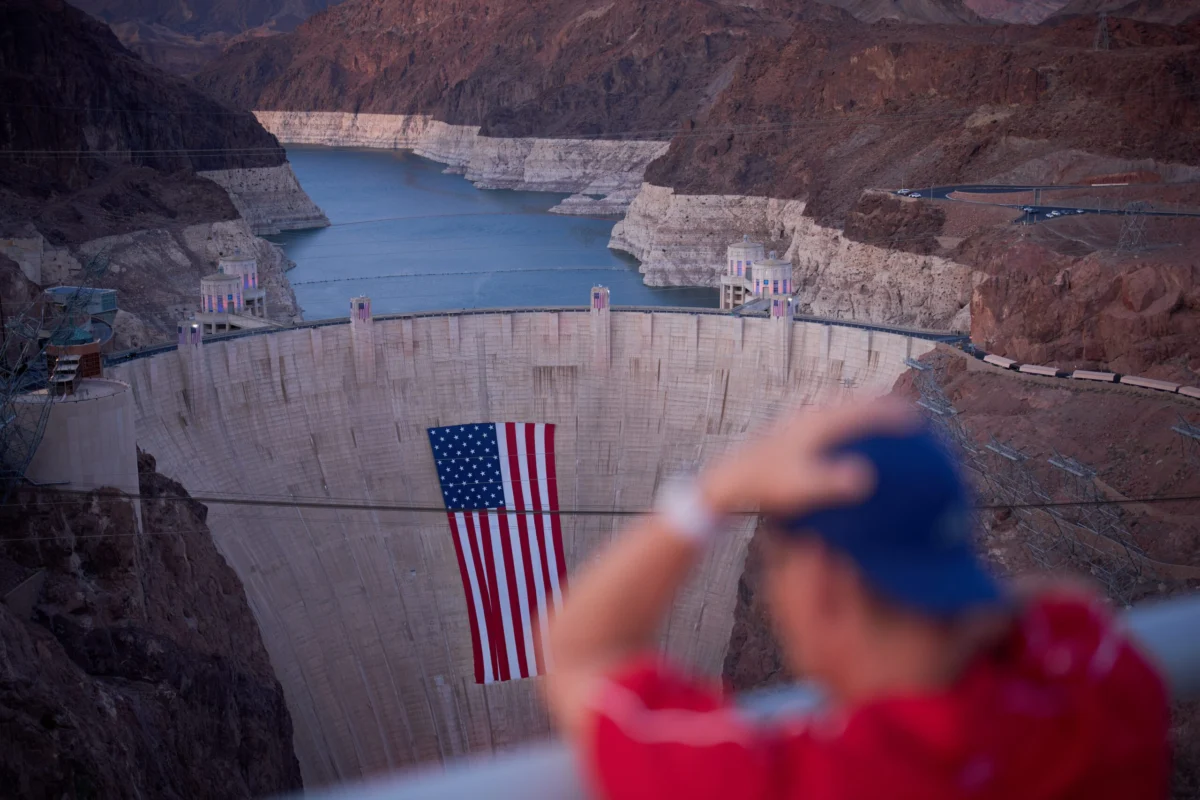
The water level at Lake Powell, the United States’ second-largest reservoir, has plummeted to an unprecedented record low, intensifying the existential crisis facing the Colorado River system and the 40 million people who depend on it. This alarming milestone, recorded on Saturday, comes less than two weeks after the river’s primary reservoir, Lake Mead, also reached its lowest point since it was first filled in the 1930s. The dual collapse of these massive man-made lakes signals a tipping point for the American West, where a combination of historical overuse, a record-dry winter, and a multi-decade megadrought fueled by rising global temperatures has pushed the region’s water infrastructure to the brink of failure.
According to data released by the U.S. Bureau of Reclamation (USBR), Lake Powell’s surface elevation dropped to 3,519.91 feet (1,072.9 meters) above sea level, falling below the previous record set in April 2023. The reservoir is currently more than 20 feet lower than it was at the beginning of the year, a rate of decline that has alarmed hydrologists and federal officials alike. Perhaps most concerning is the reservoir’s proximity to "minimum power pool"—the level at which water no longer has enough pressure to spin the hydroelectric turbines at the Glen Canyon Dam. At approximately 3,500 feet, the dam would cease to generate electricity for millions of customers across several states. Current projections suggest that without "major intervention," this threshold could be breached by the end of the calendar year.
A Systemic Collapse: The Dual Crisis of Mead and Powell
The Colorado River Basin is divided into two segments: the Upper Basin (Colorado, New Mexico, Utah, and Wyoming) and the Lower Basin (Arizona, California, and Nevada). Lake Powell serves as the primary storage facility for the Upper Basin and a regulatory mechanism to ensure water delivery to the Lower Basin. Lake Mead, situated on the Nevada-Arizona border, serves the Lower Basin and Mexico.
On August 7, Lake Mead’s water levels hit 1,040.4 feet (317.1 meters) above sea level, breaking a record low set in July 2022. This elevation is roughly 175 feet below the reservoir’s "full" level, leaving a stark, white "bathtub ring" of mineral deposits visible on the canyon walls. J.B. Hamby, chairman of the Colorado River Board of California, characterized the situation as "extremely significant and extremely concerning," noting that three-quarters of the basin’s population—nearly 30 million people—are directly impacted by the stability of Lake Mead.
The last time the combined storage of Mead and Powell was this depleted was in May 1957, a period when the Glen Canyon Dam was still under construction and Lake Powell had not yet begun to fill. The current depletion is not a temporary fluctuation but the result of a "megadrought" that has persisted for over 22 years, which scientists at UCLA and other institutions have identified as the driest period in the American Southwest in at least 1,200 years.
Chronology of a Dwindling Resource
The current crisis is the culmination of over a century of water management decisions and shifting climatic patterns. To understand the gravity of the current record lows, one must look at the timeline of the river’s management:
- 1922: The Colorado River Compact: Representatives from the seven basin states divided the river’s flow based on what was then thought to be an average annual flow of 17.5 million acre-feet. History has since shown that this period was one of the wettest in centuries, leading to a systemic over-allocation of "paper water" that does not exist in reality.
- 1963: Filling of Lake Powell: The completion of the Glen Canyon Dam allowed the U.S. to store massive amounts of water, providing a buffer for dry years.
- 2000–Present: The Megadrought Begins: Inflows into the Colorado River system began a steady decline. Reservoirs that were nearly full at the turn of the millennium began a slow, agonizing retreat.
- August 2021: The federal government declared a first-ever official water shortage on the Colorado River, triggering mandatory cuts for Arizona, Nevada, and Mexico.
- 2022–2023: Severe drought conditions saw Lake Mead expose human remains and historical artifacts previously submerged for decades. Las Vegas was forced to activate a "third intake" straw to draw water from the very bottom of the lake.
- July–August 2026: Lake Powell and Lake Mead hit simultaneous record lows, despite intermittent "wet" years, proving that short-term precipitation cannot outpace long-term aridification.
The Hydropower Threat and Federal Intervention
The most immediate physical threat beyond water delivery is the loss of hydroelectric capacity. The Glen Canyon Dam at Lake Powell and the Hoover Dam at Lake Mead provide clean, renewable energy to millions of homes, small businesses, and tribal nations. As water levels drop, the "head pressure" required to turn the turbines decreases, making power generation less efficient until it eventually stops altogether.
In April, federal officials warned that the system was approaching "dead pool"—a state where water levels are so low they can no longer flow downstream through the dams’ outlets. To prevent this, the Bureau of Reclamation has proposed a 10-year management plan that includes aggressive water cuts. In July, a federal proposal suggested that the Lower Basin states of Arizona, California, and Nevada must significantly reduce their consumption to stabilize the reservoirs.

However, negotiations between the states have been fraught with tension. California, which holds the most senior water rights under the 1922 Compact, has historically been more insulated from cuts, while Arizona, holding junior rights, has borne the brunt of recent reductions. The federal government has signaled that if the states cannot reach a consensus on how to share the pain of a shrinking river, the Department of the Interior will be forced to impose unilateral cuts to protect the integrity of the dams.
Environmental and Economic Ripples
The impact of the receding waters extends far beyond municipal taps and power grids. The ecology of the Grand Canyon and the surrounding river ecosystems are in peril. For example, federal officials recently announced they would cease releasing cool water from the bottom of the Glen Canyon Dam to protect the humpback chub, a threatened native fish. The warmer water resulting from lower reservoir levels favors invasive species and disrupts the delicate balance of the river’s thermal profile.
The tourism industry, a multi-billion-dollar engine for the region, is also reeling. At Lake Powell, marinas have been forced to relocate multiple times as the shoreline retreats. Boat ramps that cost millions of dollars to build now end in dirt hundreds of yards from the water’s edge. In some areas, the receding water has revealed long-submerged canyons, attracting some hikers but effectively ending the era of motorized houseboating that defined the reservoir’s economy for decades.
Furthermore, the agricultural sector, which consumes roughly 70% to 80% of the Colorado River’s water, faces a grim future. The Imperial Valley in California and the Yuma region in Arizona produce a significant portion of the United States’ winter vegetables. Sustained water cuts will likely lead to fallowed fields, higher food prices, and a shift in the types of crops that can be viably grown in the desert.
Analysis: The New Normal of Aridification
Water experts are increasingly moving away from the term "drought," which implies a temporary condition that will eventually end. Instead, they use the term "aridification" to describe a permanent shift toward a drier climate in the American West. The record lows at Lake Powell and Lake Mead are not merely symptoms of a bad weather cycle; they are the result of a system that was designed for a climate that no longer exists.
The Bureau of Reclamation’s modeling suggests that the record lows will not be the final bottom. Projections through the end of the year show both reservoirs continuing to drop. Of the 54 Western reservoirs tracked by the federal government, nine have recorded their lowest levels in 30 years within the last several months, indicating that the crisis is regional, not just confined to the Colorado River.
The path forward will require a fundamental reimagining of water use in the West. This includes large-scale investments in water recycling, desalination, and more efficient agricultural irrigation. It also requires a legal reckoning with the 1922 Compact, as the gap between the legal rights to water and the physical reality of the river’s flow continues to widen.
As Lake Powell and Lake Mead sit at roughly 25% to 30% of their total capacity, the "major intervention" promised by federal officials appears more urgent than ever. The survival of the modern American West—as an agricultural powerhouse, a demographic hub, and an economic engine—depends on whether seven states, dozens of tribal nations, and two countries can agree on how to live with a river that is no longer what it once was. For now, the white bathtub rings around the reservoirs remain a stark monument to a vanishing resource, and the ticking clock of a looming power-pool failure.
