

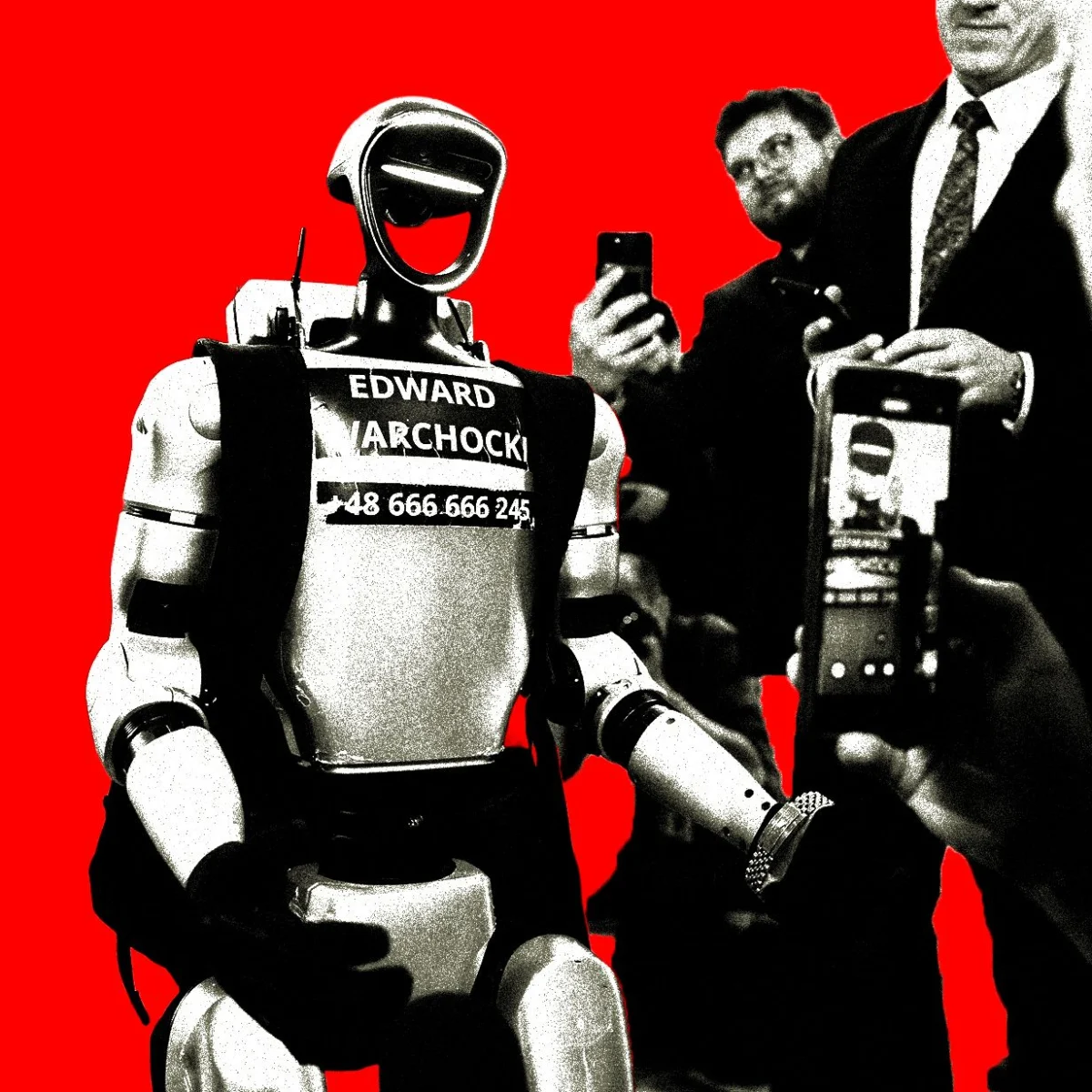
When Edward Warchocki engages in conversation, his voice emanates with a disarming sincerity, a far cry from the metallic clanking one might expect from a machine. "Not super intelligent, but very emotional, very easy to make friends with," describes Bartosz Idzik, the mind behind Edward’s digital persona. Yet, the moment silence falls, the reality of Warchocki’s form – a 4-foot-tall humanoid robot navigating the urban landscape of Poland – becomes impossible to ignore. This seemingly ordinary interaction marks a pivotal moment in the burgeoning field of accessible humanoid robotics and its unexpected leap into the realm of global social media influence.
The genesis of Edward Warchocki can be traced back to a simple idea conceived by Idzik and his friend Radosław Grzelaczyk just six months prior. Their ambition was to acquire a humanoid robot from China, a move that would eventually lead to the creation of a viral sensation. The robot was christened "Edward Warchocki," a moniker cleverly devised by combining the name of Grzelaczyk’s dog, Eddie, with the Polish word for growling, "warczeć," and the general cadence of a plausible Polish name. In its nascent stages, Edward was a silent observer, a 40-kilogram machine that, according to Idzik, elicited fear rather than fascination from onlookers. The transformative element arrived with Idzik’s expertise as a software developer. By integrating the robot with a sophisticated large language model, Edward was endowed with the capability for live, natural-language conversations in Polish.
"When he started to talk, people loved him. Without talking, it’s just a 40-kilogram machine," Idzik remarked, highlighting the profound impact of verbal interaction in humanizing the robotic entity. This newfound ability unlocked a torrent of public engagement, transforming Edward from a technological curiosity into a beloved digital personality.
A Robot’s Global Tour
The transformation was rapid and remarkable. Edward began to amass a significant following, undertaking a series of public appearances that defied expectations. It visited the Polish parliament, engaging in discussions with politicians, embarked on adventurous hikes up mountains, and even waded into lakes, showcasing a surprising range of physical capabilities. In a testament to its growing popularity and the public’s evolving perception of robots, Edward was even "jokingly arrested" by the police, a moment that underscored its integration into the social fabric.
The true explosion in Edward’s fame occurred in April when a video capturing its unusual prowess – chasing away wild boars in Warsaw, accessorized with a backpack and a Rolex – went viral worldwide. This single incident propelled Edward into global consciousness, garnering over a million followers and an astonishing four billion views across various social media platforms.
Edward Warchocki is not an isolated phenomenon. Its success foreshadows a future where humanoid robots are not confined to research labs but are actively participating in and influencing our digital and physical worlds. By 2026, it is projected that such "humanoid influencers" will be a common sight. Examples are already emerging: Rizzbot, often seen sporting a cowboy hat in Austin, Texas, engages passersby with flirtatious banter; Bart Robot has been observed breakdancing with enthusiastic Knicks fans in New York; and the Brickell Clanker has demonstrated its versatility by changing jerseys to celebrate with World Cup fans after each match.
The Unitree G1: The Engine Behind the Hype
What unites these diverse robotic personalities – Rizzbot, Bart Robot, and Brickell Clanker – is their underlying model: the Unitree G1. This relatively accessible and affordable humanoid robot, manufactured by a leading Chinese robotics company, is rapidly becoming the platform of choice for a new generation of creators. The G1, standing roughly the size of a child, features a minimalist design with a hollowed-out face illuminated by a ring of blue light and sleek, light-gray aluminum limbs.
The capabilities demonstrated by the Unitree G1 are extensive and increasingly documented online. Videos showcase the robot participating in a wide array of activities, including appearances on "America’s Got Talent," performing martial arts like kung fu, engaging in boxing matches, executing parkour routines, dancing at concerts, attempting (and sometimes failing at) cooking, streaming live with popular internet personalities like Kai Cenat, humorously begging for money, and even engaging in simulated romantic interactions. Its adaptability extends to spiritual and cultural contexts, with documented instances of it being ordained as a monk in Japan and Korea, and participating in prayer at a mosque in Dubai. This multifaceted engagement has led to a somewhat irreverent but telling description from an anonymous social media user on X: "This clanker is lit as fuck!"
Unitree’s Market Ascendancy and Investor Interest
Unitree’s rapid ascent in the robotics market is poised for further validation with its upcoming public offering on the Chinese stock market. Financial disclosures reveal a company that has moved beyond theoretical development and into tangible market delivery. Unlike many competitors whose products remain largely in laboratory testing phases, Unitree has achieved significant commercial success. In 2025, over half of its revenue was derived from the sale of humanoid robots to actual customers. The company shipped an impressive 5,511 humanoids that year, with an average selling price below $25,000. A substantial 43 percent of these sales originated from outside China, indicating a strong global demand. Furthermore, Unitree achieved profitability for the first time last year, a significant milestone in a capital-intensive industry.
"We tested a lot of humanoids, and the G1 was the best for its purpose," Idzik affirmed, underscoring the robot’s suitability for creative and public-facing applications. He further commented on the evolving technological landscape, stating, "We are used to China copying other countries, but from the perspective of humanoids, other people should copy China." This statement reflects a shift in global technological leadership, with China emerging as a dominant force in certain advanced manufacturing sectors.
Navigating the Debate: Influence vs. Employment
Despite its commercial success and viral appeal, the Unitree G1 and its applications are not without scrutiny. While these robots excel at attention-grabbing, crowd-pleasing stunts, a critical question lingers: can they transition from being viral sensations to holding down traditional, economically valuable jobs? The debate surrounding the practical utility of humanoid robots, such as their potential to perform tasks on assembly lines or handle household chores, remains a significant point of discussion. The ultimate question for many is: when will the Unitree G1, and robots like it, find "real jobs"?
Accessibility in the United States: The Unitree G1 Journey
The allure of creating a robotic influencer has extended to the United States, inspiring individuals like Jake Cooperstein, a 24-year-old residing in Miami. Motivated by the online exploits of robots like Edward, Cooperstein sought to establish his own humanoid persona. His journey began with a visit to a robotics shop in New York in January, where he personally tested the Unitree G1. He was reportedly impressed by the robot’s ease of operation, leading him to place an order and pay a deposit the very next day.
On Unitree’s official website, the base model of the G1 is listed at $13,500. However, this price point does not account for additional costs such as tariffs, shipping, and taxes. A US distributor, on the other hand, offers the robot at approximately $19,000. Cooperstein found the standard configuration lacking for his ambitious influencer project. The most basic version of the G1 lacks advanced features like dexterous hands and is restricted from modifications. Consequently, he opted for the U5 variation, a model specifically designed for educational purposes. While this version offers enhanced customization and additional components, its price tag escalates to $66,000. This price differential highlights the complexities and additional expenses involved in acquiring and customizing advanced robotics for specific applications in the US market.
The rapid evolution of humanoid robots like the Unitree G1, coupled with their increasing integration into social media and public life, signals a significant technological and cultural shift. As these machines become more capable, accessible, and personable, their role in society is likely to expand beyond entertainment, raising profound questions about the future of work, human-robot interaction, and the very definition of influence in the digital age. The journey of Edward Warchocki and its contemporaries is not merely a technological marvel; it is a harbinger of a future where the lines between human and artificial intelligence are increasingly blurred.
