

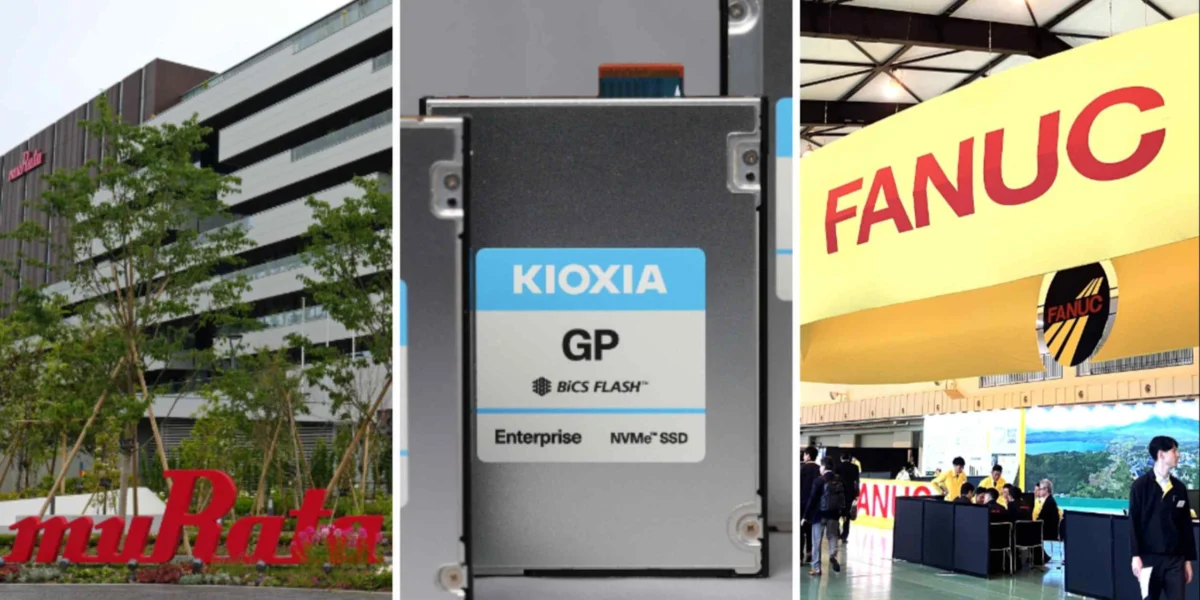
TOKYO — Japanese companies across various sectors have announced a significant upswing in their earnings for the April-June quarter of 2026, a performance primarily propelled by the sustained global appetite for artificial intelligence (AI) technologies and a beneficial tailwind from a persistently weak yen. The latest financial reports reveal a robust trend, indicating a broader economic resilience and a strategic advantage for key Japanese manufacturers in high-demand global markets.
AI Revolution Fuels Corporate Profits
The artificial intelligence sector, a rapidly evolving landscape of technological innovation, has emerged as a pivotal growth engine for a multitude of Japanese enterprises. Companies such as Murata Manufacturing, a leading producer of electronic components, Kioxia Holdings, a prominent memory solutions provider, and Fanuc, a global leader in robotics and automation, have all reported substantial contributions to their bottom lines directly attributable to AI-related demand.
Murata Manufacturing, renowned for its ceramic capacitors, filters, and other essential electronic components, has witnessed a surge in orders for high-performance parts crucial for the development and deployment of AI hardware. These components are indispensable for the complex circuitry found in AI servers, advanced graphics processing units (GPUs), and other specialized AI infrastructure. Analysts suggest that Murata’s diversified product portfolio, which serves a wide array of electronic applications, has allowed it to capitalize on the broad-based expansion of AI adoption across industries, from cloud computing and data analytics to autonomous systems and advanced robotics.
Kioxia Holdings, formerly Toshiba Memory, plays a critical role in the AI ecosystem through its advanced semiconductor memory products, including NAND flash memory. The insatiable demand for data storage and high-speed access, fundamental to the training and operation of sophisticated AI models, has directly translated into increased sales and profitability for Kioxia. The company’s investments in next-generation memory technologies, designed to meet the escalating performance requirements of AI applications, appear to be yielding significant returns. Reports indicate that Kioxia’s contributions to AI-driven data centers and edge computing devices have been particularly strong.
Fanuc, a titan in industrial automation, is experiencing heightened demand for its intelligent robots and factory automation solutions, which are increasingly integrated with AI capabilities. As businesses globally seek to enhance efficiency, productivity, and precision in manufacturing and logistics through AI-powered automation, Fanuc’s advanced robotic systems, equipped with machine learning and computer vision technologies, have become highly sought after. The company’s ability to provide integrated solutions that optimize production lines and enable smarter factory operations positions it favorably within the AI-driven industrial transformation.
The Enduring Impact of a Weak Yen
Complementing the AI-driven growth, the persistent weakness of the Japanese yen has provided a significant boost to the earnings of export-oriented companies. A depreciated yen makes Japanese goods and services more competitive in international markets, as the cost for foreign buyers decreases. For companies that generate a substantial portion of their revenue from overseas sales, a weaker yen translates into higher reported profits when those foreign earnings are converted back into Japanese currency.
This macroeconomic factor has amplified the positive impact of strong demand for AI-related products. Even if revenue in dollar or euro terms remained stable, the conversion rate to yen would automatically increase the reported yen-denominated earnings. This phenomenon has provided a broad-based benefit across Japan’s export-heavy industrial sectors, including electronics, automotive, and machinery manufacturing.
Timeline of Evolving Trends
The current financial quarter’s performance is not an isolated event but rather a culmination of several years of strategic investment and market evolution.
- Early 2020s: The initial surge in AI research and development, coupled with the widespread adoption of cloud computing, began to lay the groundwork for increased demand in specialized hardware. Companies like Murata and Kioxia started to see a gradual uptick in orders for components supporting these nascent AI applications.
- Mid-2020s: The acceleration of AI model development, particularly with the advent of large language models (LLMs) and generative AI, dramatically increased the need for massive data processing and storage capabilities. This period saw a pronounced rise in demand for high-performance memory and advanced semiconductor components. Fanuc also began to integrate more sophisticated AI into its robotic systems, responding to industry calls for smarter automation.
- 2025-2026: The AI sector matured into a significant revenue driver. Global investments in AI infrastructure, including data centers and specialized hardware, reached unprecedented levels. Simultaneously, currency markets saw a sustained period of yen depreciation against major currencies like the US dollar and the Euro, creating a dual advantage for Japanese exporters. The April-June 2026 quarter has now demonstrated the potent combination of these two powerful trends.
Supporting Data and Market Insights
While specific earnings figures are proprietary until officially released, industry analysts have been tracking key indicators that foreshadow this positive trend. For instance, global semiconductor sales have shown consistent year-on-year growth, with a significant portion attributed to AI-specific chips and related components. Market research firms have reported an average growth rate of over 15% in the AI hardware market during the past two years, a trend that is expected to continue.
The automotive sector, another major contributor to Japan’s economy, has also seen its own AI-related investments, particularly in autonomous driving systems and advanced driver-assistance systems (ADAS). While not explicitly detailed in the initial report, companies like Toyota and its component suppliers, many of whom rely on the same electronic component manufacturers as the AI sector, are indirectly benefiting from the technological advancements driven by AI research.
Furthermore, trade data from Japan’s Ministry of Economy, Trade and Industry (METI) consistently highlights the strong performance of electrical machinery exports, a category that encompasses semiconductors, electronic parts, and industrial robots. The trend of increasing export values in these categories, even when adjusted for price fluctuations, suggests a genuine increase in demand.
Reactions and Strategic Implications
Industry observers anticipate that the strong earnings reported by these key players will reinforce investor confidence in the Japanese technology sector. The ability of these companies to not only adapt but to lead in a transformative technology like AI, while also benefiting from favorable currency conditions, paints a picture of strategic agility and robust competitive positioning.
A spokesperson for Murata Manufacturing, speaking on condition of anonymity due to the embargo on detailed financial disclosures, indicated that the company is "pleased with the strong demand for our high-quality electronic components, which are critical for the advancement of AI technologies globally. We remain committed to innovation and expanding our production capacity to meet this growing market need."
Similarly, representatives from Kioxia Holdings have previously emphasized their focus on developing cutting-edge memory solutions that cater to the evolving demands of data-intensive applications, including AI. Their strategic partnerships and ongoing research into advanced semiconductor technologies are seen as crucial for sustained growth.
Fanuc, in its forward-looking statements, has consistently highlighted the increasing integration of AI and IoT (Internet of Things) into its industrial robots and automation systems, aiming to create "smart factories" that are more efficient and adaptable. The current earnings surge validates this strategic direction.
Broader Economic Impact and Future Outlook
The implications of this earnings season extend beyond the individual companies involved. A strong performance from leading industrial firms can have a ripple effect throughout the Japanese economy, stimulating domestic investment, potentially leading to job creation, and bolstering the nation’s export competitiveness.
The sustained weakness of the yen, however, also presents a dual-edged sword. While beneficial for exporters, it can lead to higher import costs for raw materials and consumer goods, potentially contributing to inflationary pressures. The Bank of Japan’s monetary policy decisions will be closely watched for any shifts aimed at managing these macroeconomic dynamics.
Looking ahead, the outlook for Japanese companies deeply embedded in the AI ecosystem appears promising. The global AI market is projected for continued exponential growth, driven by advancements in machine learning, natural language processing, and computer vision. Companies that can consistently deliver the foundational components, memory solutions, and intelligent automation systems required for this expansion are well-positioned for sustained profitability.
The success of companies like Murata Manufacturing, Kioxia Holdings, and Fanuc serves as a testament to Japan’s enduring strengths in manufacturing, technological innovation, and its ability to adapt to rapidly evolving global economic landscapes. The synergy between the AI revolution and favorable currency conditions has created a potent environment for growth, with these companies at the forefront of this exciting new era. The challenge for these enterprises will be to maintain their innovative edge and adapt to the accelerating pace of technological change to secure long-term prosperity in the global AI race.
