

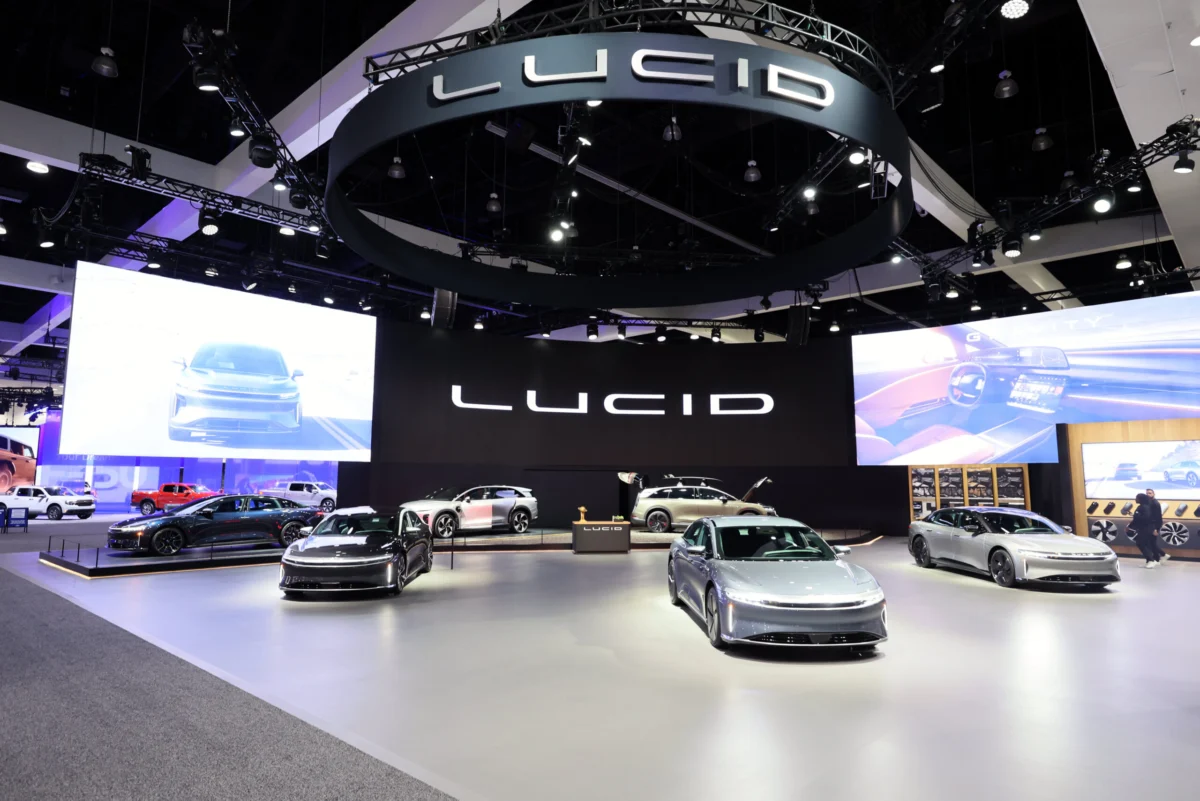
Lucid Group, the luxury electric vehicle manufacturer, reported financial results for its second fiscal quarter that fell significantly short of Wall Street’s expectations, prompting the company to announce a comprehensive "operational reset." This strategic overhaul, spearheaded by newly appointed CEO Silvio Napoli, involves substantial leadership changes, aggressive cost-cutting initiatives, and a significant recalibration of its product development timeline, including the delay of its highly anticipated midsize vehicle and a sharpened focus on robotaxi production. Following the announcement, shares of Lucid experienced a notable decline of approximately 8% in after-hours trading, reflecting investor apprehension regarding the revised outlook and extended timelines.
The company’s second-quarter performance underscored the challenges faced by EV startups in a rapidly evolving and increasingly competitive market. Lucid reported a net loss exceeding $1 billion for the quarter, a substantial increase from the $539.4 million loss recorded in the same period last year. On an adjusted basis, the loss amounted to $901.1 million, or $3.30 per share, compared to an adjusted loss of $632.1 million, or $2.80 per share, a year prior. These figures starkly contrasted with average estimates compiled by LSEG, highlighting the growing financial pressures on the company. Despite the widening losses, production figures showed a modest increase, with 4,774 vehicles manufactured, up 24% year-over-year, and deliveries rising by 19% to 3,953 vehicles during the second quarter. The company’s current offerings include the Lucid Air sedan and the recently unveiled Gravity SUV, with starting prices around $70,000 and $80,000, respectively.
A Sweeping "Transformation Program" Unveiled
At the core of Lucid’s strategic shift is a newly articulated "operational reset," or "transformation program," designed to fortify the company’s financial position and streamline its development roadmap. CEO Silvio Napoli, who assumed the top leadership role in June, emphasized the necessity of this comprehensive reevaluation, stating, "We’re not going to make the mistake of the past where products, great cars, were in fact tainted by launching before things were ready." This statement alludes to previous production challenges and market reception issues that have plagued some EV newcomers, including Lucid, in their early stages.
The transformation program is structured around three foundational pillars: "cash and cost," "customer and quality," and "culture and team." These areas represent a holistic approach to address both immediate financial concerns and long-term operational efficiency. Crucially, the company has identified approximately $1.4 billion in potential cash flow improvement opportunities for the current year. This substantial target is broken down into several key areas: between $600 million and $800 million from optimizing vehicle inventory management, $500 million from a reduction in capital expenditures, and $200 million from operating expense efficiencies. These measures reflect a clear mandate to conserve capital and achieve greater financial discipline as Lucid navigates its growth trajectory.
As part of the cost-cutting measures, Lucid had already initiated significant changes prior to the earnings announcement. In June, the company reduced production at its U.S. manufacturing facility in Arizona, scaling back from a two-shift operation to a single shift. This decision was a direct response to a broader reevaluation of Lucid’s business operations and market demand, and it preceded Napoli’s formal suspension of updated 2026 production guidance, which he had announced shortly after taking the helm. Napoli underscored that the company is "not ready" to provide new guidance, emphasizing the need for solid data and a conservative approach to investor expectations. "I want it to be anchored in solid data, and most of all, I want a guidance that I’m confident Lucid will be able to deliver on and possibly even do better than that," he explained. "This takes time. I wanted to make sure that we align the reality with consensus, which is today based on outdated business model." He did, however, indicate that second-half production is expected to be lower than Wall Street’s consensus and the first half of the year, while deliveries are projected to be higher than the first half.
Product Strategy: Midsize Vehicle Delayed, Robotaxis Accelerated
Perhaps one of the most significant announcements affecting Lucid’s future product portfolio was the delay of its upcoming midsize vehicle. Originally anticipated to launch by the end of this year, the introduction of this crucial model has now been pushed back to "most likely" the second half of 2027. This postponement, while potentially disappointing to some investors eager for a more accessible Lucid offering, aligns with Napoli’s stated commitment to quality and readiness over speed. The midsize segment is vital for broader market penetration and scaling production volumes, making its delay a strategic but impactful decision.
Conversely, the company is significantly accelerating its robotaxi program, designating it a "top priority." This initiative, which involves partnerships with ride-sharing giant Uber and autonomous delivery company Nuro, is set to see non-prototype robotaxi production commence early next year. Napoli revealed that the company expects to deliver approximately 100 preproduction robotaxi vehicles, based on the Lucid Gravity SUV platform rather than the delayed midsize vehicle, to its partners by the end of the current year. This shift underscores Lucid’s belief in the burgeoning autonomous mobility sector. "The robotaxi opportunity is huge, and it’s an industry that is about to start an exponential growth," Napoli told CNBC, highlighting Lucid’s positioning as a "software-defined vehicle company" as a key advantage. This strategic pivot suggests a potential diversification of revenue streams and a leveraging of Lucid’s advanced electric vehicle architecture and software capabilities beyond direct consumer sales.
Leadership Transition and Investor Reassurance
Silvio Napoli officially took over as CEO in June, succeeding interim CEO Marc Winterhoff. Napoli, who previously led an escalator and elevator manufacturer, has quickly moved to reshape Lucid’s executive team and strategic direction. His appointment and the subsequent "operational reset" signal a decisive shift in management philosophy, prioritizing sustainable growth and financial prudence over aggressive, potentially unsustainable expansion targets.
The company’s financial stability and long-term viability have been a point of scrutiny, particularly after an online report in July circulated rumors about Lucid considering bankruptcy or going private. The report led to a sharp drop in Lucid’s stock price, though it subsequently recovered some losses. Napoli vehemently denied these claims, both at the time of the report and again during the recent earnings call. "I wholeheartedly reinforce the denial," he stated emphatically. "We are here to stay. We are here. We have a plan. We have a board and a majority investor that will help us to go through what is admittedly a moment where we are doing many things at the same time."
This reassurance is bolstered by the continued strong backing of Saudi Arabia’s Public Investment Fund (PIF), which remains Lucid’s largest shareholder. The PIF’s investment has been crucial for Lucid’s funding, including its plans for a new factory in Saudi Arabia, which is currently under construction. With $3 billion in total liquidity at the end of the second quarter, Lucid stated that its current financials, combined with the actions taken under the transformation program, are "expected to provide sufficient liquidity runway well into 2027." Turqi Alnowaiser, Lucid Chairman, publicly affirmed the board’s confidence: "Silvio and his leadership team are transforming the company, and the Board stands firmly behind their actions." This institutional support is a critical factor in dispelling market anxieties and providing a foundation for the company’s ambitious restructuring efforts.
Broader Market Context and Implications
Lucid’s challenges and strategic adjustments are not occurring in isolation but within a broader context of a maturing and increasingly competitive electric vehicle market. While global EV adoption continues to grow, many startups are grappling with the complexities of scaling production, managing supply chains, and achieving profitability. Companies like Rivian and Tesla, while more established, have also faced their own sets of challenges related to production ramp-ups, cost control, and market demand fluctuations. Lucid, positioned in the luxury segment, faces the added task of justifying premium price points against established luxury brands and increasingly sophisticated mainstream EVs.
The delay of the midsize vehicle carries significant implications. This segment is often seen as the gateway to higher volume sales and broader market acceptance, critical for an EV manufacturer to transition from a niche player to a mainstream competitor. Pushing this launch back by several years means Lucid will forgo potential market share and revenue in a crucial period, while competitors continue to innovate and expand their offerings. However, the company’s leadership believes that a meticulously developed and flawlessly executed product launch will ultimately serve its long-term interests better than a rushed introduction.
Conversely, the accelerated focus on robotaxi production represents a calculated bet on the future of autonomous mobility. By leveraging its existing Gravity SUV platform for these initial vehicles, Lucid can potentially enter the commercial autonomous vehicle market sooner, diversifying its business model and tapping into a potentially lucrative new revenue stream. This strategy could position Lucid as a key technology provider in the autonomous space, rather than solely a consumer vehicle manufacturer. The success of this pivot will depend heavily on the rapid development and deployment of robust autonomous driving technology and the cultivation of strong partnerships within the mobility sector.
In summary, Lucid Group is at a critical juncture. The second-quarter results and the subsequent "operational reset" mark a decisive turning point for the company. Under new leadership, Lucid is committing to a disciplined, long-term strategy, prioritizing financial health, product quality, and strategic diversification into autonomous services. While the path ahead involves significant challenges, including extended product timelines and intense market competition, the strong backing of its major investor and a renewed focus on operational excellence offer a potential roadmap for Lucid to navigate these turbulent waters and solidify its position in the global electric vehicle landscape. Investors will be closely watching for tangible signs of progress on the cost-cutting initiatives and the development of both its core consumer vehicles and its ambitious robotaxi program in the coming quarters.
