

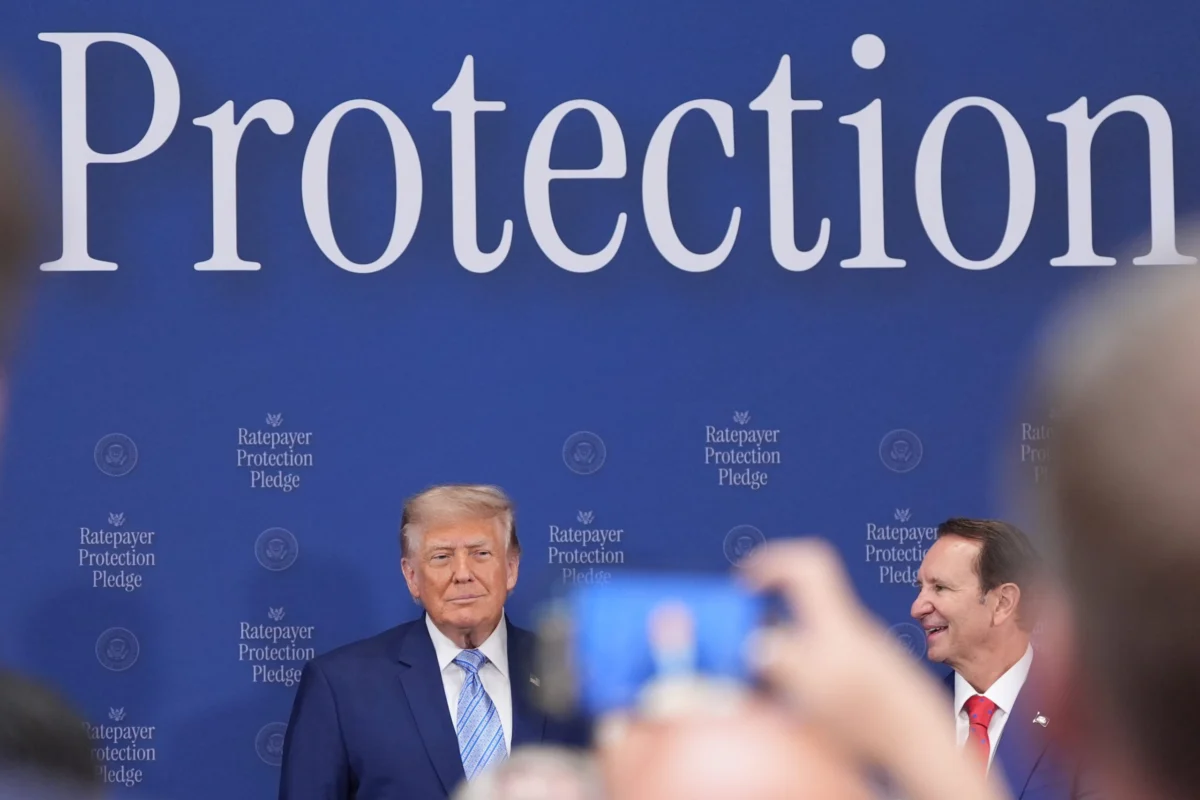
President Donald Trump convened a high-level summit at the Environmental Protection Agency on Thursday, securing a voluntary commitment from a coalition of governors and utility executives to shield American households from the escalating costs associated with the artificial intelligence infrastructure boom. The expansion of the "Ratepayer Protection Pledge" represents a strategic effort by the administration to address mounting public anxiety over utility affordability as the nation undergoes a rapid industrial transformation driven by data center construction.
Standing alongside Louisiana Governor Jeff Landry and other key political allies, the president characterized the massive influx of data center investment as an economic windfall that must not come at the expense of the average consumer. The event serves as a pivotal moment in the administration’s domestic policy, coming just months before the midterm elections, where the rising cost of living and the social implications of AI have become central campaign themes.
The pledge, which was initially launched in March with a select group of Silicon Valley technology firms, has now grown to include 23 governors and at least 187 corporate entities. This expansion reflects the growing realization that the physical requirements of AI—massive amounts of electricity, water, and land—are beginning to collide with the daily lives of citizens in both urban hubs and rural communities.
The Evolution of the Ratepayer Protection Pledge
The "Ratepayer Protection Pledge" originated as a nonbinding agreement intended to ensure that the multi-billion-dollar build-out of server warehouses would be financed by the technology companies themselves rather than through increases in residential electricity rates. In its initial phase, the pledge was signed by industry titans including Google, Microsoft, Meta, Oracle, xAI, OpenAI, and Amazon. These companies committed to exploring self-generation of power and funding necessary grid upgrades.
However, as data center projects began to proliferate across states like Texas, Virginia, and Ohio, the voluntary nature of the agreement drew skepticism from consumer advocacy groups and local lawmakers. Thursday’s expansion to include 55 utilities and 27 data center developers aims to create a more comprehensive framework for accountability. Notable new signatories include some of the nation’s largest power providers, such as NextEra Energy, Duke Energy, American Electric Power, Southern Co., and Pacific Gas & Electric.
During his remarks at the EPA, President Trump urged the gathered executives and state leaders to become ambassadors for the technology, framing data centers as the engines of future municipal wealth. "You have to convince your community," the president stated. "You can’t fight it. You have to go with it. If you don’t take all that money, somebody else is going to take it. You might as well do it yourselves."
The administration’s rhetoric suggests a dual-track strategy: aggressively promoting the U.S. as the global leader in AI to counter Chinese technological expansion, while simultaneously attempting to neutralize the political liability of rising energy costs.
Chronology of the AI Energy Crisis
The current tension over power resources traces back to the late 2022 release of generative AI tools, which triggered an unprecedented global demand for specialized computer chips. By early 2024, the scale of the energy required to train and run these large language models became clear to grid operators.
In 2025, several major utilities began revising their five-year load forecasts upward by double digits, citing data center applications. By early 2026, the White House recognized that the "AI arms race" was outstripping the capacity of the U.S. electrical grid to adapt. In March 2026, the first iteration of the Ratepayer Protection Pledge was announced.
The months following the initial pledge saw a surge in local opposition. In May 2026, Florida Governor Ron DeSantis signed legislation prohibiting utilities from passing on data center-related costs to residential customers. In June 2026, New York Governor Kathy Hochul issued a one-year moratorium on large-scale server warehouse construction to allow for a state-wide impact study. These state-level actions set the stage for Thursday’s federal intervention, as the Trump administration sought to create a unified national approach to the problem.
Analyzing the Economic and Infrastructure Data
The scale of the challenge is underscored by recent independent economic analyses. A report by ICF, a global consulting and technology services firm, suggests that the surge in electricity demand from data centers could drive monthly utility bills for American families up by 15% to 40% by the year 2030 if infrastructure costs are not properly allocated.
Data centers are uniquely energy-intensive. A single large-scale facility can consume as much electricity as a small city. Furthermore, the cooling requirements of these servers often demand millions of gallons of water daily, raising concerns about local aquifers in drought-prone regions.

The White House has expressed specific frustration with regional grid operators, particularly PJM Interconnection, which manages the power supply for 13 states and the District of Columbia. White House spokeswoman Taylor Rogers noted on Thursday that PJM has struggled to implement a "Statement of Principles" signed by the administration and regional governors intended to streamline the integration of new power sources.
"The Trump administration strongly advises PJM and its member companies to proactively reform its stakeholder process, reform its board governance, and implement the Statement of Principles before it is too late," Rogers said. The administration’s critique highlights a bottleneck in the American energy system: the slow pace of permitting for new transmission lines and the backlog of new power plants waiting to connect to the grid.
Bipartisan Friction and State-Level Pushback
While the president’s pledge is framed as a solution, it has not silenced critics across the political spectrum. In Texas, the rapid expansion of data centers in rural areas has become a flashpoint in the upcoming gubernatorial race. Democratic nominee Gina Hinojosa has targeted incumbent Governor Greg Abbott—a signatory of the pledge—over the lack of enforceable regulations.
"They are owned by the richest men in the world," Hinojosa said of the data center developers. "We’re all footing the bill. There are no rules. It is the Wild West of data centers." This sentiment is echoed by some conservative voters in rural districts who fear that the industrialization of their landscapes will lead to higher taxes and diminished property values.
In California, the Utility Reform Network (TURN) has expressed disappointment that tech companies are participating in national voluntary pledges while simultaneously lobbying against state-level mandates. Matthew Freedman, a staff attorney for TURN, argued that the industry’s opposition to binding legislation suggests the voluntary pledge may lack teeth. "It is perhaps not surprising that the same tech companies signing the Ratepayer Protection Pledge are simultaneously opposing efforts at the state level to force them to deliver on their promises," Freedman noted.
National Security and Global Competition
The administration views the data center build-out not merely as a commercial venture but as a cornerstone of national security. During an interview last month, Nvidia CEO Jensen Huang emphasized that the primary constraint on American AI leadership is no longer chip architecture, but the availability of power generation.
The White House argues that if the U.S. slows its infrastructure development due to local opposition or high costs, it risks ceding the technological "high ground" to China. The Chinese government has integrated its AI development with state-controlled energy planning, allowing for rapid deployment of massive compute clusters.
President Trump’s strategy involves encouraging data centers to develop their own "behind-the-meter" power sources, such as small modular nuclear reactors (SMRs) or dedicated natural gas plants. The president claimed on Thursday that this would eventually lead to a "surplus" of power. "They’re going to have a lot of electricity left over, and they’ll put that into the grid," Trump told the audience. "Electricity bills for American families will actually come down."
However, energy experts remain cautious. The timeline for bringing new nuclear or gas-fired generation online often spans several years, while data center demand is increasing almost monthly. There is a significant risk that the "surplus" the president envisions may not materialize until well after the initial price shocks hit consumers.
Legislative Outlook and Formalization
While the current pledge is voluntary, there are concurrent efforts in Congress to codify these protections into federal law. The House Energy and Commerce Committee recently approved a bipartisan bill that would require data center operators to bear the full cost of grid upgrades and new transmission lines required for their operations.
The bill aims to transition the principles of the Ratepayer Protection Pledge from a "handshake agreement" into a regulatory requirement. Proponents of the legislation argue that without a legal mandate, the pressure of quarterly earnings will eventually force utilities to seek rate increases from their captive residential customer bases.
As the midterm elections approach, the success of the Ratepayer Protection Pledge will likely be measured by whether utility commissions across the country begin to approve or deny rate hikes linked to industrial load growth. For the Trump administration, the goal is to prove that the "AI Revolution" can be a tide that lifts all boats, rather than a wave that washes away the financial stability of the American middle class.
The meeting at the EPA concluded with a call to action for the private sector to innovate not just in software, but in energy efficiency and infrastructure financing. Whether the voluntary commitments of 187 companies and 23 governors can withstand the immense economic pressure of the AI era remains the defining question of the current industrial cycle.
