

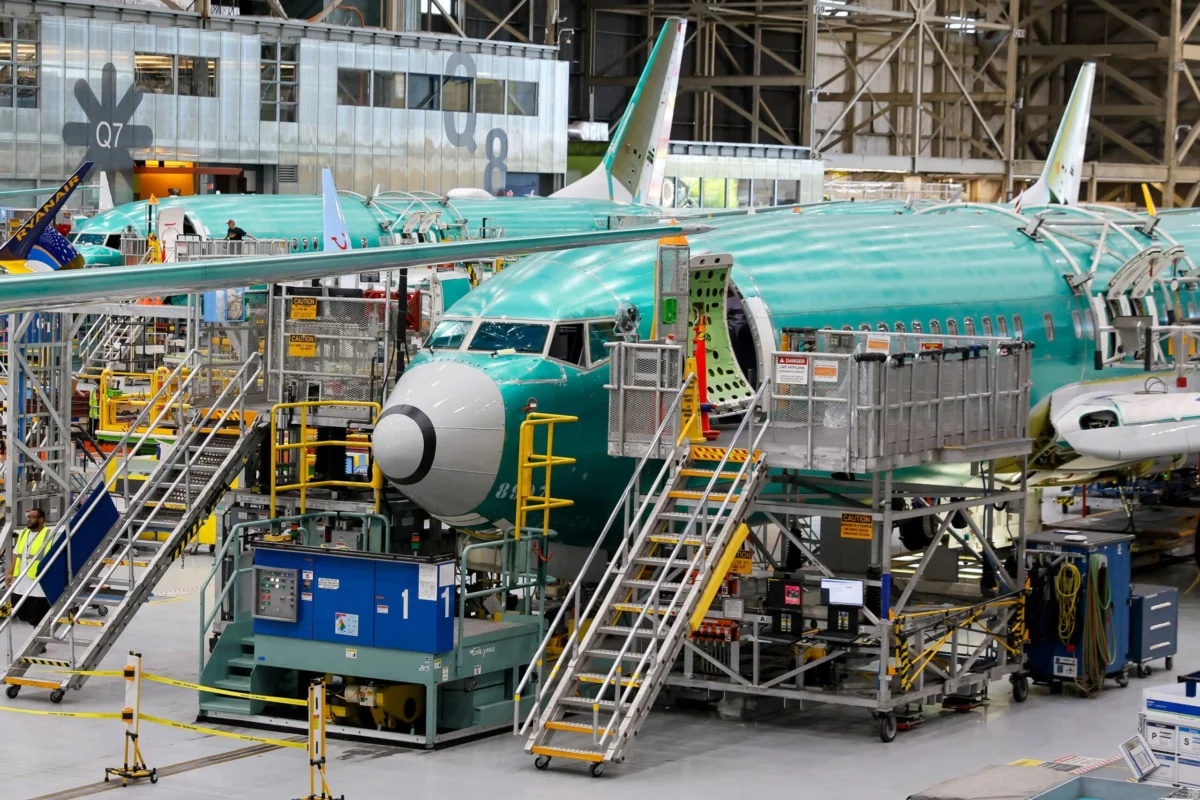
Boeing Co. reported a wider-than-expected net loss for the second quarter, primarily attributed to substantial cost overruns and delays in its highly scrutinized Air Force One program, even as the aerospace giant demonstrated robust revenue growth and a significant uptick in commercial aircraft deliveries. The financial results highlight the ongoing challenges of managing complex, high-stakes government contracts alongside efforts to ramp up production and certify new aircraft models in a demanding global market.
For the second quarter, Boeing announced a net loss of $428 million, translating to 67 cents per share, which widened from a net loss of $612 million, or 92 cents per share, in the same period a year prior. Adjusting for one-time items, the company reported a loss of 76 cents per share. These figures came in below Wall Street analyst expectations, as surveyed by LSEG, which had anticipated a narrower loss. However, a silver lining emerged in the form of free cash flow, which registered a positive $631 million, far exceeding analysts’ projections of a $177 million cash burn and marking a significant improvement from a $200 million burn in the second quarter of the previous year. This strong cash performance provided a crucial positive signal to investors, suggesting underlying operational improvements despite the headline loss.
The Air Force One Program: A Costly Burden
A significant factor contributing to the quarterly loss was a $280 million charge taken on the program to deliver two highly customized 747-8 aircraft, designated VC-25B, that will serve as the next generation of Air Force One for the U.S. government. This latest charge underscores the persistent financial strain associated with this bespoke contract. The program, initiated under a fixed-price contract inked during the Trump administration, has been a recurring source of financial difficulty for Boeing. Fixed-price contracts transfer much of the financial risk of cost overruns from the client to the contractor, a structure that has proven particularly challenging for Boeing given the unprecedented customization and stringent security requirements of the presidential aircraft.
The original agreement, valued at approximately $3.9 billion, committed Boeing to design, build, and deliver the two aircraft, which are essentially flying command centers. Delays have plagued the program for years, stemming from a confluence of factors including design complexities, supply chain disruptions, labor issues, and the sheer scale of integrating cutting-edge technology into an existing airframe. The company reiterated its expectation for the first delivery in 2028, a timeline that has been pushed back multiple times from initial targets. Each delay and technical hurdle necessitates further investment and incurs additional costs, directly impacting Boeing’s profitability. The company has explicitly stated it is ramping up investment for this particular plane, indicating a concerted effort to accelerate progress, albeit at a higher cost.
Commercial Aircraft Sector Shows Resilience
Despite the setbacks in its defense and government services segment, Boeing’s commercial aircraft division demonstrated notable resilience and growth. The aircraft manufacturer, a leading U.S. exporter, saw its total revenue increase by 8% in the second quarter to $24.56 billion from a year earlier. This growth was fueled by gains across all its businesses, most prominently driven by increased deliveries of commercial aircraft.
The company delivered 171 commercial planes in the second quarter, marking a 14% increase from the 150 planes delivered in the same period last year. This uptick reflects a broader recovery in air travel demand and a concerted effort by Boeing to accelerate its production rates, particularly for its bestselling 737 Max family. Boeing has been actively ramping up production of the 737 Max to 47 aircraft per month, with further increases planned for the coming quarters. This steady increase in output is crucial for Boeing to meet the substantial backlog of orders and to regain market share in the fiercely competitive single-aisle aircraft segment. The 737 Max remains a cornerstone of Boeing’s commercial strategy, and its successful production ramp-up is vital for the company’s long-term financial health and market positioning against its European rival, Airbus.
Leadership’s Perspective and Future Outlook
In a note to staff, Boeing CEO Kelly Ortberg acknowledged the ongoing challenges while emphasizing the importance of continued focus and execution. "While we’re making progress on our development programs, you’re never done until you’re done," Ortberg stated, underscoring the demanding nature of aerospace development and certification. His comments reflect a cautious optimism, recognizing the arduous path ahead while highlighting the strides made.
Looking ahead, Ortberg expressed confidence in the company’s ability to improve its performance in the latter half of the year. "While two quarters don’t make a year, if we work together and stay focused on safety, quality and on-time performance – we’ll improve our competitiveness and set ourselves up for a big second half," he added. This statement signals a strategic emphasis on fundamental operational excellence—safety, quality, and delivery—which are critical for rebuilding trust with customers and regulators following a tumultuous period for the company. The focus on these core tenets is paramount as Boeing strives to navigate complex certification processes and supply chain constraints that continue to affect the global aerospace industry.
Critical Certification Milestones Loom
A significant portion of Boeing’s future hinges on the successful certification of several delayed aircraft programs. The nearest milestone is expected to be the certification of the Boeing 737 Max 7, the smallest variant in the Max family. This certification is crucial not only for expanding the Max product line but also for demonstrating Boeing’s ability to navigate increasingly stringent regulatory reviews.
Beyond the Max 7, executives are bracing for intense scrutiny during their upcoming call with analysts, where questions are expected to center on the certification timelines for the 737 Max 10 and the 777X, Boeing’s new wide-body aircraft. The 737 Max 10, the largest variant of the Max, and the 777X, a next-generation twin-engine widebody, have both faced significant delays. These programs have been particularly impacted by enhanced regulatory oversight following the two fatal 737 Max crashes in 2018 and 2019, which led to a worldwide grounding of the fleet and a complete overhaul of certification procedures by the Federal Aviation Administration (FAA) and other global aviation authorities.
The certification process for new aircraft models has become significantly more complex and time-consuming. Regulators are demanding extensive data, analysis, and often additional design changes to ensure compliance with the highest safety standards. The delays in certifying the Max 10 and 777X have not only pushed back delivery schedules but have also created uncertainty for airline customers who have placed significant orders for these aircraft, affecting their fleet planning and expansion strategies. The successful and timely certification of these models is paramount for Boeing to maintain its competitive edge against Airbus, fulfill its backlog, and restore investor and customer confidence in its product development capabilities.
Broader Industry Context and Challenges
Boeing’s performance is set against a backdrop of a global aerospace industry that is still recovering from the profound disruptions of the COVID-19 pandemic and grappling with persistent supply chain challenges. While passenger demand has largely rebounded, particularly in domestic and short-haul international markets, manufacturers continue to face hurdles in sourcing components, managing labor availability, and navigating geopolitical uncertainties. Both Boeing and Airbus have had to adjust their production forecasts multiple times due to these external pressures.
Moreover, Boeing specifically has been under immense pressure to improve its quality control and manufacturing processes. Following several high-profile incidents and revelations of manufacturing flaws, including foreign object debris (FOD) issues and misdrilled holes, the company has committed to a comprehensive overhaul of its quality management systems. This renewed focus on manufacturing integrity is essential but also adds layers of complexity and cost to its production efforts.
The Air Force One program’s troubles, in particular, highlight the inherent risks of defense contracting, where specialized requirements, often classified technologies, and evolving governmental demands can lead to unforeseen technical challenges and cost escalation. Unlike commercial aircraft, which benefit from economies of scale and standardized production, bespoke defense projects often involve unique engineering solutions that are difficult to predict and budget for.
Strategic Implications and Path Forward
Boeing’s second-quarter results present a mixed picture. The wider net loss due to the Air Force One program is a clear negative, reinforcing concerns about program management and the risks associated with fixed-price government contracts. However, the strong performance in commercial aircraft deliveries and, critically, the positive free cash flow, offer a counter-narrative of operational improvement and demand recovery. Positive cash flow is vital for Boeing as it allows the company to invest in research and development, pay down debt, and potentially return capital to shareholders in the future.
The path forward for Boeing involves a delicate balancing act: accelerating production of existing successful models like the 737 Max, diligently pursuing certification for delayed new programs, and meticulously managing its complex defense portfolio. The company’s ability to successfully navigate the certification hurdles for the 737 Max 10 and 777X will be a critical determinant of its market position and financial trajectory over the next few years. Simultaneously, demonstrating a consistent commitment to safety and quality across all its operations will be paramount for rebuilding its brand reputation and securing its long-term future in the fiercely competitive global aerospace market. The upcoming analyst call will undoubtedly provide further insights into how Boeing plans to tackle these multifaceted challenges and capitalize on the growing demand for new aircraft.
