

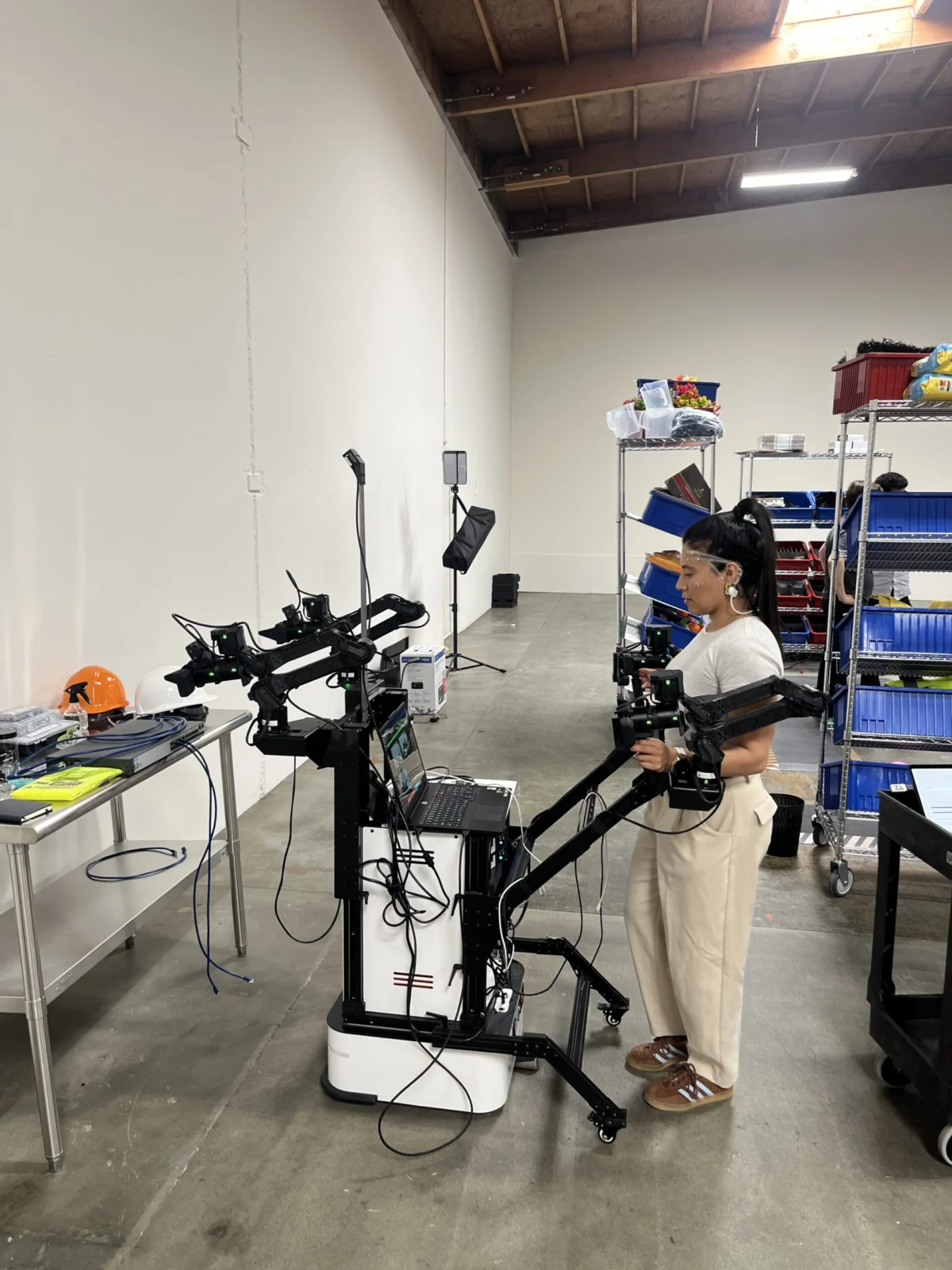
The burgeoning field of physical AI, poised to revolutionize industries from logistics to personal assistance, currently faces a profound bottleneck: the sheer scarcity of high-fidelity, real-world training data. While large language models (LLMs) have demonstrated astonishing capabilities, fueled by the vast repositories of internet text, their physical counterparts are grappling with a fundamental challenge – the physical world cannot be scraped like the digital one. This critical juncture finds its starkest illustration not in a gleaming research lab, but in a utilitarian warehouse in San Leandro, California, where the future of embodied intelligence is being built, block by painstakingly collected block, by a company named Encord.
The Genesis of a New Industry: From Annotation to Creation
Encord, initially established to provide robust data tooling for annotating machine-vision applications and evaluating AI models, found its mission evolving rapidly as its customers, many of whom are leading robotics firms, ventured into end-to-end learning for complex robotic manipulation tasks. The critical realization, articulated by Vineeth Velmurugan, Encord’s head of robot learning and a veteran of OpenAI’s robot lab and warehouse automation firm Berkshire Grey, was unequivocal: "The data simply does not exist." This stark reality necessitated a strategic pivot, transforming Encord from a data management facilitator into a proactive data manufacturer.
The chasm between the digital and physical realms for AI training data is immense. LLMs thrived on an unprecedented scale of textual information, enabling them to grasp linguistic nuances and generate coherent responses. For robots, however, learning to interact with the messy, unpredictable physical world requires an analogous, yet far more complex, data foundation. Self-driving car companies collect vast amounts of proprietary data, but this is an isolated, difficult-to-scale solution. Training from video, while accessible, often lacks the crucial fidelity and depth of real-world interaction necessary for precise manipulation. Velmurugan estimates that breaking through the current limitations of physical AI will require a data set five times the size of YouTube’s entire video corpus – a staggering scale that underscores why data generation, rather than mere collection, has emerged as a distinct and vital business. This shift represents a significant evolution in the AI landscape, moving beyond theoretical model architectures to confront the pragmatic, resource-intensive demands of real-world robot deployment.
Bleeding Edge Modalities: Beyond Vision and Touch
Encord’s San Leandro facility serves as a vibrant laboratory for pioneering new data modalities designed to bridge this gap. Here, "pilots" – Encord’s term for its robotic trainers – engage in intricate tasks, meticulously capturing every nuance of human interaction with objects. Andrew Ceja, one such pilot, demonstrates this by carefully disassembling a Jenga tower. What sets this seemingly common task apart is the sophisticated array of sensors he wears: a headset not only equipped with a camera to track his gaze but also integrated with sensors to measure his brain waves. This partnership with Zander Labs, a German neuroscience startup, represents the "bleeding edge" of this effort.
Zander Labs’ innovative brainwave headsets aim to deduce critical mental states such as error, intent, and surprise during human task execution. Lucas Gehrke, a Zander neuroscientist supervising the work, explains that the intensity and patterns of brain activity at different points in a task can provide invaluable clues for model builders. This allows them to discern when a human is struggling, concentrating intensely, or making a precise decision, information far richer than mere visual input. This initial trial run with Encord is focused on building a brainwave-tagged data set, which will then be fed into customer robotics models. The ultimate goal is to rigorously evaluate whether this neurophysiological data demonstrably improves robot performance before considering a wider scale deployment. This deep dive into human cognitive states is a testament to the belief that understanding the "why" behind human actions is as crucial as observing the "what" for building truly intelligent, adaptable robots.
Beyond brainwaves, Encord is exploring other advanced sensor modalities. Another novel approach involves strapping a set of sensors to the forearm to detect electrical signals in muscles. Traditional video footage of human hands manipulating objects often fails to capture the full dexterity and minute movements of the hand. By leveraging these arm sensors, Velmurugan hopes to construct a precise 3D depiction of the hand’s position and movement at any given moment. This robust understanding of fine motor control, derived from the actual muscular effort, promises to imbue AI models with a far greater capacity for delicate manipulation, overcoming the current limitations of robotic pincers which often lack the degrees of freedom and tactile sensitivity inherent in human fingers.
The Data Foundry: Methods and Mechanisms
Encord employs a dual strategy for data collection, addressing both the broad strokes of human activity and the fine-grained details of specific manipulation tasks. One primary source is "egocentric" video, collected by workers wearing cameras in various factories globally. This provides a wide array of real-world operational contexts, albeit often with lower fidelity for specific actions. The San Leandro facility, conversely, is optimized for generating highly specific and novel data sets. Here, pilots utilize "leader-follower rigs," which are paired robotic arms where one is directly controlled by a human operator, and the other precisely mimics its movements. This setup allows for the creation of meticulously controlled data for tasks demanding high precision, such as pouring coffee from a pot into mugs – a surprisingly complex task involving fluid dynamics and delicate motor control – or stacking poker chips with unwavering accuracy. Velmurugan notes that "Every humanoid company has asked us for these pieces," highlighting the universal demand for data on such foundational manipulation skills.
The warehouse itself is a microcosm of future automated environments, with storage racks brimming with everyday objects: fake flowers in vases, books, plastic vegetables, kitty litter trays and scoops, bags, and bundles of wires. This diverse inventory is the "stock in trade" for training manipulators for a vast array of household and industrial tasks. At one station, pilot Sofia Infante meticulously maneuvers robotic arms to plug and unplug ethernet cables from the back of a server. This is precisely the kind of tedious, repetitive, yet precision-demanding work that data center operators desperately wish to automate. Observing the task firsthand reveals the current limitations: robotic pincers, despite advancements, are still far less dextrous than human fingers, lacking the nuanced control and tactile feedback that humans take for granted. This vivid demonstration underscores the gap that Encord’s data manufacturing aims to close.
Crucial to the value of Encord’s data sets is their rigorous annotation. Each video segment is meticulously tagged with dense, physical descriptions – for instance, "right hand tightens bolt." This semantic richness is paramount for LLM-based models to truly understand the context and purpose of an action, moving beyond mere pixel recognition. Velmurugan estimates that this kind of densely annotated, high-fidelity data is worth a hundred times as much as "junky ego data" for training specific tasks. While it costs approximately twenty times more to produce, this represents an exceptionally favorable trade-off on paper, yielding significantly higher returns on investment in terms of model performance and robustness.
Economic Realities and the Cost of Embodied Intelligence
The economic underpinnings of physical AI training data fundamentally diverge from those of LLMs. The foundational models for LLMs were built by scraping the vast, largely "free" text resources of the internet – forums, wikis, digital libraries. This data acquisition cost frontier labs next to nothing, allowing them to focus resources on model architecture and computational power. In contrast, physical training data cannot be passively collected; it must be actively manufactured. This process involves specialized facilities, advanced sensor arrays, a skilled workforce of "pilots," and extensive post-processing for annotation. This inherent cost structure reshapes the economics of building physical AI models, making data acquisition a significant and ongoing investment rather than a one-time, low-cost endeavor.
The global robotics market is projected to continue its rapid expansion, with industrial robotics alone expected to reach values well over $60 billion by the mid-2020s, and service robotics seeing even more explosive growth. This burgeoning market creates an insatiable demand for robots capable of performing increasingly complex tasks in unstructured environments. Companies like Encord are positioning themselves at the core of this expansion, recognizing that without a scalable, efficient, and high-quality data pipeline, the most advanced robotic hardware and sophisticated model architectures will remain largely theoretical. The transition from research problem to a commercially viable business model for data generation is a clear indicator of the maturity and pressing need within the physical AI sector.
The Human Element: Pilots at the Frontier
The "pilots" at Encord’s facility, such as Andrew Ceja and Sofia Infante, are more than just data collectors; they are an integral part of a burgeoning workforce developing the foundational building blocks for future neural networks. Both Ceja and Infante previously worked at Scale, another prominent AI data annotation firm, before joining Encord, highlighting a career path emerging at the intersection of human dexterity and AI development. These individuals possess a unique blend of patience, precision, and an intuitive understanding of physical interaction, skills critical for translating complex human actions into machine-understandable data.
Andrew Ceja’s journey exemplifies this evolving career landscape. Prior to Encord, he worked at a waste management company, where his interest in technology led him to oversee the maintenance of a robotic trash sorter. This background in practical robotics and problem-solving makes him an ideal candidate for his current role. As he carefully manipulates the Jenga tower, he expresses genuine enjoyment for the challenge, noting, "It’s something new every day!" This enthusiasm reflects a deeper engagement with the problem of teaching robots, transcending mere task execution to become an active participant in shaping the intelligence of future machines. The human element, far from being replaced, is being redefined and integrated at a deeper level into the AI development pipeline, providing the nuanced interaction and intuitive understanding that machines currently lack.
Strategic Advantage and Industry Implications
Encord’s position, situated between numerous leading robotics companies, offers a unique strategic advantage. This vantage point allows Velmurugan and his team to observe and analyze what data techniques and modalities are gaining traction across the industry. They can identify emerging best practices, pinpoint common data deficiencies, and understand the collective needs of the sector before any single customer might. This aggregated intelligence provides Encord with an unparalleled ability to refine its data generation strategies, ensuring that the "manufactured" data is not just voluminous but also precisely tailored to accelerate advancements in physical AI.
The broader implications of this data manufacturing paradigm are substantial. For the robotics industry, it promises to accelerate development cycles, allowing companies to focus on hardware and model innovation while outsourcing the incredibly resource-intensive task of data acquisition. It could also help democratize access to high-quality training data, potentially lowering barriers to entry for smaller firms or research groups. The ability to produce robots capable of performing complex household tasks, industrial assembly, or specialized maintenance like server cable management, hinges directly on the availability of such rich, context-aware data. The ultimate vision is a future where robots can adapt and learn with the same intuitive ease as humans, navigating the complexities of the physical world with dexterity and understanding.
Conclusion: Bridging the Gap to Truly Intelligent Machines
The quest for truly intelligent, physically capable robots is a marathon, not a sprint, and the current bottleneck lies squarely in the realm of data. Encord, operating from its San Leandro warehouse, is at the forefront of tackling this challenge head-on by manufacturing the high-fidelity, multimodal training data that simply does not exist in the wild. Through pioneering partnerships like that with Zander Labs for brainwave integration, and by developing sophisticated methods for capturing human dexterity and intent, Encord is laying the essential groundwork for the next generation of embodied AI.
The distinction between merely collecting data and actively manufacturing it is not just semantic; it represents a fundamental shift in the economic and technological landscape of AI development. As Andrew Ceja carefully pulls blocks from a Jenga tower, augmented by cutting-edge sensors, he embodies the intricate human-machine collaboration required to bridge the gap between digital intelligence and physical mastery. The success of this endeavor will determine the pace at which robots transition from automated tools to genuinely intelligent, adaptable partners, transforming industries and everyday life in profound ways.
