

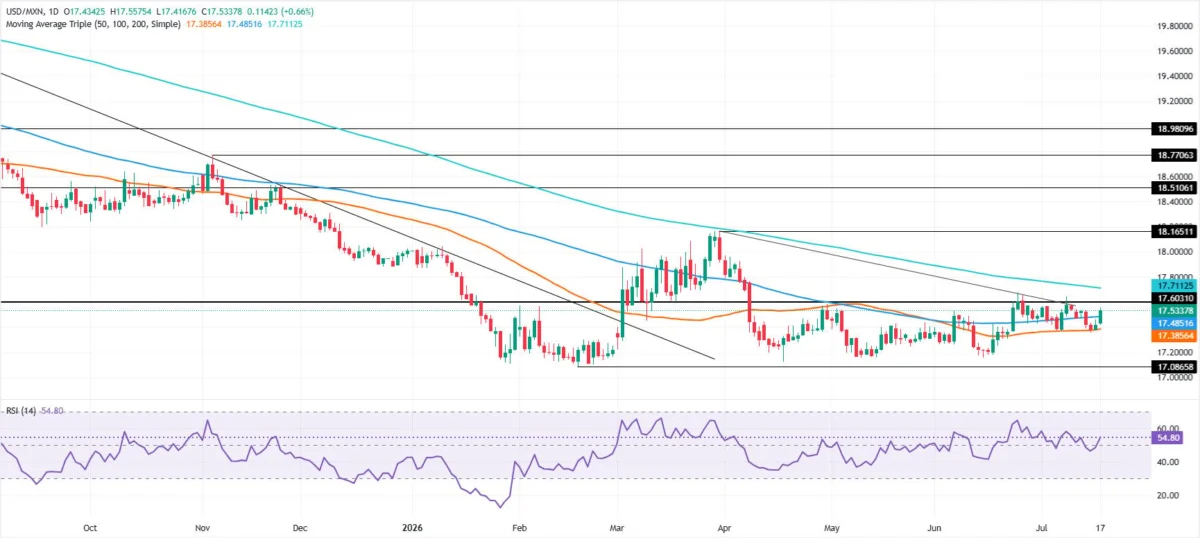
The Mexican Peso experienced a notable loss of momentum against the surging US Dollar during Friday’s North American trading session, depreciating by over 0.65%. This decline saw the USD/MXN pair climb to 17.53, rebounding from an earlier daily low of 17.41. The American currency benefited significantly from its traditional safe-haven appeal, as lingering geopolitical tensions stemming from the US-Iran conflict continued to fuel market uncertainty despite ongoing diplomatic discussions aimed at de-escalation. This shift underscores a broader pivot in investor sentiment, moving away from riskier emerging market assets like the Peso towards the perceived stability of the Dollar.
Geopolitical Undercurrents Drive Safe-Haven Demand for the Dollar
The primary catalyst for the Dollar’s resurgence and the Peso’s weakening on Friday was the persistent US-Iran conflict. While talks have been held to address the strained relationship and avert further military confrontation, a definitive resolution remains elusive, keeping geopolitical risk premiums elevated across global markets. The Strait of Hormuz, a critical chokepoint through which roughly one-fifth of the world’s total oil consumption passes daily, lies at the heart of these tensions. Any perceived threat to shipping or stability in this region invariably triggers a surge in crude oil prices and a flight to safety, with the US Dollar being a primary beneficiary.
Historically, periods of heightened geopolitical instability in key oil-producing regions have invariably led to increased volatility in energy markets and a strengthened demand for safe-haven currencies. Investors, anticipating potential disruptions to global supply chains and economic activity, tend to divest from assets perceived as higher risk, such as emerging market currencies, and reallocate capital into more liquid and stable assets like the US Dollar, US Treasuries, and gold. The current standoff between the US and Iran, particularly concerning maritime security in the Persian Gulf, directly taps into this well-established pattern, creating a challenging environment for currencies like the Mexican Peso that thrive on global stability and risk-on sentiment.
Federal Reserve Policy and Oil Price Dynamics
Adding another layer of complexity to the market dynamics was the intertwined relationship between rising oil prices and the Federal Reserve’s monetary policy outlook. Friday’s market sentiment was further dampened by a significant sell-off in chip stocks, indicating a broader risk aversion across equities. This cautious mood coincided with an increase in global oil prices, which revived speculation that the Federal Reserve might be compelled to pursue further interest rate hikes. Elevated energy costs are a significant component of inflation, and a sustained rise could undermine the Fed’s efforts to bring inflation back down to its 2% target.
Should the Federal Reserve opt for additional rate hikes, it would narrow the interest rate differential between the US and Mexico. This differential has historically been a key supportive factor for the Mexican Peso, particularly during its appreciation cycle that began in early 2025 (or late 2024, depending on the precise start of the cycle), as higher Mexican rates offered an attractive carry trade for investors. A reduction in this differential diminishes the Peso’s allure, making it less attractive for investors seeking higher yields relative to the US.
Earlier in the week, benign US inflation data had initially been cheered by investors, leading to a trimming of the odds for a Fed rate hike at the upcoming September meeting. This brief respite, however, was overshadowed by the re-emergence of geopolitical risks. The prospect of continued skirmishes or escalations between the US and Iran over the Strait of Hormuz has the potential to trigger another substantial leg-up in oil prices. Such a scenario would inevitably reignite concerns about inflationary pressures, putting renewed pressure on the Federal Reserve to maintain a hawkish stance and potentially extend its tightening cycle.
US Economic Indicators and Federal Reserve Commentary
On Friday, the University of Michigan (UoM) released its latest Consumer Sentiment Index for July, providing a snapshot of consumer confidence. The data revealed a slight improvement in optimism among US consumers regarding both current economic conditions and the future outlook. The index increased to 54 from a previous reading of 50.7, indicating a modest uptick in consumer confidence. Furthermore, the report showed an easing of both short-term and medium-term inflation expectations among consumers, which is a positive signal for the Fed in its fight against rising prices. While this domestic data offers some comfort regarding the US economy’s resilience, its impact on the Dollar was nuanced, as the overarching geopolitical concerns took precedence.
The US Dollar Index (DXY), which meticulously tracks the American currency’s performance against a carefully selected basket of six major global peers, registered a modest increase of 0.05% to 100.76. This upward movement provided a significant tailwind for the USD/MXN exotic pair, pushing it higher. The DXY’s resilience underscores the Dollar’s intrinsic strength as the world’s primary reserve currency, often sought out during periods of global economic uncertainty or financial market volatility. Its performance is not merely a reflection of domestic US economic health but also a barometer of global risk appetite.
Further underscoring the Federal Reserve’s vigilant stance on inflation, remarks from Cleveland Fed President Beth Hammack crossed the wires on Friday. In a hawkish statement, Hammack expressed profound concern about persistent high inflation, placing it at the very top of her policy agenda. "Inflation is too high," she asserted, articulating the central bank’s unwavering commitment to price stability. She further noted the robust health of the US labor market, stating that "growth numbers are good and consumer spending is stable." This assessment, while acknowledging economic strengths, implicitly suggests that the Fed has the bandwidth to continue its fight against inflation, even if it means further monetary tightening. Such comments reinforce market expectations that the Fed is prepared to act decisively to control prices, even at the risk of potentially slowing economic growth.
Upcoming Economic Calendars and Central Bank Blackout
For Mexico, the economic docket remained notably absent on Friday, leaving the Peso highly susceptible to external drivers. However, the coming week promises a more active data schedule, with key releases including Retail Sales figures, comprehensive employment data, and the crucial inflation report for the first fifteen days of July. These indicators will provide vital insights into the health and trajectory of the Mexican economy and will be closely scrutinized by investors for any clues regarding Banxico’s future monetary policy decisions.

Across the border in the United States, the upcoming week’s economic calendar will feature important jobs data, which will shed light on the strength of the labor market, as well as S&P Global Flash PMIs, offering an early glimpse into manufacturing and services sector activity. Concurrently, Federal Reserve officials have entered their traditional blackout period ahead of the highly anticipated July 29 policy meeting. This period, during which policymakers refrain from public comments, is designed to prevent market manipulation or undue influence prior to a major policy announcement. The absence of further official commentary during this time means market participants will be left to interpret incoming data and geopolitical developments without direct guidance from the Fed, potentially leading to increased volatility.
The Mexican Peso: A Deep Dive into its Dynamics
The Mexican Peso (MXN) stands as the most actively traded currency among its Latin American counterparts, making its performance a critical indicator for regional economic health. Its valuation is profoundly influenced by a confluence of factors, including the overall health and performance of the Mexican economy, the monetary policy decisions enacted by Banxico (Mexico’s central bank), the level of foreign direct investment flowing into the country, and even the volume of remittances sent home by Mexicans residing abroad, particularly in the United States.
Beyond these traditional economic levers, geopolitical trends have increasingly become significant catalysts for the MXN. For instance, the ongoing phenomenon of nearshoring – where companies strategically relocate manufacturing capacities and supply chains closer to their primary consumer markets – is widely viewed as a long-term positive for the Mexican currency. Mexico, by virtue of its geographical proximity to the United States and its robust manufacturing infrastructure, is uniquely positioned as a key manufacturing hub in the American continent, making it an attractive destination for firms looking to de-risk their supply chains. This influx of investment and manufacturing activity translates into increased demand for the Peso.
Furthermore, Mexico’s status as a significant oil exporter means that global oil prices also play a crucial role in the MXN’s valuation. While higher oil prices can boost government revenues and provide a positive impulse to the economy, they also carry a dual edge. As discussed earlier, elevated oil prices can fuel global inflation, compelling central banks like the Federal Reserve to adopt more aggressive tightening measures, which in turn can narrow interest rate differentials and reduce the carry appeal of the Peso.
Banxico’s Monetary Policy and the Peso’s Outlook
Banxico, Mexico’s central bank, operates with a clear primary objective: to maintain inflation at low and stable levels. Its target is typically set at or close to 3%, within a tolerance band ranging from 2% to 4%. To achieve this, Banxico strategically adjusts its benchmark interest rates. In periods of persistently high inflation, the central bank will typically raise interest rates, making borrowing more expensive for both households and businesses. This action is designed to cool aggregate demand and, consequently, the broader economy, thereby bringing inflationary pressures under control. Higher interest rates generally exert a positive influence on the Mexican Peso, as they lead to more attractive yields for investors, making Mexico a more appealing destination for capital. Conversely, a reduction in interest rates tends to weaken the MXN. Banxico has historically been proactive in its monetary policy, often beginning its tightening cycle earlier than other major central banks, which has contributed to the Peso’s recent strength.
The release of macroeconomic data is paramount for assessing the state of the Mexican economy and invariably impacts the MXN’s valuation. A robust Mexican economy, characterized by strong economic growth, low unemployment rates, and high consumer and business confidence, is inherently beneficial for the Peso. Such positive economic indicators not only attract increased foreign investment but can also embolden Banxico to raise interest rates, particularly if this economic strength is accompanied by elevated inflation. Conversely, periods of weak economic data are typically associated with depreciation of the MXN.
As an emerging-market currency, the Mexican Peso is particularly sensitive to global risk sentiment. It tends to thrive during "risk-on" periods, when investors perceive broader market risks as low and are thus more inclined to engage with higher-yielding, higher-risk assets. During such times, the Peso benefits from increased capital inflows. Conversely, the MXN tends to weaken significantly during periods of market turbulence or heightened economic uncertainty, as investors typically liquidate higher-risk assets and seek refuge in more stable safe-haven currencies. The current geopolitical landscape and the re-emergence of inflationary concerns are tilting global sentiment towards a more "risk-off" environment, placing downward pressure on the Peso.
Technical Outlook for the USD/MXN Pair
From a technical perspective, the USD/MXN pair is currently trading at 17.5333, a level that places it above the clustered 50-day, 100-day, and 200-day simple moving averages (SMAs), which are converging around 17.3856. This positioning generally suggests a constructive near-term bias, indicating that the pair continues to find support from its broader trend floor. The price action on Friday saw the pair testing a recent downward-sloping resistance trend line, which originates from the 18.1651 high and is currently situated near 17.5456. The Relative Strength Index (RSI) for a 14-period setting is presently near 54.8, which hints at mildly positive momentum without yet entering the overbought territory, suggesting there could be further room for upside movement before a significant pullback.
Looking ahead, immediate resistance for the USD/MXN pair is identified at the aforementioned near-term descending trend line at 17.5456. A decisive break above this level would open the path towards a higher structural cap, represented by a longer-term downward resistance line drawn from the 21.0808 high, currently converging near the 18.1200 mark. Overcoming this more significant barrier would signal a more pronounced shift towards a bullish trend.
On the downside, initial support for the pair is robustly provided by the triple SMA cluster at 17.3856. A sustained hold above this critical moving-average base would be essential for maintaining the current bullish bias. Conversely, a daily close below this cluster would signal a significant fading of upside pressure and could expose the pair to a deeper corrective phase, potentially targeting lower support levels as market sentiment shifts. The technical indicators suggest a delicate balance, with the immediate direction heavily reliant on how the pair interacts with these key support and resistance levels in the context of evolving fundamental drivers.
In conclusion, the Mexican Peso’s recent retreat against the US Dollar is a multifaceted phenomenon, intricately linked to escalating geopolitical tensions, particularly the US-Iran conflict, and the evolving monetary policy landscape dominated by the Federal Reserve’s fight against inflation. While domestic US economic data offers some positive signals, the overarching risk-off sentiment globally, coupled with the potential for further Fed tightening, continues to bolster the Dollar’s safe-haven appeal. The coming weeks, with key economic data releases from both Mexico and the US, alongside continued geopolitical developments, will be crucial in determining the next directional move for the USD/MXN pair.
