

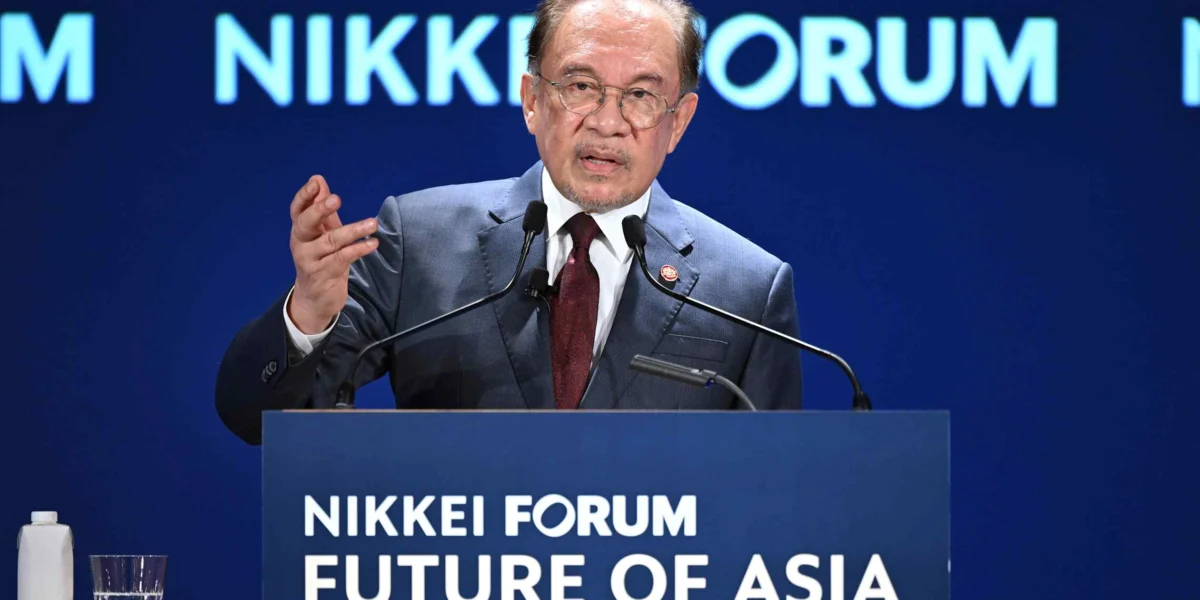
TOKYO – Malaysian Prime Minister Anwar Ibrahim has sharply criticized major global powers for leveraging the world’s intricate economic interconnectedness as a tool, thereby creating significant vulnerabilities for middle-ranking nations. Speaking at Nikkei’s Future of Asia forum in Tokyo on June 10, 2026, Ibrahim articulated a growing concern within developing and emerging economies: that the very global supply chains and financial networks designed to foster prosperity are increasingly being manipulated for geopolitical leverage.
The Prime Minister’s address comes at a critical juncture for global trade and diplomacy. The forum, an annual high-profile event drawing leaders, policymakers, academics, and business executives from across Asia and beyond, has become a crucial platform for dissecting the region’s most pressing economic and political challenges. This year’s discussions are particularly framed by the persistent geopolitical tensions, ongoing shifts in global economic power, and the lingering effects of recent global crises, including the COVID-19 pandemic and its subsequent supply chain disruptions, as well as the ongoing conflict in Eastern Europe.

Ibrahim’s central thesis posits that while globalization has historically been lauded for its benefits in promoting growth and lifting millions out of poverty, its current manifestation is becoming a double-edged sword. He argued that larger economies, by wielding their market dominance and technological influence, are increasingly employing economic coercion through sanctions, export controls, and the weaponization of financial systems. This strategy, he contended, disproportionately impacts nations that, while not superpowers, play vital roles in global value chains and are reliant on stable international trade for their development.
"We are witnessing a disturbing trend where the very interconnectedness that has driven global progress is being weaponized," Ibrahim stated, his words resonating with an audience keenly aware of the complexities of the current international landscape. "For middle-ranking nations like Malaysia, and indeed many others in Asia, this creates a precarious situation. Our economic stability, our ability to plan for the future, and our capacity to provide for our citizens are becoming hostage to the strategic calculus of a few dominant powers."
The Malaysian Prime Minister elaborated on how these actions manifest. He cited instances where critical technologies or essential commodities are subjected to export restrictions based on political considerations, disrupting established trade flows and forcing nations to scramble for alternative, often more expensive or less reliable, sources. Furthermore, he pointed to the increasing politicization of international financial institutions and the potential for financial sanctions to be used as a broad-brush tool, impacting not only targeted entities but also the wider economies of the countries involved.

The Geopolitical Undercurrents of Interdependence
The Prime Minister’s remarks are a direct reflection of the evolving geopolitical climate. The post-Cold War era saw an unprecedented wave of economic liberalization and integration, with organizations like the World Trade Organization (WTO) aiming to create a rules-based global trading system. However, in recent years, the rise of new economic powers, coupled with increased strategic competition between established and emerging superpowers, has led to a fragmentation of this order.
The "Future of Asia" forum, hosted by Nikkei Inc., has consistently provided a platform for discussions on these critical issues. Previous forums have addressed topics ranging from regional economic integration and digital transformation to the implications of China’s Belt and Road Initiative and the United States’ re-engagement with the Indo-Pacific. This year’s event, held in Tokyo, a city that embodies Asia’s economic dynamism and its strategic positioning, served as a fitting backdrop for Ibrahim’s sobering assessment.
The timeline of events leading up to Ibrahim’s speech underscores the growing anxieties. Over the past decade, the global economy has experienced a series of shocks. The trade war initiated between the United States and China in 2018, the COVID-19 pandemic starting in early 2020 which exposed the fragility of global supply chains, and the ongoing conflict in Ukraine since February 2022, have all contributed to a reassessment of economic dependencies. These events have accelerated a trend towards "friend-shoring" and "near-shoring" as nations seek to secure their supply lines, often at the expense of pure economic efficiency.

Supporting Data: Quantifying the Vulnerability
The vulnerabilities described by Prime Minister Ibrahim are not merely anecdotal. Economic data from recent years illustrates the interconnectedness that can become a point of weakness. For instance, in 2025, global trade in intermediate goods – components and materials used in manufacturing – accounted for approximately 60% of total merchandise trade, according to estimates from the UN Conference on Trade and Development (UNCTAD). This deep integration means that disruptions in one part of the supply chain can have cascading effects across multiple industries and nations.
Furthermore, the concentration of critical raw materials and advanced manufacturing capabilities in a limited number of countries presents another layer of vulnerability. For example, the production of semiconductors, essential for virtually all modern technologies, is heavily concentrated in East Asia, particularly Taiwan and South Korea. Any disruption to this supply, whether due to geopolitical tensions, natural disasters, or political decisions, has immediate and far-reaching consequences for global industries, from automotive manufacturing to consumer electronics and defense.
Data from the International Monetary Fund (IMF) has also highlighted the increasing use of economic sanctions as a foreign policy tool. The number of individuals and entities subject to international sanctions has grown significantly in the past decade, with a substantial portion of these measures being imposed by major economic blocs. While intended to pressure specific regimes or actors, the broad application of these sanctions can lead to unintended consequences, including price volatility for essential goods and disruptions to humanitarian aid.

Implications for Middle-Ranking Nations
The implications of this weaponization of interdependence for middle-ranking nations are multifaceted. Economically, it can lead to increased operating costs, reduced competitiveness, and slower economic growth. Businesses may face higher import bills for essential components, be forced to invest in less efficient alternative supply chains, or even face outright bans on accessing certain markets or technologies. This can stifle innovation and hinder long-term development prospects.
Politically, these vulnerabilities can undermine the sovereignty and policy autonomy of middle-ranking nations. They may find themselves pressured to align their foreign policy with dominant powers to avoid economic repercussions, even if such alignment is not in their national interest. This can lead to a more constrained diplomatic space and a reduced ability to pursue independent foreign policy objectives.
For a nation like Malaysia, with its strong export orientation and its strategic position in Southeast Asia, these trends pose significant challenges. Malaysia is a key player in global supply chains for electronics, palm oil, and automotive components. Any disruption to its trade relationships or its access to critical technologies could have a substantial impact on its economy. The nation’s economic growth, which relies heavily on foreign direct investment and robust international trade, could be jeopardized.

Potential Reactions and Future Trajectories
While the original article does not include specific reactions from other parties, it is logical to infer that Prime Minister Ibrahim’s remarks would elicit a range of responses. Major powers might defend their actions as necessary for national security or to uphold international norms. They could argue that their policies are targeted and not intended to harm innocent populations or economies.
However, other middle-ranking nations, particularly those in Asia, Africa, and Latin America, are likely to find resonance in Ibrahim’s critique. They may begin to coordinate their efforts more closely within international forums to advocate for a more equitable and less weaponized global economic system. This could involve pushing for reforms within international institutions, strengthening regional trade blocs, and seeking to diversify their economic partnerships to reduce reliance on any single dominant power.
The long-term implications point towards a potential recalibration of globalization. Instead of a purely efficiency-driven model, there may be a greater emphasis on resilience, security, and strategic autonomy. This could lead to a more fragmented global economy, with regional blocs playing a more significant role. For middle-ranking nations, the challenge will be to navigate this evolving landscape, to build domestic capacity, and to forge alliances that can protect their interests in an increasingly uncertain world.

Prime Minister Anwar Ibrahim’s address at the Future of Asia forum serves as a stark warning. It highlights a growing concern that the architecture of global economic interdependence, once seen as a guarantor of peace and prosperity, is increasingly being shaped by power dynamics that can leave smaller nations vulnerable. His call for a more equitable and less weaponized approach to global economic relations is likely to echo across the developing world, setting the stage for a critical debate on the future of international cooperation and economic governance. The coming years will reveal whether global powers heed these concerns or whether the trend towards economic weaponization continues to deepen, further complicating the path to sustainable development for many nations.
