

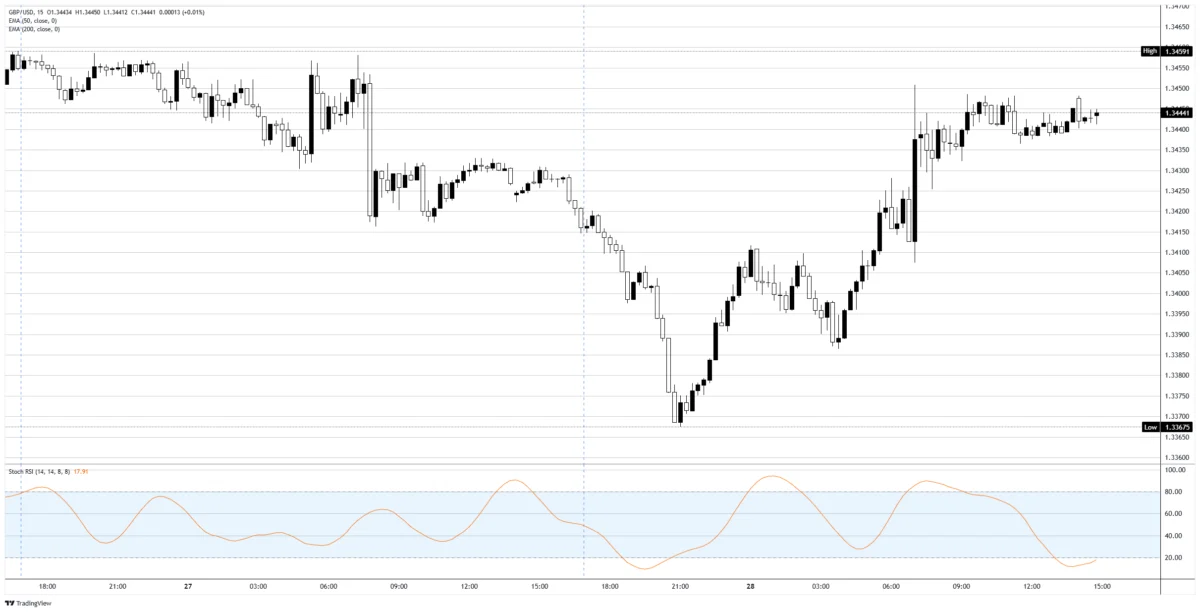
The financial markets witnessed an intriguing development as the Personal Consumption Expenditures (PCE) Price Index, the Federal Reserve’s preferred gauge for inflation, delivered a print that seemingly favored a more dovish outlook. Sterling traders, keenly anticipating these figures, observed the data land squarely in the bears’ lap, yet the Pound Sterling exhibited a remarkably muted reaction, demonstrating minimal movement against the US Dollar. Core PCE, which strips out volatile food and energy prices, registered a monthly increase of 0.2%, falling below the consensus expectation of 0.3% and marking the softest monthly read in three periods. Concurrently, the headline PCE equivalent, encompassing all categories, printed at 0.4% against an anticipated 0.5%. Adding to the dovish sentiment, the Gross Domestic Product (GDP) revision for the first quarter came in at an annualized rate of 1.6%, a notable deceleration from the initial advance estimate of 2.0%. Despite a trifecta of dovish economic indicators released simultaneously, the Pound Sterling was observed trading near 1.3440, largely unchanged from its position preceding the 12:30 GMT release. The most compelling narrative emanating from this event was not the data itself, but rather the conspicuous absence of significant market follow-through, pointing towards deeper underlying dynamics at play.
Detailed Analysis of Key US Economic Indicators
The Personal Consumption Expenditures (PCE) Price Index is a crucial metric for the Federal Reserve, providing a comprehensive measure of inflation across a broad range of goods and services. Unlike the more widely known Consumer Price Index (CPI), PCE accounts for shifts in consumer spending habits, making it a more robust indicator of underlying inflationary pressures from the Fed’s perspective. The core PCE figure, which excludes the often-volatile food and energy sectors, is particularly scrutinized as it offers a clearer picture of sustained price trends. A 0.2% monthly increase in core PCE signals a moderation in inflationary momentum, potentially alleviating pressure on the Federal Reserve to maintain an aggressive tightening stance. This figure, being the lowest in three months, suggests that previous rate hikes may be having the desired effect on demand and price stability.
Similarly, the headline PCE, which includes all components, also came in below expectations, further reinforcing the narrative of cooling inflation. While 0.4% is still a considerable monthly increase, its deviation from the 0.5% forecast contributes to the dovish surprise. These figures are typically annualized to provide context, and even a small deviation from expectations can have significant implications for market sentiment and central bank policy projections.
The downward revision of the first-quarter Gross Domestic Product (GDP) from 2.0% to 1.6% annualized further underscores a slowdown in economic activity. GDP, the broadest measure of economic output, reflects the total value of goods and services produced in an economy. A revision downwards indicates that the economy grew at a slower pace than initially estimated, suggesting potentially weaker consumer spending, business investment, or government expenditure than previously thought. This softening in growth, coupled with moderating inflation, creates a complex environment for policymakers, balancing the need to control prices with the risk of stifling economic expansion.
The Enigma of Sterling’s Non-Reaction: A Case of Priced-In Expectations
The market’s seemingly indifferent response to these significantly dovish US economic data points was not a testament to the data’s insignificance, but rather a classic illustration of market efficiency and pre-positioning. The narrative suggests that the "dovish surprise" had already been largely factored into asset prices prior to the official announcement. Sterling’s trajectory preceding the data release provides critical insight into this phenomenon. The currency had established a bottom near 1.3350 late on Wednesday and subsequently embarked on a steady upward grind throughout the European morning trading session, reaching 1.3450 a full five hours before the Bureau of Economic Analysis (BEA) pushed out its scheduled release.
This pre-emptive rally indicates that a substantial portion of market participants had already anticipated a softer set of US economic figures, or at least positioned themselves to benefit from such an outcome. By the time the actual PCE and GDP numbers were released, the market had largely "priced in" the dovish implications. Consequently, the actual print did not serve as a new catalyst for movement but rather became a "take-profit" signal for those who had correctly anticipated the outcome. This dynamic led to a stabilization of the pair within a range, as initial gains were consolidated and profit-taking offset any further upward momentum that might have otherwise materialized. The lower GDP revision, while confirming the slowdown, did little to extend the move, as its impact, too, was overshadowed by the prior positioning. Traders hoping for the soft PCE data to propel Sterling cleanly past the 50-period Exponential Moving Average (EMA) above 1.3500 were left wanting, underscoring the importance of understanding market psychology and positioning ahead of major data releases.
Bank of England vs. Federal Reserve: A Shifting Monetary Policy Landscape
The backdrop to this immediate market reaction is a broader and increasingly divergent monetary policy landscape between the Bank of England (BoE) and the Federal Reserve (Fed). This divergence is becoming a critical determinant for the Pound Sterling’s long-term trajectory. The original article highlights a key observation: the BoE’s Monetary Policy Committee (MPC) split 8-1 at its most recent meeting, with the lone dissenter voting for a rate hike. This contrasts sharply with the Federal Open Market Committee (FOMC) where dissenting votes are skewed in the opposite direction, typically favoring a less hawkish stance or even cuts.
This internal dynamic suggests that the BoE currently exhibits a more hawkish lean compared to the Federal Reserve. While the Fed has signaled a potential pause or even future rate cuts, albeit cautiously, the BoE appears to be grappling with more persistent inflationary pressures or a stronger conviction to continue its fight against inflation. This "structural rate differential" — the difference in interest rates or the expected path of interest rates between two economies — has historically played a pivotal role in currency valuations. For a prolonged period, the differential often worked against the Pound, as the Fed’s aggressive tightening cycle made US assets more attractive. However, the current shift implies that this dynamic may be reversing. If the BoE maintains or even strengthens its hawkish stance while the Fed pivots towards a more accommodative policy, the interest rate differential could begin to favor the Pound Sterling, potentially leading to an "asymmetric move up" for the currency, rather than down. This fundamental shift, if fully digested by the market, could provide a more robust and sustainable tailwind for GBP/USD beyond short-term data reactions.
Governor Bailey’s Upcoming Communication Blitz: Massaging Market Expectations
Adding another layer of complexity and potential volatility to the Sterling outlook is the unusually dense schedule of public appearances by Bank of England Governor Andrew Bailey next week. His calendar includes four speeches: Friday morning, then Tuesday, Thursday, and finally Friday again. Sandwiched in the middle of this communication blitz are the crucial Bank of England Monetary Policy Report (MPR) Hearings on Wednesday.

This "unusual cadence" of public engagement is highly significant. Central bankers typically embark on such extensive communication campaigns when they aim to carefully "massage" market expectations ahead of an upcoming policy meeting that might still be several weeks away. In this context, with the next MPC meeting still six weeks out, Bailey’s remarks will be meticulously scrutinized for any hints regarding the BoE’s future policy direction. Given the recent 8-1 split in the MPC, where a dissenting member voted for a hike, any comments from Governor Bailey that lean into or acknowledge the rationale behind this hawkish dissent could have a disproportionately positive impact on Sterling. Market participants will be looking for clues on whether the BoE is prepared to maintain a tighter monetary policy for longer than currently anticipated, or even consider further hikes if inflationary pressures persist. The market’s anticipation of these speeches and the MPR Hearings will contribute to the underlying sentiment for the Pound, potentially creating opportunities for an asymmetric move higher if Bailey signals a more hawkish stance.
The Road Ahead: Nonfarm Payrolls as the Ultimate Regime Test
While this week’s PCE softness was "noted" by the market, its impact was largely contained because market attention has already pivoted towards more influential upcoming events. Foremost among these is the Nonfarm Payrolls (NFP) report scheduled for Friday, June 5. NFP is widely considered the most critical monthly labor market indicator for the US economy, providing insights into job creation, wage growth, and overall labor market health. It holds immense sway over Federal Reserve policy decisions, as a robust labor market can fuel inflationary pressures, while signs of softening can pave the way for a more dovish stance.
The NFP release arrives at the culmination of a calendar week packed with other significant US economic data. This includes the Institute for Supply Management (ISM) Manufacturing Purchasing Managers’ Index (PMI) on Monday and the ISM Services PMI on Wednesday. These PMIs offer leading indicators of economic activity in the manufacturing and services sectors, respectively, providing an early glimpse into the health of the broader economy. Furthermore, Federal Reserve Chair Jerome Powell is scheduled to speak on Sunday night, potentially setting the tone for the week and offering further insights into the Fed’s current thinking.
The current trend in jobless claims, which has shown some hints of softening, suggests a potential easing in labor market tightness. If the upcoming NFP report confirms this softening trend, the implications for Fed policy could be profound. A weaker-than-expected NFP print would likely weaken the resolve of the Fed’s hawkish bloc, providing cover for a more dovish pivot and potentially leading to a rapid repricing of the December rate path, perhaps even bringing forward expectations for rate cuts. Until such a definitive signal emerges from the labor market, the PCE data, while dovish, remains "filed under ‘noted’" rather than serving as a primary market mover.
Technical Outlook for GBP/USD: Key Levels and Actionable Bias
From a technical perspective, the GBP/USD pair has established identifiable support and resistance levels following the recent data releases and market dynamics. The daily 200 Exponential Moving Average (EMA), positioned near 1.3400, has proven to be a robust practical floor for the pair over the past three trading sessions, demonstrating its significance as a psychological and technical support level. Conversely, the 50 EMA, located near 1.3460, currently acts as the immediate ceiling, capping upward movements.
A decisive break above 1.3500 is identified as the key breakout pivot. A reclaim of this level would signal renewed bullish momentum, putting the next resistance target of 1.3550 in play and necessitating a fundamental rethink of the current sideways drift. Such a move would suggest that the underlying bullish sentiment, perhaps driven by the shifting rate differential dynamics, is gaining traction.
Conversely, a break below the 1.3400 floor would expose the next critical support level at 1.3350. A sustained move below 1.3350, which marked the late Wednesday bottom, would be a bearish signal, potentially exposing the 1.3300 level and indicating a weakening of Sterling’s short-term prospects. The daily Stochastic Relative Strength Index (Stoch RSI) is currently hovering close to 30, which is broadly considered a neutral reading, suggesting that the pair is not oversold or overbought in the immediate term, allowing for movement in either direction based on fresh catalysts. The actionable bias into Governor Bailey’s Friday speech is currently "range-fade," meaning traders might look to sell at the top of the range and buy at the bottom, but with an "asymmetric eye on hawkish surprise," implying that any hawkish signals from Bailey could trigger a stronger upward move than a dovish signal would cause a downward one.
Pound Sterling: A Historical Perspective and Fundamental Drivers
The Pound Sterling (GBP), with its origins dating back to 886 AD, holds the distinction of being the oldest currency in the world and serves as the official currency of the United Kingdom. It remains a cornerstone of global finance, ranking as the fourth most traded unit in foreign exchange (FX) markets. According to 2022 data, it accounts for a substantial 12% of all global transactions, averaging an impressive $630 billion in daily turnover. Its most prominent trading pair is GBP/USD, affectionately known as "Cable," which alone constitutes 11% of FX transactions. Other significant pairs include GBP/JPY, dubbed the "Dragon" by traders (3%), and EUR/GBP (2%). The Bank of England (BoE) is the sole issuer of the Pound Sterling.
The single most influential factor driving the value of the Pound Sterling is the monetary policy decisions made by the Bank of England. The BoE’s primary mandate is to achieve "price stability," targeting a steady inflation rate of approximately 2%. Its primary instrument for achieving this goal is the adjustment of interest rates. When inflation exceeds its target, the BoE typically raises interest rates to curb economic activity and demand, making borrowing more expensive for both individuals and businesses. This action generally supports the GBP, as higher interest rates increase the attractiveness of UK assets to global investors seeking better returns. Conversely, if inflation falls too low, signaling a slowdown in economic growth, the BoE may consider lowering interest rates. This makes credit cheaper, encouraging businesses to borrow and invest, thereby stimulating economic expansion. Such a move can, however, weaken the Pound.
Beyond monetary policy, a plethora of economic data releases provide crucial insights into the health of the UK economy and can significantly impact Sterling’s value. Key indicators include Gross Domestic Product (GDP), which measures overall economic output; Manufacturing and Services Purchasing Managers’ Indexes (PMIs), which offer forward-looking assessments of economic activity in key sectors; and employment data, including jobless claims and wage growth, reflecting labor market dynamics. A robust and growing economy generally strengthens the Pound, attracting foreign investment and potentially encouraging the BoE to raise interest rates. Conversely, weak economic data typically leads to a depreciation of the Pound Sterling.
Another important data point for the Pound is the Trade Balance, which quantifies the difference between a country’s export earnings and import expenditures over a specified period. A country that produces highly sought-after exports benefits from increased demand for its currency from foreign buyers. Therefore, a positive net Trade Balance (a surplus) tends to strengthen a currency, while a negative balance (a deficit) can exert downward pressure. Understanding these fundamental drivers, alongside technical analysis and central bank policy divergences, is crucial for comprehending the complex movements of the Pound Sterling in the global financial markets.
