

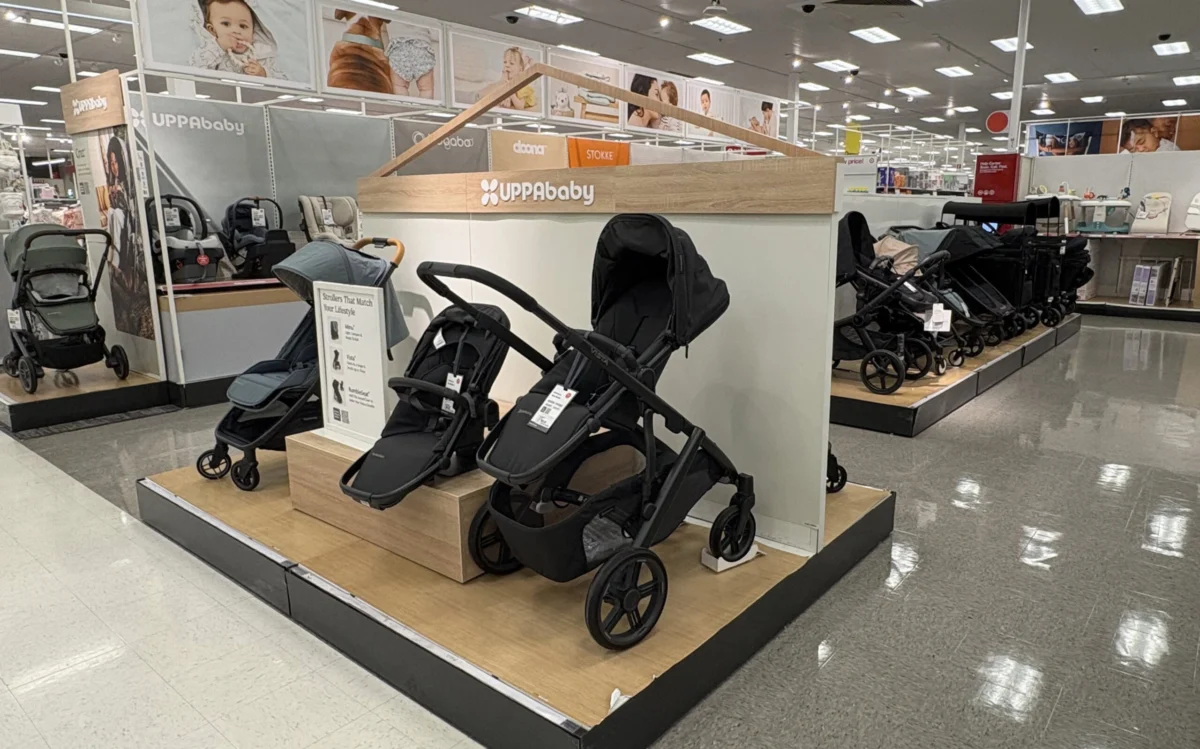
CLIFTON, New Jersey – In a bold strategic maneuver to rejuvenate its sales trajectory and solidify its appeal to a critical customer segment, Target has begun rolling out specialized "baby boutiques" within its sprawling big-box stores. This initiative, observed across approximately 200 locations, representing roughly 10% of the retailer’s extensive footprint, marks a significant departure from traditional mass-market baby aisles. Shoppers are now invited to explore a curated selection of baby brands, previously exclusive to high-end specialty retailers, within an enhanced, experiential environment. The move is a cornerstone of CEO Michael Fiddelke’s ambitious turnaround plan, aiming to reverse a three-year sales slump and fend off fierce competition from industry titans like Walmart and Amazon.
The "baby boutiques" concept transcends the conventional display of baby essentials. In these dedicated sections, customers can engage directly with premium products, experiencing the functionality and design of strollers, car seats, and high chairs outside their packaging. This tactile interaction allows for a comprehensive evaluation of items, a critical factor for parents making significant purchases. The offerings extend to merchandise from prestigious brands such as UPPAbaby, known for its $1,000 strollers, alongside Stokke, Bugaboo, and Doona. Complementing these high-end selections, Target has also bolstered its own private label, Cloud Island, with an expanded range of clothing, bibs, and crib sheets. In total, nearly 2,000 new baby items have been introduced, available both in the refreshed stores and across Target’s robust online platform.
A Strategic Pivot Towards Family Engagement
The introduction of these specialized baby zones over the past two months is not an isolated initiative but an integral component of a broader, company-wide refresh designed to captivate and retain busy families. This demographic, particularly those with children aged five and under, represents an invaluable customer base for Target. According to Cara Sylvester, Target’s Chief Merchandising Officer, these young families spend twice as much and visit stores twice as frequently as the average Target shopper. This data, uncovered during a comprehensive internal review spurred by Fiddelke’s leadership, underscored an "incredible opportunity" for Target to deepen its relationships and become the preferred destination for a wider array of everyday needs for these families.
Michael Fiddelke, who assumed the company’s top leadership role in early February, faces the formidable challenge of steering Target back to sustained growth. The retailer’s upcoming first-quarter earnings report on May 20 will provide the initial glimpse into the impact of his tenure and the efficacy of these new strategic directions. The overall strategy, as outlined by Target, is multifaceted: it involves a renewed focus on enhancing the quality of its product offerings, elevating the in-store shopping experience, and expanding convenient options such as same-day pickup and delivery. These pillars are deemed critical for boosting sales and maintaining a competitive edge against formidable rivals.
Navigating a Challenging Retail Landscape
Target’s proactive investment in the baby category comes at a time of significant shifts in both consumer behavior and broader demographic trends. Despite a national decline in birth rates, the company’s internal research suggests a compelling rationale for this focus. Preliminary data from the Centers for Disease Control and Prevention’s National Center for Health Statistics indicates that U.S. births have fallen from a peak of 4.32 million in 2007 to an estimated 3.61 million in 2025, representing a roughly 16% reduction over eighteen years. Researchers attribute this decline to various factors, including decreased teen pregnancies and a trend among women to delay childbearing.
However, Sylvester emphasizes that even with lower birth rates, the strategy remains sound. Target’s research reveals that new parents, pressed for time, tend to consolidate their shopping destinations. By capturing these customers early in their parenting journey, Target aims to secure not only their purchases of diapers and wipes but also their loyalty for groceries, clothing, and other household essentials. This "lifetime value" of a first-time parent is a significant driver behind prioritizing the baby department, positioning it as a crucial "on-ramp to greater sales and then to multiple years of higher wallet share," as described by Simeon Gutman, a Morgan Stanley retail analyst.
The competitive landscape for baby products is intense. Market researcher Numerator, which tracks baby gear excluding apparel, places Target as the third-largest retailer in the U.S. baby sector. In the 12-month period ending February, Walmart held the largest share at 27%, followed by Amazon at 24.4%, and Target at 17.6%. Notably, Target’s market share in this category has seen a decline from 18.6% over the past two years, while Walmart’s has grown from 25.4%, and Amazon’s has remained relatively stable. This erosion of market share underscores the urgency of Target’s current initiatives to regain ground.
Financial Commitment and Market Signals

Target’s commitment to this revitalization is backed by substantial financial investment. In March, the company announced plans to allocate approximately $5 billion to capital expenditures this fiscal year, representing an increase of over $1 billion from the previous year. These funds are earmarked for store openings, remodels, and, crucially, the expansion of initiatives like the baby boutiques. While Target has not disclosed the specific investment dedicated to the baby boutique rollout, the scale of its overall capital expenditure highlights the strategic importance of these store enhancements. The retailer anticipates extending the baby boutique concept to more stores, though a definitive timetable remains undisclosed.
Despite challenges, including a decline in customer traffic across its stores and website for four consecutive quarters, there are nascent signs of recovery. Placer.ai, an analytics firm that utilizes anonymized mobile device data to estimate store visits, suggests that store traffic is beginning to show positive trends. Target’s leadership has expressed optimism, projecting a return to annual sales growth this year, with net sales expected to rise by approximately 2% year-over-year and grow positively in every quarter compared to the previous year.
However, the path to recovery is fraught with external pressures. Target faces stiffer competition across various retail segments, and it must navigate potential headwinds such as a fresh boycott threat from a major teachers’ union, particularly as the crucial back-to-school season approaches. Rising gas prices also pose a risk, potentially dampening overall consumer spending. Morgan Stanley’s Gutman points to the widening disparity in spending power between lower- and higher-income households, often referred to as the "K-shaped economy." While competitors like Walmart have leveraged gains from wealthier households to offset declines among cash-strapped customers, Gutman suggests Target may not be as well-positioned in this regard. Nevertheless, he remains encouraged by Target’s efforts to refine its stores and refresh merchandise, believing these changes will ultimately drive increased customer traffic.
Elevating the Shopping Experience and Filling a Market Void
The design and functionality of Target’s baby boutiques represent a significant evolution from its previous offerings. Cara Sylvester describes them as feeling "more like a curated shop," designed to simplify what can often be an overwhelming decision-making process for new parents. The emphasis on allowing customers to interact with products – pushing, folding, and lifting strollers – addresses a critical gap in the market. This in-store experience has become increasingly rare following the closure of several specialty baby retailers, such as Buybuy Baby and Babies R Us, both of which succumbed to bankruptcies (though Babies R Us has since re-emerged as pop-up shops within some Kohl’s stores).
Further enhancing the customer journey, Target is piloting a baby concierge service in partnership with Tot Squad. This service offers complimentary guidance to shoppers, assisting them in comparing products and compiling baby registries, available both in-person at the boutiques and online. This personalized support aims to build trust and reduce decision fatigue for new parents.
The rise of secondhand markets, notably platforms like Facebook Marketplace, also presents a competitive threat, allowing families to acquire high-end brands at significant discounts. Paradoxically, these markets can also indirectly justify larger initial purchases of premium brands, as their strong resale value offers a tangible return on investment a year or two later.
The significance of Target’s move is further illuminated by the perspective of its brand partners. WildBird, a direct-to-consumer company specializing in baby carriers, debuted its products on Target’s shelves in March, marking its first major foray into brick-and-mortar retail. Nate Gunn, co-founder and CEO of WildBird, and a father of three, observes that the proliferation of brands driven by social media, particularly in the baby category, has led to consumer "confusion and overwhelm." He notes that while shopping might be "easier than ever," the pervasive "fatigue is ‘What do I buy?’" a sentiment magnified for parents navigating hundreds of product choices in a short span. Gunn characterizes Target’s previous baby aisles as feeling "stale" and "a bit commoditized."
Gunn believes the baby boutiques allow Target to leverage its unique strengths. He envisions Target as a destination where parents can enjoy a more "premium experience, but still accessible," perhaps while grabbing a Starbucks coffee and strolling with their child – a distinct offering compared to the price-driven approach of a Walmart. This differentiation is key to Target’s broader strategy to regain customer loyalty and market share in a fiercely competitive retail environment.
In early March, at an investor presentation, Cara Sylvester candidly acknowledged Target’s recent struggles, stating, "Our performance over the last few years has not met expectations. And that is on us." She admitted that the company had "lost the clarity and the discipline that make Target a place loved by busy families." The baby boutique initiative, therefore, represents not just a product refresh, but a concerted effort to recapture that lost clarity, discipline, and, ultimately, the unwavering loyalty of families nationwide. The success of this focused investment in the baby category will be a crucial indicator of Target’s broader turnaround efforts and its ability to thrive in an evolving retail landscape.
