

In a significant development that signals a potential paradigm shift in how the United States military approaches cybersecurity and strategic influence, Admiral Samuel Paparo, Commander of U.S. Indo-Pacific Command (INDOPACOM), revealed on April 21st and 22nd, 2026, during a Senate Armed Services Committee hearing, that the command is actively experimenting with the Bitcoin protocol. Admiral Paparo characterized Bitcoin as a "valuable computer science tool as power projection," and disclosed that INDOPACOM is operating a Bitcoin node as part of these investigations.
This disclosure comes at a time of heightened geopolitical tension and a growing recognition of the strategic importance of digital assets and decentralized technologies. The comments by Admiral Paparo, a key figure in a vital theater of U.S. foreign policy, suggest a serious examination of Bitcoin’s utility beyond its role as a financial asset. The very term "power projection" employed by the Admiral has strong ties to the theoretical work of Jason Lowery, a MIT Fellow and Special Assistant to the Commander of INDOPACOM, who authored "Softwar: A Novel Theory on Power Projection."
Lowery’s research, which includes an MIT thesis and a subsequent book, delves into the cybersecurity implications of Bitcoin and its unique capacity for "power projection" within the digital domain. This is particularly relevant in cyberspace, a domain that often lacks traditional, tangible deterrence mechanisms. The book, though later removed from distribution at the request of superiors, garnered considerable attention and debate within the Bitcoin community, with some interpreting its withdrawal as an indication of its sensitive or strategically valuable content, potentially deemed too important for broad public dissemination by the U.S. military.
The exploration of Bitcoin by INDOPACOM also occurs in the shadow of recent events, such as the Islamic Republic of Iran’s reported demand for Bitcoin payments for safe passage through the Strait of Hormuz just days prior to the Admiral’s testimony. This incident highlights the evolving role of digital currencies in international relations and their potential to circumvent traditional financial sanctions and control mechanisms.
Defining "Power Projection" in a Digital Age
To understand the significance of Admiral Paparo’s remarks, it is crucial to define "power projection" within a military and national security context. The U.S. Department of Defense’s 2002 Dictionary of Military and Associated Terms defines power projection as: "The ability of a nation to apply all or some of its elements of national power – political, economic, informational, or military – to rapidly and effectively deploy and sustain forces in and from multiple dispersed locations to respond to crises, to contribute to deterrence, and to enhance regional stability." In essence, it is a nation’s capability to influence the actions of other states or entities beyond its borders through various means, including diplomacy, economic leverage, information operations, and military force.
The concept of "deterrence" is intrinsically linked to power projection. The DoD defines deterrence as: "The prevention from action by fear of the consequences. Deterrence is a state of mind brought about by the existence of a credible threat of unacceptable counteraction." The U.S. military’s interest in Bitcoin suggests an exploration of how this digital asset might contribute to, or even redefine, these foundational concepts in the context of modern warfare and international relations.
Bitcoin as a "Macrochip" and a New Form of Deterrence
Jason Lowery’s theoretical framework offers a novel perspective on Bitcoin’s potential strategic value. He posits that the global electricity grid can be viewed as a "macrochip," analogous to the microchips within computers, where vast amounts of electrical power are transmitted across nations. Within this "macrochip," Bitcoin mining operations function as logic gates, consuming significant energy to generate a scarce digital asset that can be programmed through Bitcoin’s scripting language.
This "Bitcoin macrochip" concept suggests a way to bind cybersecurity challenges to the physical world. Energy is a fundamental and resource-intensive component of national power. While governments can readily create fiat currency, the ability to marshal massive amounts of electricity for a purpose like powering Bitcoin’s proof-of-work competition is significantly more difficult to replicate, forming the basis of Bitcoin’s inherent resilience. This physical constraint, tied to energy consumption, could offer a unique form of deterrence.
The resilience of Bitcoin stems from its proof-of-work (POW) consensus mechanism, which requires substantial computational power and energy expenditure to validate transactions and secure the network. This energy-intensive process makes it prohibitively expensive for malicious actors to disrupt or control the network. Admiral Paparo’s reference to Bitcoin as a "valuable computer science tool" hints at the potential for this underlying protocol to be leveraged for securing data and networks beyond the Bitcoin asset itself.
Multisignature Wallets: A Foundation for Digital Defense
One of Bitcoin’s most robust security features, multisignature (multisig) wallets, offers a compelling example of its "embedded logic" in action. Multisig technology requires multiple predefined private keys to authorize a transaction, significantly enhancing security by decentralizing the control over digital assets. This architectural feature allows for the geographic distribution of private key storage across various locations and jurisdictions, presenting a formidable challenge to potential attackers.
To compromise a multisig wallet, an adversary would need to acquire multiple private keys, often stored in disparate and secured locations, within a specific timeframe. This is compounded by the legitimate owners’ ability to react quickly to threats and move assets. The high cost and complexity imposed on attackers by multisig technology align with the principles of deterrence, potentially fitting the DoD’s definition of creating a "credible threat of unacceptable counteraction." Furthermore, the ability to secure Bitcoin funds and make them available globally, leveraging Bitcoin’s censorship-resistant network properties, can be interpreted as a form of "power projection" in the digital realm.
This contrasts sharply with traditional financial systems. Centralized databases are susceptible to political pressure, enabling authorities to freeze or confiscate assets, as exemplified by the Cyprus bail-in or the U.S. seizure of Russian foreign treasury reserves held in Europe. Bitcoin’s decentralized nature and multisig capabilities offer a potential alternative for securing assets against such unilateral actions.
The "Electro-Cyber Dome": Securing Networks with Proof-of-Work
While INDOPACOM’s immediate focus might be on the potential for Bitcoin’s proof-of-work protocol to secure external data and networks, the practical application of this concept is where Lowery’s theoretical work becomes particularly relevant. The Bitcoin script, the programming language of the Bitcoin blockchain, primarily governs its native asset, BTC. For external networks to benefit from Bitcoin’s proof-of-work "macrochip," they would likely need to be anchored to the Bitcoin network in some manner, a point where Lowery’s thesis, while expansive, faces certain complexities.
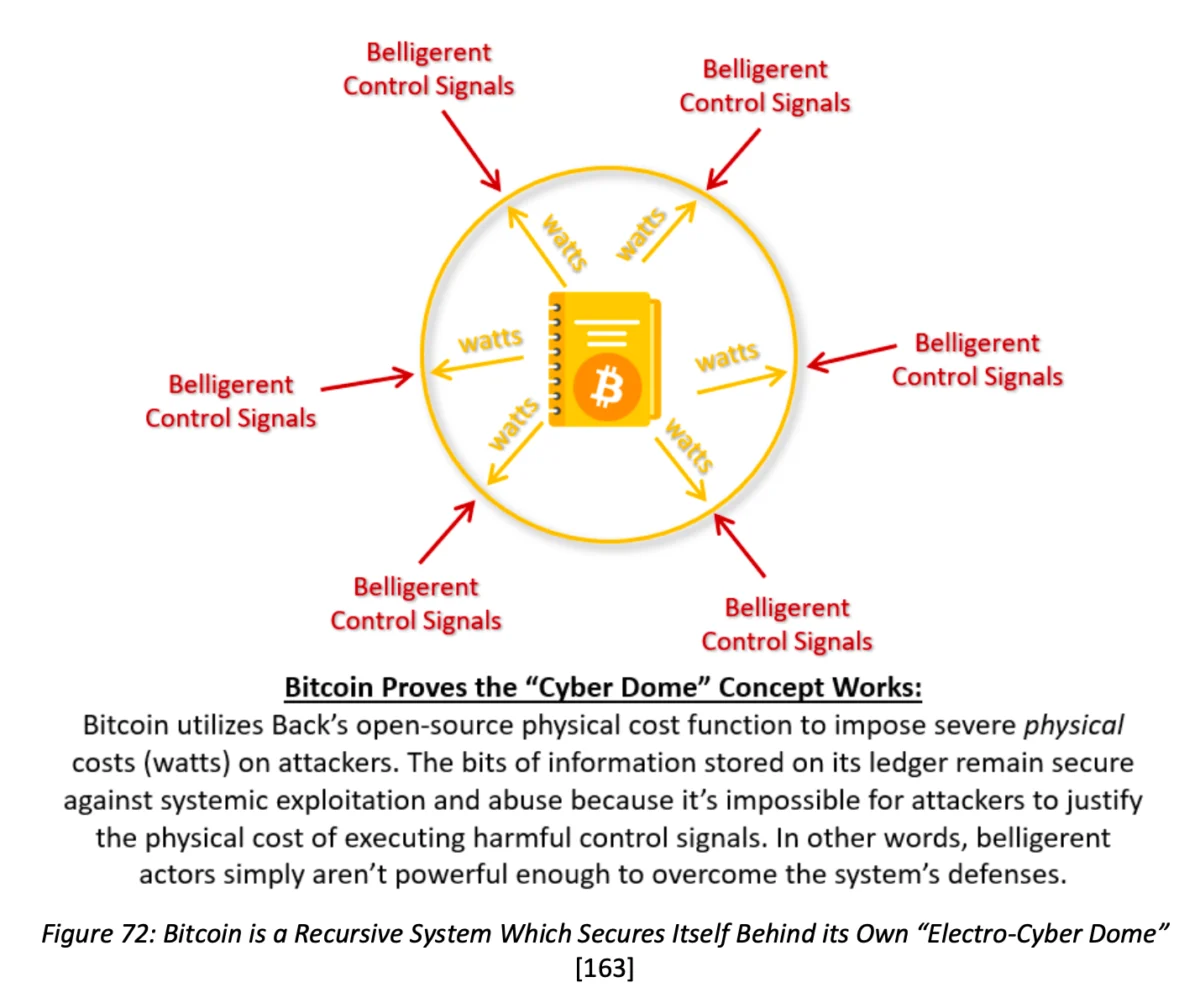
Lowery’s proposed solution to this is the "Electro-Cyber Dome." In his work, he argues that software system vulnerabilities often stem from insufficient constraints on control signals sent to networked machines. This can manifest as distributed denial-of-service (DDoS) attacks, where the cost of authenticating a request to a server exceeds the cost of sending the request, leading to system overload and potential insecurity. Lowery contends that such vulnerabilities can be exploited to place software into hazardous states.
He suggests that other networks could significantly defend against a range of threats, including various forms of cyberattacks, by implementing proof-of-work protocols similar to Bitcoin’s. Satoshi Nakamoto, in the Bitcoin white paper, elegantly described proof-of-work as a process of finding a value that, when hashed (e.g., using SHA-256), results in a hash beginning with a predetermined number of zero bits. The computational effort required is exponential with the number of zero bits, and verification is swift, involving a single hash computation.
Nakamoto’s concept was influenced by Adam Back’s "Hash Cash," a system designed to mitigate email spam by requiring sending computers to generate a proof-of-work stamp. While Hash Cash stamps were not transferable, Hal Finney’s invention of Reusable Proof of Work (RPOW) laid the groundwork for tokenizing these stamps. Nakamoto’s innovation was to decentralize this process through the blockchain, eliminating the need for a central server and implementing a global difficulty adjustment algorithm.
Lowery’s "Electro-Cyber Dome" concept is conceptually aligned with Hash Cash. He suggests that servers could set their own difficulty targets for proof-of-work computations. While he doesn’t explicitly mandate the use of Bitcoin’s SHA-256 protocol, the idea of a "macrochip" implies a reliance on such robust hashing algorithms. Bitcoin serves as Lowery’s primary example of a proof-of-work network operating at scale, stating, "We know for sure that electro-cyber domes can function successfully as a security protocol because this is what Bitcoin uses to secure itself and its own bits of information against systemic exploitation."
Power Projection and the Potential for Aggression
Lowery further extends his theory beyond purely defensive applications, suggesting that proof-of-work protocols could also enable offensive capabilities. He writes, "it should be noted that this wouldn’t be a strictly ‘defensive’ power projection capability… People with access to proof-of-power can theoretically ‘smash’ through these electro-cyber dome defenses if desired. Thus, proof-of-power protocols are not strictly ‘defense only’ protocols as some have argued. A top threat to people using physical cost function protocols like Bitcoin is other people using the same protocol." This observation underscores the competitive and potentially confrontational nature of large-scale proof-of-work deployments, a dynamic that could have significant implications for military strategy.
Critiques and Challenges to the "Softwar" Thesis
Despite the intriguing theoretical underpinnings, Lowery’s "Softwar" thesis has faced considerable criticism within the Bitcoin community. Critics, such as Shinobi writing for Bitcoin Magazine, have described the idea of resolving military conflicts through "hash rate wars" as "delusional." A primary point of contention is the feasibility of securing external data or networks using Bitcoin’s technology stack, including its proof-of-work, blockchain, or native asset.
Jameson Lopp, a prominent figure in the Bitcoin space, conducted an extensive multi-part review of Lowery’s work. While acknowledging certain merits, Lopp ultimately concluded that "Softwar falls short on acting as a blueprint for how we should build the future." A key concern raised by critics is the practical utility of employing SHA-256 proof-of-work for networks outside of Bitcoin. If such a system does not require mining actual Bitcoin, does not adhere to Bitcoin’s target difficulty, and does not leverage its blockchain or asset, then its connection to Bitcoin becomes tenuous.
Furthermore, the geopolitical landscape of Bitcoin mining presents a significant challenge. With China dominating a substantial portion of the ASIC manufacturing industry for Bitcoin mining, the U.S. military, particularly INDOPACOM, might be hesitant to secure its critical cyber networks with algorithms for which a potential adversary mass-produces the necessary hardware. This could lead to a preference for alternative proof-of-work algorithms, which, while potentially more secure from a geopolitical standpoint, would move away from the "Bitcoin macrochip" argument and revert to a more general application of Hash Cash-like principles. This suggests that Bitcoin’s role might be more inspirational or a marketing strategy for Lowery’s broader ideas rather than the direct technological implementation for INDOPACOM.
Navigating the Middle Ground: Practical Implementations
Between the theoretical debates and potential geopolitical hurdles, several projects are exploring practical applications of Bitcoin’s technology for securing more than just financial transactions.
-
SimpleProof: This project functions as a Bitcoin notary service, utilizing the blockchain to record hashes of data. By anchoring digital records to the Bitcoin blockchain, it establishes an irrefutable timestamp, demonstrating the existence of a specific version of data at a particular time. This application was notably employed to counter accusations of fraud during the Guatemalan elections, where the integrity of the electoral process was bolstered by the verifiable timestamps provided by the Bitcoin blockchain, leading to tangible political consequences.
-
Orange Checkmark Protocol: Michael Saylor, a prominent Bitcoin advocate, has spearheaded the development of what has been termed the "Orange Checkmark protocol" on top of Bitcoin. This initiative, detailed on GitHub, aims to create a privacy-preserving, Bitcoin-native decentralized digital identity system. While it garnered interest within the Bitcoin community, widespread adoption has not yet materialized.
-
Proof-of-Work Spam Protection: Ironically, Jameson Lopp, a vocal critic of Lowery’s broader thesis, has implemented a proof-of-work-based spam protection mechanism on his own website for submission forms. This system, based on principles similar to Hash Cash, effectively filters spam by requiring users to perform a small computational task. Lopp’s practical application suggests that while the grander visions of "Softwar" may be debated, the underlying principles of proof-of-work for network security hold practical value, even if they do not directly involve Bitcoin itself.
The U.S. military’s exploration of Bitcoin, as articulated by Admiral Paparo, represents a significant acknowledgment of the evolving landscape of cybersecurity and strategic influence. Whether this exploration leads to direct integration of Bitcoin’s protocol, or inspires the adoption of similar proof-of-work mechanisms for national security purposes, remains to be seen. However, the very fact that such discussions are occurring at the highest levels of the U.S. military underscores the profound impact that decentralized technologies are having on global security paradigms. The concept of "power projection" is clearly being re-examined through the lens of digital capabilities, and Bitcoin, with its unique blend of cryptography, economics, and distributed consensus, is at the forefront of this re-evaluation.
