


The Evolution of PropTech: A Contextual Background
The integration of AI into real estate—often referred to as "PropTech"—has followed a rapid trajectory over the last decade. In the early 2010s, technology was largely limited to digital listing aggregators and basic Customer Relationship Management (CRM) systems. By 2020, the industry began experimenting with Big Data to predict market trends. However, the true inflection point occurred between 2023 and 2025, following the mass adoption of Large Language Models (LLMs) and generative AI.

In 2026, the focus has shifted from general-purpose AI, like basic ChatGPT, to "Agent-Centric AI." These are specialized platforms designed to interface directly with Multiple Listing Services (MLS), local tax records, and consumer behavioral data. According to industry reports, real estate firms that integrated AI into their lead-generation workflows in 2025 saw a 35% increase in conversion rates compared to those relying on traditional manual outreach. This shift reflects a broader movement toward efficiency, where the goal is to reduce the "time-to-contact" and provide hyper-personalized service at scale.

A Chronology of AI Integration in Residential Real Estate
- 2018–2022: The Data Foundation. Early adoption of predictive modeling used to estimate home values (AVMs) and basic chatbot implementation for website inquiries.
- 2023: The Generative Explosion. Real estate agents began using generative AI for listing descriptions, social media captions, and email drafting.
- 2024: Workflow Automation. Introduction of AI assistants capable of scheduling showings and performing basic CRM database "scrubbing."
- 2025: Specialized Visual and Voice AI. The rise of indistinguishable AI voice assistants for cold calling and high-fidelity virtual staging that replaced physical furniture rental.
- 2026: Deep Ecosystem Integration. AI tools now operate as "Copilots," managing transactions from initial lead capture through to the closing of escrow with minimal manual intervention.
Leading AI Lead Generation and Nurturing Solutions
Lead generation remains the highest priority for real estate professionals. Modern AI tools utilize sophisticated algorithms to sift through vast consumer data sets, identifying potential sellers before they even contact an agent.

1. Top Producer’s Smart Targeting
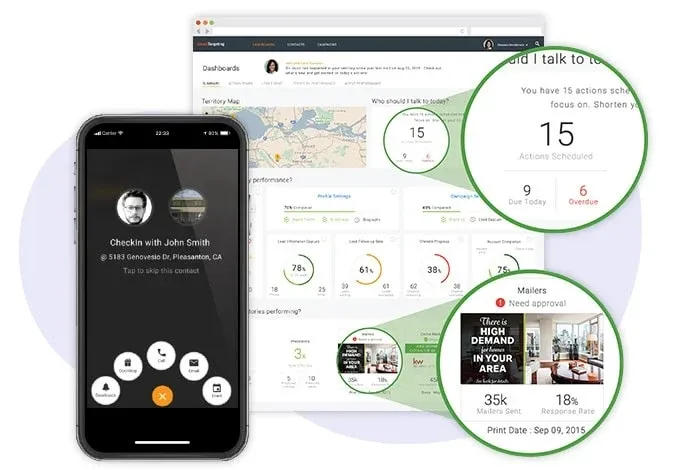
Recognized as a premier solution for seasoned professionals, Top Producer has integrated proprietary AI into its legacy CRM platform. The "Smart Targeting" feature identifies the top 20% of homeowners in a specific geographic "farm" area who are statistically most likely to sell within the next year. By analyzing over 30 data points—including length of ownership and local market turnover—the system allows agents to focus marketing budgets on high-probability prospects.

2. SmartZip
SmartZip remains a leader in predictive analytics, aggregating data from more than 25 sources. The platform claims a 72% accuracy rate in identifying future listings. Agents utilizing SmartZip gain access to a CRM pre-populated with leads, allowing for automated direct mail and digital advertising campaigns targeted specifically at likely movers.

3. Ylopo’s AI Voice and Text Nurturing
Ylopo has pioneered the use of "Human-Level" AI voice assistants. These tools can place outbound calls to new leads, qualifying them through natural conversation before handing them off to a human agent. In an industry where the first agent to respond often wins the client, Ylopo’s 24/7 availability provides a significant operational advantage.

AI-Driven Marketing and Virtual Staging Tools
Marketing in 2026 requires a multi-channel approach, combining high-quality video, professional design, and immersive virtual experiences.

4. Trolto
Trolto leverages advanced computer vision to transform static listing photos into cinematic, high-definition videos. Unlike traditional slideshows, Trolto’s AI adds smooth pans, fly-through effects, and synchronized audio, creating content that mimics the work of professional videographers at a fraction of the cost.

5. REimagineHome and Collov AI
Virtual staging has undergone a revolution. REimagineHome allows agents to batch-upload photos and apply specific design themes, landscape improvements, and even "sky replacement" to correct for poor weather during a shoot. Collov AI provides a similar service with a focus on affordability, offering high-fidelity renders that allow potential buyers to visualize empty spaces as fully furnished homes.

6. Canva’s Integrated AI
While a general design tool, Canva’s real estate-specific AI templates have become a staple for brochure and social media design. Its "Magic Studio" can suggest layouts and color schemes based on the architectural style of a property, ensuring brand consistency across all marketing collateral.

AI-Enhanced CRMs and Productivity Suites
The modern CRM is no longer just a digital Rolodex; it is an active participant in the agent’s daily workflow.

7. Lofty (formerly Chime)
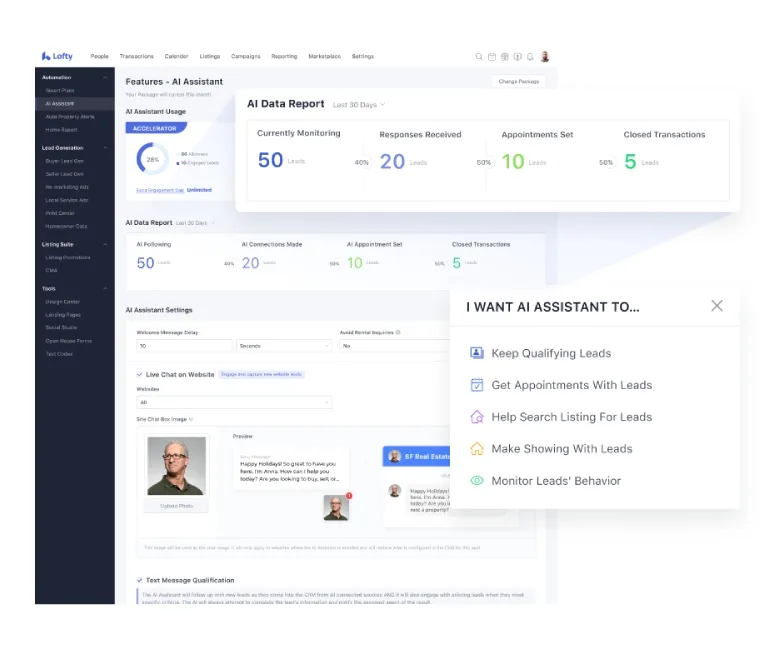
Lofty’s AI Sales Assistant and AI Copilot represent the "all-in-one" approach. The system monitors lead behavior on an agent’s website and triggers automated, personalized outreach based on the specific properties a lead views. The Copilot feature further assists agents by navigating complex software tasks through simple chat commands.

8. Rechat (Lucy Assistant)
Rechat’s "Lucy" serves as a proactive personal assistant. Accessible via mobile, Lucy automates the creation of marketing materials the moment a new listing is detected in the MLS. This "zero-click" philosophy aims to free agents from administrative tasks, allowing them to focus on client-facing activities.

Property Valuation and Market Analysis Tools
Accuracy in valuation is critical for securing listings and advising buyers. AI tools now process billions of data points to provide real-time market insights.

9. HouseCanary
HouseCanary provides advanced analytics and valuation models that go far beyond basic "Zestimates." Its "CanaryAI" allows agents to query a database of 136 million properties using natural language. Agents can ask, "How will a new school district boundary affect property values in this zip code?" and receive a data-backed forecast.

10. Cotality
Cotality specializes in granular market data, offering risk assessment and trend analysis that helps agents identify emerging "hot" neighborhoods before they become mainstream. This enables agents to position themselves as local experts with proprietary data.
Transaction Management and Administrative Efficiency
The final stages of a real estate deal are often the most paperwork-intensive. AI is now being used to ensure compliance and accuracy.

11. ListedKit AI
ListedKit acts as an AI-powered transaction coordinator. It reviews documents for accuracy, creates closing timelines, and sets task reminders for all parties involved, including lenders and title companies. This reduces the risk of human error and ensures that deadlines are met, protecting the agent’s reputation and the client’s earnest money.

12. Sidekick
Built on the OpenAI GPT-4 platform, Sidekick is designed specifically for real estate productivity. It can pull information directly from the MLS to draft Comparative Market Analyses (CMAs) and listing descriptions, effectively acting as a bridge between raw data and client-ready reports.

Supporting Data and Industry Analysis
The shift toward AI is supported by compelling industry data. A 2025 survey by the National Association of Realtors (NAR) indicated that 78% of top-performing agents (those in the top 5% of production) utilized at least three AI-integrated tools in their daily practice. Furthermore, brokerage firms that implemented AI-driven transaction management reported a 22% reduction in administrative overhead.

However, the implications of this technology extend beyond simple efficiency. Industry analysts suggest that the "AI Gap"—the performance difference between tech-enabled agents and traditional agents—is widening. Agents who leverage AI are able to manage larger pipelines without a proportional increase in staff, allowing for higher profit margins.

Official Responses and Regulatory Considerations
The rise of AI in real estate has not been without scrutiny. Regulatory bodies and industry associations have expressed concerns regarding data privacy and fair housing.

In a statement regarding the use of predictive analytics, a spokesperson for the Fair Housing Bureau noted, "While AI offers incredible efficiency, we must ensure that algorithms do not inadvertently incorporate bias or reinforce historical patterns of discrimination in housing." Consequently, many AI providers, such as HouseCanary and Top Producer, have implemented "Bias Audits" to ensure their models comply with federal and state regulations.
Broader Impact and Future Implications
As we look toward the end of 2026 and beyond, the role of the real estate agent is being redefined. AI is not replacing the agent; rather, it is automating the "commodity" tasks of the job—data entry, basic lead follow-up, and report generation. This leaves the "high-value" tasks—negotiation, emotional support, and complex problem-solving—to the human professional.

The long-term impact on the industry will likely be a move toward more transparent, data-driven transactions. Buyers and sellers now have access to better information, and agents who can interpret that information through the lens of AI will be the most successful. The "full picture" reveals that AI tools are no longer optional for those wishing to thrive in a modern real estate environment; they are the essential infrastructure of the 21st-century brokerage.
