

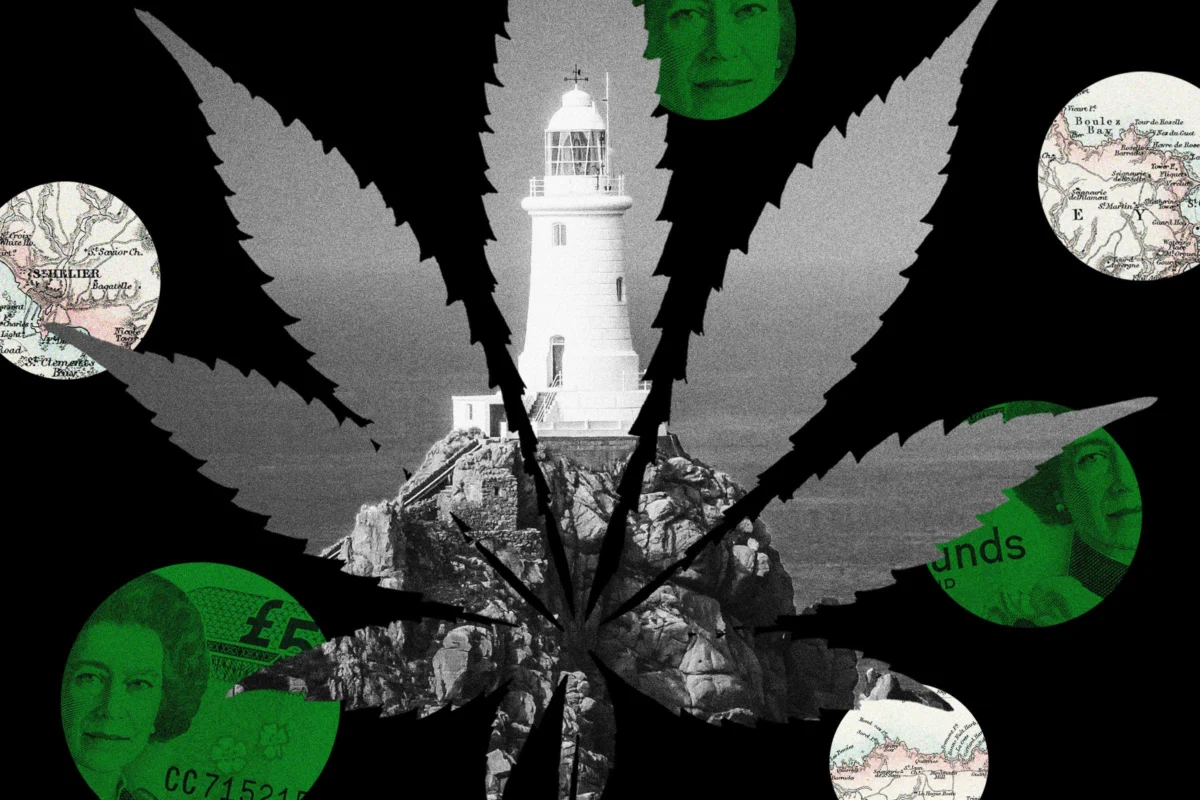
Steven Tan, CEO and director of Northern Leaf, walks along a narrow concourse in the Northern Leaf greenhouse in St Lawrence, Jersey, his voice a low murmur as he recites the names of his cannabis plants: Pink Gasoline, Moon Beam Gelato, Carbon Fibre, Gorilla Kush. Rows upon rows of these plants stretch into the distance, their distinctive jagged-edged, multi-fingered leaves and sticky buds resembling tiny pinecones. To the untrained eye, they appear largely uniform, but Tan knows each one intimately. "These plants are all different," he states, pausing beside a mature Carbon Fibre specimen. "Just like humans."
Northern Leaf stands as one of Europe’s largest licensed medical marijuana producers. Its expansive 100,000-square-foot growing facility is strategically located in Jersey, the largest of the Channel Islands, nestled between England and France. This very greenhouse was once a thriving hub for Jersey tomatoes, a once-famed crop on the island that teetered on the brink of extinction due to escalating fuel costs and fierce competition from overseas. Now, it has been transformed into a state-of-the-art facility, equipped with the advanced technology required to cultivate cannabis that adheres to the stringent regulations for medical use. This includes sophisticated automated irrigation systems, comprehensive environmental monitoring, and advanced air purification technologies.
Despite its modest size of just 45 square miles and a population of approximately 100,000, Jersey has emerged as an unexpected powerhouse in the burgeoning medical cannabis industry. While its total cannabis exports, exceeding 9,200 kilograms in 2025, may seem modest compared to larger UK growers, this figure represents a significant per capita output. Cannabis is rapidly becoming one of the island’s most vital new industries. Jersey’s Chief Minister, Lyndon Farnham, has publicly articulated his vision for Jersey to become a "centre of excellence" for medical cannabis, with production poised to become a cornerstone of the island’s economy.
The Rise of a New Agricultural Giant
Currently, Northern Leaf accounts for a remarkable 90 percent of Jersey’s total cannabis production. In 2025 alone, the company achieved an impressive export revenue of £8.4 million (approximately $11.3 million) from medical marijuana sales to markets including the UK and Germany. It is crucial to note that due to current regulations, Northern Leaf is exclusively permitted to grow cannabis for export and cannot supply the domestic market within Jersey.
Steven Tan harbours ambitions that far exceed current achievements. He draws a compelling parallel with another celebrated Jersey export, the Jersey Royal potato. "Jersey’s potato industry generated £40 million in 2025," Tan stated. "I am already generating a quarter of that industry’s revenue using only 5 percent of the land. If I were to utilize 20 percent of the land, I could create an industry worth more than the potato sector. That’s where the real potential lies."
Tan’s journey to the forefront of the cannabis industry is as intriguing as the plant itself. Born in Malaysia to a Chinese father and an Irish mother, his initial aspiration was to become a veterinarian. However, after graduating in 1998, he found himself developing software for Citibank. While financially rewarding, his heart was not in the world of finance. His true passion lay in cultivating cannabis. "I was captivated by the science of it all – the genetics, the seeds, the aromas," Tan confessed.

A Global Shift Towards Cannabis Legalization
The early 2000s proved to be an opportune period for an inquisitive business graduate to enter the cannabis sector. Across the globe, governments were beginning to legalize medical marijuana and move away from punitive sentencing towards decriminalization. This shifting legal landscape provided fertile ground for Tan’s entrepreneurial spirit.
Tan began exploring jurisdictions that were actively relaxing their cannabis laws, working as a consultant in places like California, the Netherlands, and Canada. "I started observing these legal frameworks opening up. The moment they existed, I was there," he explained. This proactive approach allowed him to gain invaluable experience and establish crucial connections within the emerging global cannabis market.
Jersey’s Unique Regulatory Landscape
Jersey possesses a distinct regulatory environment that has proven advantageous for the cannabis industry. As a British Crown Dependency, it maintains close ties with the United Kingdom but operates as a self-governing entity, empowered to enact its own legislation. Historically, Jersey has been recognized as a tax haven, attracting high-net-worth individuals and corporations through its absence of capital gains tax and a 0 percent corporation tax for most businesses. Along its picturesque coastline, nestled between charming beachside cafes and remnants of World War II fortifications – the Channel Islands being the only British territory occupied by Nazi forces – stand the offices of international banks and wealth management firms serving the ultra-rich.
Despite a traditionally conservative cultural outlook, Jersey has demonstrated a progressive stance on cannabis. The island legalized medical cannabis in 2019, a move that has since spurred the establishment of five private clinics. Recent figures indicate that approximately 6 percent of Jersey’s population has been prescribed cannabis, a notably higher proportion compared to an estimated 0.4 percent in Germany and 0.1 percent in the UK. Upon legalization, Chief Minister Lyndon Farnham outlined ambitious plans to position the island as a central hub for the medical cannabis trade, strategically repurposing the horticultural expertise and infrastructure honed during its celebrated tomato-growing era for this new venture.
Steven Tan joined Northern Leaf as CEO in 2024, a period when the company was facing significant challenges following a failed initial public offering. At that time, its valuation stood at a mere £3.7 million, despite substantial investments of up to £30 million in its cannabis cultivation facility. Nevertheless, Tan recognized the considerable potential within the company. Over the subsequent two years, he has overseen a significant increase in the facility’s operational capacity, raising it from 25 percent to 75 percent. He firmly believes that the £8.4 million in product exported last year represents merely the nascent stage of the company’s growth trajectory.
Quality Control and Regulatory Rigour
Sarah Clover, a barrister at Kings Chambers specializing in cannabis licensing in Jersey, highlighted the island’s unique advantage in a conversation with WIRED. "Anybody buying from Jersey knows that the product coming out of it is absolutely gold standard, because the MHRA says it is," she asserted, referring to the UK Medicines and Healthcare products Regulatory Agency. The MHRA’s rigorous inspection standards for growers ensure a high level of quality control that is difficult to replicate. Furthermore, the permitting process on the island is notably streamlined. "You can make an application for a permit on a Monday and get it on a Tuesday," Clover added, underscoring the administrative efficiency.
Many stakeholders within Jersey’s medicinal cannabis industry are now looking to expand beyond the cultivation of raw cannabis to include processing and packaging for export on the island itself. Northern Leaf already possesses the necessary facilities for such operations. However, current Jersey law restricts the export of cannabis to bulk, raw material only, requiring other companies to undertake processing and packaging for distribution and sale. The company awaits a potential shift in legislation. "At the minute, we’re kind of on this seesaw – which way will the island go?" Clover mused. "It could really take off here. Jersey could be a life sciences hub, not just for cannabis but for all sorts of pharmaceuticals."

Challenges and Local Concerns
Operating a cannabis business on a small island presents its own set of challenges, and not all residents are enthusiastic about the prospect of expansion. Steven Tan has encountered opposition from local residents during each phase of the facility’s production expansion. Some have voiced complaints about the discernible smell of cannabis wafting from their balconies. Others have drawn links between the burgeoning cannabis industry and concerns over the misuse of cannabis on the island, despite the fact that all of its legally produced product is exported. Jersey’s Health Minister has noted that cannabis is a "contributory factor" in 22 percent of admissions to the island’s acute mental health ward.
One patient, who requested to be identified only as Michael, shared his experience with WIRED. He was prescribed medical cannabis for 18 months after exhausting two other prescribed medications for insomnia and anxiety. "The initial assessment was simple. I had a meeting with the cannabis doctor who was pretty evangelical about its medicinal properties. They check your medical history with your GP, and within 10 days you’re good to go," he recounted.
Michael was prescribed 30 grams of "unbelievably good" cannabis per month, with instructions that he could request more if he ran out. However, he later decided to discontinue the treatment. "I stopped because it was seriously affecting my mental health, and I have since seen a psychiatric professional who said I should never have been prescribed it given my documented mental health history," he stated.
The illegal resale of medical cannabis has also emerged as a concern, with a rise in so-called "user-dealers" who sell their excess medical marijuana to others. Jersey Police informed WIRED that this practice "undermines the legal framework and creates opportunities for criminal supply."
Despite these challenges, overall cannabis-related offenses have seen a significant decline since Jersey legalized medical cannabis in 2019. Offenses dropped from 216 in 2016 to just 12 as of July 2026, indicating a positive impact on crime statistics.
Tan remains pragmatic about the difficulties of operating in Jersey. "Culturally, the people here are harder to convince about cannabis," he admitted. "It’s an older society." However, with over 25 years of experience in the industry, he is accustomed to navigating pushback. "It’s a normal challenge," he stated. "And I think when anyone sits down and meets me, they understand. This isn’t a bunch of stoners growing a bit of weed in a plastic greenhouse."
The Lure of Recreational Legalization and Regulatory Loopholes
While Jersey’s medical cannabis industry continues to expand, a segment of its population is advocating for broader legalization. In 2024, a vote to decriminalize recreational cannabis was narrowly defeated by a single vote in the island’s parliament. A subsequent attempt by the island’s then Health Minister to reintroduce the legislation was withdrawn before it could be debated. It is anticipated that the matter will be brought before parliament again in the coming months.

Some individuals on the island have taken matters into their own hands, exploiting a loophole in current laws to make Jersey one of the few places in Europe, outside of Amsterdam, where THC products can be legally purchased and consumed.
Gary Tucker, a California native and former analyst in the US Army, operates a weed shop in St Helier, Jersey. He has experienced multiple raids on his establishment, Bailiwick Botanicals, which sells recreational cannabis products such as hash cakes, gummies, and other edibles infused with tetrahydrocannabinol (THC), the psychoactive compound responsible for the "high" associated with cannabis. During one raid in February 2024, customs officers and local media were present as shelves and boxes of products were confiscated. "They were literally running their arms down the shelves and putting everything into bags. They took everything," Tucker recounted to WIRED.
Tucker’s business operates independently of Jersey’s regulated medical cannabis industry. He circumvents existing laws by leveraging a loophole that permits the sale of products containing CBD (cannabidiol), another key compound in cannabis that does not induce intoxication. Jersey’s law stipulates that the THC content in CBD products cannot exceed 3 percent of the CBD’s weight. By increasing the CBD content, sellers can effectively incorporate higher levels of THC. "It’s just a math equation," Tucker explained.
Tucker acknowledges that this approach is not without its drawbacks, citing studies that suggest high levels of CBD can potentially cause liver damage. However, he views this as an issue with the regulation itself, not with his business model. "I’m just following consumer demand," he stated.
Tucker is a vocal proponent of cannabis’s therapeutic benefits. During his tenure as a weapons trainer for the military, he grappled with the psychological toll of learning about the deaths of recruits he had trained. "I needed to step back from it. It started to really affect my mind," he said. He observed veterans turning to cannabis for relief, and he too found solace in its properties. "It was the only thing that helped me," he affirmed. "Cannabis gave me my life back."
Currently, Tucker manufactures most of his products in the United States before shipping them to Sark, a smaller Channel Island known for its car-free environment and independent governance, and then onward to Jersey. However, evolving regulations in the US may necessitate a revision of his operational strategy.
Tucker envisions Jersey as a potential export hub for THC products into Europe. He advocates for the island’s burgeoning cannabis industry to expand beyond the medical sector into the recreational market. "This isn’t just a bunch of guys in a cellar somewhere. Not only does cannabis help people, but getting it to the shelf creates jobs. From the grower to the retailer. It permeates across all industries. We’re making cosmetics. We’re making gummies. We’re making drinks," he enthused.

Following the 2024 raid, Bailiwick Botanicals temporarily ceased operations for two weeks, and its confiscated stock was not returned for another six months. As of June 2026, Tucker and his team continue to sell a range of THC-infused confectionery, including fudge, chocolate, and sweets. His latest offering, THC-infused coffee beans, has proven particularly popular. Law enforcement has, for the time being, refrained from further action.
In a written statement to WIRED, the Government of Jersey acknowledged concerns regarding the potential for regulatory circumvention. "The possibility of abuse of our limits to get round the law in other jurisdictions is a matter of concern to the Government of Jersey and we are looking at ways to address it," the statement read. "Work is underway to consider whether Jersey’s existing legal exemptions for CBD products require amendment."
The Shadow of International Treaties
While Jersey asserts its autonomy in setting its own laws, the complete legalization of cannabis faces potential obstacles. As a signatory to the UN Convention on Narcotic Drugs through the UK, any move towards full legalization by the island could attract scrutiny from the UK Home Office. The precedent set by Bermuda, a British Overseas Territory, offers a cautionary tale. In 2022, an effort by Bermuda to legalize recreational cannabis was blocked when the UK withheld Royal Assent from the bill, highlighting the complexities of navigating international drug control treaties.
Back at the Northern Leaf facility in St Lawrence, Tan inspects large boxes filled with cannabis destined for destruction. This material is either removed due to production issues or insufficient THC levels. It is then transported to a secure area of the facility and locked away in a reinforced, armored vault. Specialist staff, equipped with bodycams, transport the bags to the island’s incinerator for disposal, as mandated by law.
Tan consistently advocates for legislative reform and increased support for the cannabis industry, including the introduction of an industrial energy tariff to mitigate soaring energy costs. He envisions Jersey becoming "the Monsanto of cannabis," referencing the agricultural giant acquired by Bayer, and aims to delve deeper into cannabis genetics, establish a tissue-culture laboratory, and "bring out strains that nobody has ever seen."
Reflecting on his career path, Tan likens himself to Willy Wonka, but for the cannabis industry. He recalls his father’s warning when he left corporate finance 30 years ago: he could have amassed far greater wealth in banking. "And you know what, he was right," Tan conceded. "But I would not have had nearly as much fun."
