

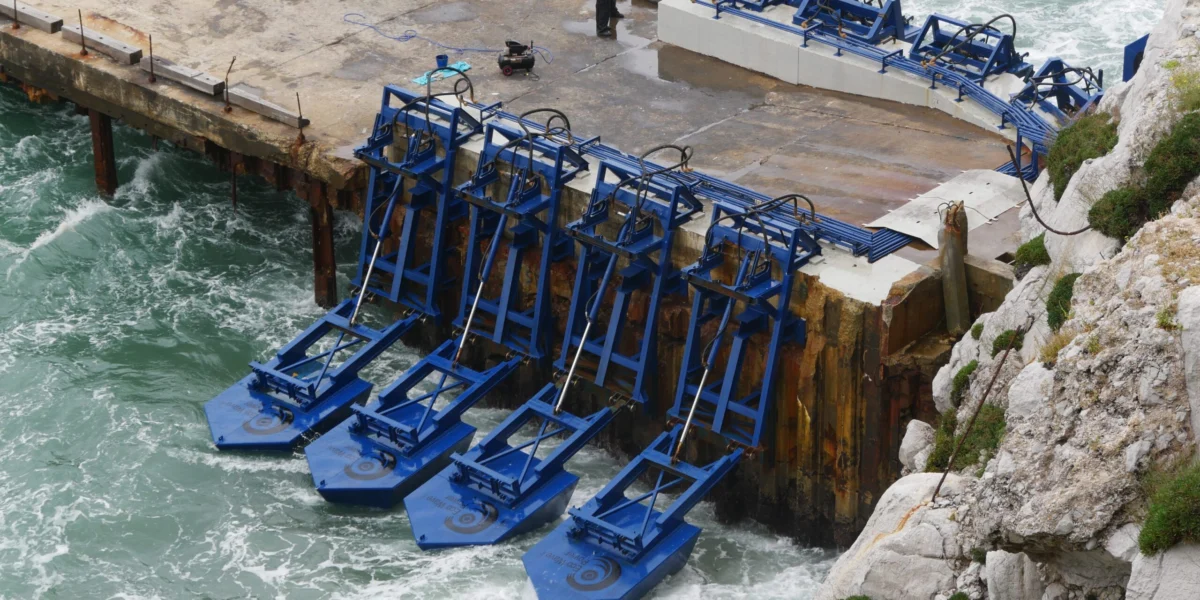
Eco Wave Power Global AB, a prominent developer of onshore wave energy conversion technology, has officially announced the successful conclusion of the primary phase of its sophisticated digital twin development program. This initiative, conducted in partnership with the German firm AI engineering GmbH, represents a significant leap forward in the integration of artificial intelligence and physics-based modeling within the marine energy sector. By creating a high-fidelity digital representation of its proprietary wave energy systems, the company aims to resolve some of the most persistent engineering challenges associated with the volatile ocean environment, ultimately paving the way for more efficient, scalable, and predictable renewable energy production.
The completion of Phase 1 marks the establishment of a robust computational framework that simulates the intricate interactions between ocean waves and the company’s unique floater mechanisms. This virtual environment allows engineers to analyze wave loading, structural stress, and potential energy yield under a vast array of simulated sea states before any physical hardware is deployed. The collaboration leverages the specialized expertise of AI engineering GmbH in the fields of mechanical engineering and machine learning, alongside the advanced computational resources provided through the NVIDIA Inception program, an accelerator for startups transforming industries with AI and data sciences.
Technical Foundation of the Phase 1 Digital Twin
The first stage of the project focused on the development of a physics-based digital model designed to mirror the real-world behavior of Eco Wave Power’s onshore technology. Unlike traditional data-driven models that rely solely on historical inputs, a physics-based digital twin incorporates the fundamental laws of fluid dynamics and structural mechanics. This allows the system to predict how the equipment will respond to unprecedented environmental conditions, such as extreme storm surges or unusual wave frequencies.
During this phase, the joint engineering team conducted extensive simulations regarding floater movement and the resulting structural forces exerted on the power take-off (PTO) units. By analyzing these forces in a virtual space, the company can identify potential points of mechanical fatigue and optimize the design of the floaters to maximize energy capture while ensuring long-term durability. The model also integrated initial machine-learning capabilities, which are being trained to forecast energy output and mechanical loads based on incoming wave data.
A critical component of this phase was evaluating the model’s adaptability. Eco Wave Power intends for this digital twin to be a "living" asset that can be reconfigured for different geographical locations. As the company expands its global footprint—with projects planned or underway in regions ranging from California to the Mediterranean—the ability to input site-specific bathymetry and wave climate data into the digital twin will drastically reduce the time and cost associated with site-specific engineering and environmental assessments.
Strategic Collaboration and the NVIDIA Ecosystem
The development of such a complex simulation environment requires immense computational power and sophisticated software tools. Both Eco Wave Power’s U.S. subsidiary and AI engineering GmbH are members of the NVIDIA Inception program, which has provided the technological backbone for the project. The collaboration utilizes several key components of the NVIDIA technology stack to achieve high-fidelity results.
Chief among these tools is NVIDIA Omniverse, a platform built for developing and operating industrial metaverse applications. Within Omniverse, the teams can visualize complex fluid-structure interactions in real-time, allowing for a more intuitive understanding of how waves transfer energy to the floaters. Additionally, the project utilizes NVIDIA Warp, a Python framework designed for high-performance GPU (Graphics Processing Unit) simulation and geometry processing. Warp enables the rapid calculation of the mathematical models required to simulate free-surface fluid dynamics, which are notoriously difficult to compute due to the chaotic nature of water movement.
By utilizing NVIDIA-accelerated computing infrastructure, the partners have been able to run simulations that would have previously taken weeks in a matter of days or even hours. This acceleration is vital for the iterative design process, enabling the team to test hundreds of design variations in the digital realm to find the optimal configuration for maximum efficiency.
Addressing the Challenges of Marine Engineering
Wave energy is widely regarded as one of the most difficult forms of renewable energy to harness. Unlike solar or wind, which interact with relatively consistent or predictable mediums, wave energy systems must operate at the interface of air and water—a region of intense mechanical stress and complex fluid behavior.
PD Dr.-Ing. habil. Stefan Adami, Co-Founder and General Manager of AI engineering GmbH, emphasized that the goal of the project is to bridge the gap between theoretical simulation and operational reality. He noted that wave energy involves a "challenging engineering problem" because it necessitates the management of structural motion within highly variable environmental conditions. The digital twin serves as the link, using high-fidelity simulations to better understand energy capture and system behavior across a wide range of "sea states"—a technical term used to describe the general condition of the free surface on a large body of water.
By combining these physics models with machine learning, the partnership aims to move beyond simple monitoring. The goal is to create a system that can perform "predictive maintenance," identifying when a component is likely to fail before it actually does, and "real-time optimization," where the system adjusts its resistance and damping settings on the fly to match the incoming wave profile.
The Synergy Between Wave Energy and AI Data Centers
While the primary goal of the digital twin is to optimize energy production, Eco Wave Power is also looking toward the broader energy landscape, specifically the burgeoning demand from the artificial intelligence industry itself. As AI models become more complex, the data centers required to train and run them are consuming unprecedented amounts of electricity. Recent industry reports suggest that data center power demand could double by the end of the decade, placing a significant strain on existing power grids and threatening corporate carbon-neutrality goals.
Eco Wave Power CEO Inna Braverman has identified a unique synergy: AI can be used to make wave energy more efficient, and that efficient wave energy can, in turn, provide the clean power needed to fuel the AI revolution. Because many of the world’s largest data centers are located in coastal regions to take advantage of seawater cooling or proximity to subsea fiber-optic cables, they are ideally positioned to be powered by nearshore wave energy installations.
The company is currently engaged in discussions with data center developers and infrastructure partners to explore the feasibility of direct-to-facility renewable energy supply. This vision includes the development of secure connection infrastructure and settlement mechanisms to ensure that the electricity supplied is accurately measured and verified. The digital twin plays a crucial role here as well; by forecasting energy production with high accuracy, it allows data center operators to coordinate their high-intensity computing tasks with periods of peak renewable energy availability, thereby reducing reliance on the traditional grid and fossil-fuel backups.
Chronology and Future Roadmap
The completion of Phase 1 is the first step in a multi-year roadmap designed to bring wave energy into the digital age. The project’s timeline is structured to move from theoretical modeling to real-world integration:
- Phase 1 (Completed): Creation of the physics-based digital model, initial machine-learning integration for load forecasting, and evaluation of site-adaptability.
- Phase 2 (Upcoming): Integration of the digital twin with Eco Wave Power’s full energy-conversion system, including the hydraulic and electrical components. This phase will involve "hardware-in-the-loop" testing to ensure the digital model accurately reflects the behavior of the physical PTO units.
- Phase 3 (Long-term): Deployment of the AI-driven operation system across commercial-scale installations. This will involve the use of real-time operational data to continuously refine the digital twin, creating a feedback loop that improves the entire system’s performance over its lifecycle.
Inna Braverman highlighted that the next stages are focused on connecting the digital foundation to real-world data. The ultimate objective is to create a wave energy system that is not only smarter and easier to scale but also capable of interacting securely with the energy infrastructure of the future, including smart grids and microgrids.
Broader Impact and Industry Implications
The success of the Eco Wave Power and AI engineering GmbH collaboration has implications that extend far beyond a single company. The wave energy sector has historically struggled with high costs and technical failures, often lagging behind the rapid growth seen in the wind and solar industries. However, the application of digital twin technology could be the catalyst needed to achieve commercial viability.
By reducing the need for expensive physical prototypes and long-term sea trials, digital twins lower the barrier to entry for marine energy technologies. Furthermore, the ability to provide reliable energy forecasts addresses one of the main criticisms of renewables: intermittency. If wave energy can be predicted with the same accuracy as weather patterns, it becomes a much more attractive prospect for grid operators and industrial energy consumers.
From a global perspective, the development of intelligent wave energy systems supports the "Blue Economy"—the sustainable use of ocean resources for economic growth. As nations strive to meet the targets set by the Paris Agreement, the diversification of the renewable energy portfolio to include the ocean’s vast power will be essential. With 70% of the Earth’s surface covered by water, the potential for wave energy is immense, and through the marriage of physical engineering and digital intelligence, companies like Eco Wave Power are working to ensure that this potential is finally realized.
As the program moves into its subsequent phases, the industry will be watching closely to see how these virtual models translate into real-world gains in efficiency and reliability. For now, the completion of Phase 1 stands as a testament to the power of collaborative innovation and the transformative potential of artificial intelligence in the global transition to clean energy.
