

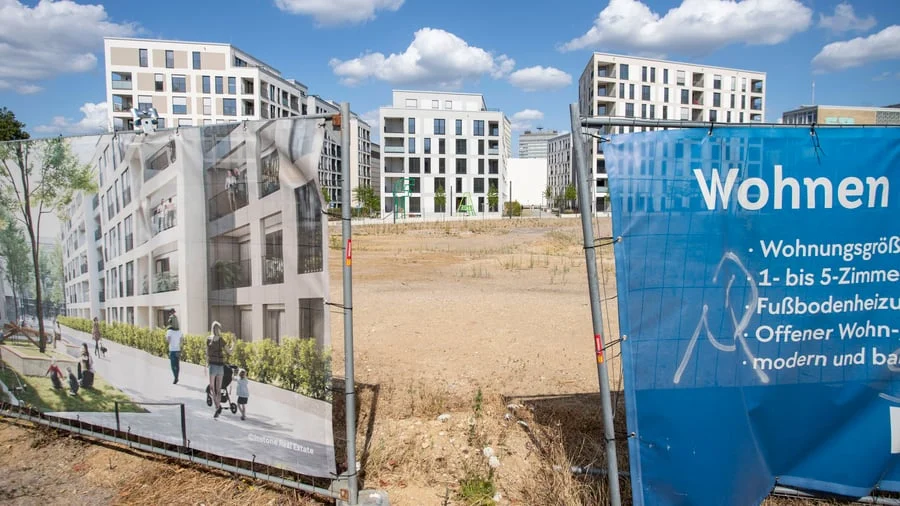
In the bustling Düsseldorf district of Flingern, a relic of the past is making way for the future. An old building is being demolished to clear the site for ten new apartments and two townhouses. The structure’s roof has already been removed, and a mountain of rubble now occupies the inner courtyard. The first of these new residential units are slated for completion by the end of 2028, with prices ranging from €289,000 for a compact 34-square-meter living space to a substantial €1.15 million for a more expansive 125-square-meter apartment.
According to developers, rental income from similar new builds in the area hovers around €26 per square meter per month, a figure considered remarkably high, even for Düsseldorf. This contrasts sharply with the current local rental index, which caps rents at €17.35 per square meter for newer constructions. This significant price disparity between purchase and rental yields highlights a growing challenge for investors and a concern for housing affordability.
The construction of high-priced apartments like those in Flingern continues, yet the landscape for affordable housing options for the middle class appears increasingly bleak. The German federal government has set an ambitious target of 400,000 new homes annually, a goal that has been consistently missed. In the past year alone, approximately 206,000 new residential units were completed, falling far short of the required volume. This persistent deficit exacerbates the existing housing shortage and contributes to rising rental costs.
A Multifaceted Crisis: The Roadblocks to New Construction
Various policy initiatives, including subsidized loans, tax incentives, and direct grants, have been implemented to stimulate new construction. However, these measures have yet to yield a discernible impact on the market. The reasons behind this stagnation are complex and interconnected.
Several government funding programs are restricted to specific types of properties and are subject to numerous stringent conditions. Fluctuations in these program conditions have also contributed to confusion among developers and investors. Furthermore, regulatory hurdles often create significant delays in bringing construction projects to fruition. The most significant impediment, however, remains the substantial increase in construction and financing costs, which has drastically altered the economic viability of many real estate ventures.
For new construction to thrive, it requires investors willing to commit capital to these projects. However, with both construction expenses and borrowing costs significantly higher than in previous years, many new developments are no longer financially attractive to investors. The prospect of purchasing a property solely for rental income has, in many cases, become a losing proposition. Sophisticated strategies are now essential for such investments to yield any return.
The Investor’s Dilemma: When New Builds Become Unprofitable
In the five largest German cities, rental yields for newly constructed apartments are consistently below four percent. This threshold is widely considered the minimum required for a rental investment to be profitable. Sven Keussen, Managing Director and Head of Investment Properties at Rohrer Immobilien in Munich, notes, "With construction costs in Munich exceeding €5,000 per square meter, achievable gross rental yields often only reach 3.5 percent." This is insufficient to cover the financing costs associated with these properties.
Market Strain: Stalled Projects and Slow Sales
The crisis in new construction is visibly manifested in the sluggish sales of residential properties. Lothar Schubert, who oversees projects in Hamburg, including those in HafenCity, observes this phenomenon firsthand. Previously, up to 40 percent of apartments were sold before construction even began. "Today, it’s zero percent," he states.
Schubert, who previously developed new construction projects with DC Developments, founded a new company, DCD Services, at the end of 2024. This firm specializes in restructuring troubled real estate projects that have stalled and can no longer proceed with construction, aiming to make them viable again.
During periods of low interest rates, rental income in desirable locations was often sufficient to cover loan repayment and interest. However, Schubert explains, investors now must increasingly rely on property value appreciation. This shift in expectation makes potential buyers hesitant.
A recent report from the ifo Institute indicated a significant downturn in the construction industry, with a revised forecast for new housing construction up to 2028. The economic climate, characterized by high inflation and rising interest rates, has dampened investor confidence and increased the financial risks associated with long-term real estate commitments.
The Search for Profitability: Strategies in a Challenging Market
In Germany’s top five cities, new apartment rental yields are struggling to break the 4% mark, a critical point for profitability. This situation is particularly acute in expensive markets like Munich, where construction costs are soaring. Sven Keussen of Rohrer Immobilien highlights that achieving a gross rental yield of even 3.5% is challenging, which is insufficient to cover the interest on loans.
The federal government’s goal of building 400,000 new homes annually has proven elusive, with completions significantly lagging behind. In 2023, for instance, only around 206,000 new units were built, reflecting a systemic issue in the construction sector.
Navigating the New Real Estate Landscape: Five Keys to Profitable Investment
The current market conditions necessitate a more strategic approach for real estate investors. The days of relying solely on rental income to cover loan obligations are largely over. Property value appreciation is now a critical component, but this, too, is subject to market volatility.
1. Prudent Acquisition: Beyond Emotional Decisions
The purchase of a property is often an emotionally charged decision. However, for investment purposes, emotions can be detrimental. Buyers who are swayed by aesthetics rather than financial logic may undertake excessive economic risks.
Rigorous calculation is paramount. Projected rental income must demonstrably exceed financing costs to ensure a positive cash flow. This ensures that the rental activity contributes to profitability rather than being a financial drain.
A hypothetical scenario in Düsseldorf illustrates this challenge: a three-bedroom, 75-square-meter new build costing €450,000 (or €6,000 per square meter) incurs additional costs for property transfer tax (6.5%) and notary fees (1.5%). If the loan carries a 4% interest rate, a cold rent of €26 per square meter results in a monthly loss, regardless of whether the calculation is made before or after taxes, or over 1, 5, 10, or 20 years. To break even, the landlord would need to charge an ambitious €31 per square meter.
The potential for future capital gains can offset these initial losses. In the Düsseldorf example, assuming a 2% annual property value increase over 20 years, the capital gain would be €385,207. However, if the property value remains stagnant, the total gain over two decades shrinks to €175,278. Jeanette Kuhnert, Vice President of the German Real Estate Association (IVD), cautions that there is "no guarantee that a new build will increase in value." A decline in value is also possible, underscoring the importance of acquiring properties at a reasonable price.
The price-to-rent ratio, known as the multiplier, is a key indicator of a property’s economic viability. At a 4% interest rate, a multiplier exceeding 20 suggests that the investment may not be profitable.
2. Foresighted Planning: Securing Future Financial Stability
Even if a new build appears financially sound, it can strain an investor’s liquidity. Properties tie up capital that may be needed in emergencies. Thomas Teske, a fee-based mortgage advisor from Hilden, advises clients to prioritize renovating their primary residence before investing in a rental property. Unexpected expenses, such as replacing a heating system in their own home, could be jeopardized if funds are tied up in an investment property.
The German government has introduced incentives for landlords to renovate rental properties, offering grants and loans for modernization. However, the focus on acquiring new rental properties while neglecting essential maintenance on existing ones can lead to a broader housing crisis.
3. Maximizing Value: Strategies for Rental Success
In Hamburg’s Altona district, the "Gute Stube" (literally "Good Parlor") residential building, despite its name, is not a pub but a new construction block. Its design, featuring large, floor-to-ceiling windows, has drawn criticism, with some residents dubbing it an "aquarium." Many apartments offer views of a busy, four-lane street, a less than idyllic setting.
Initial plans for the "Gute Stube" date back to 2018, when interest rates for a ten-year loan were just over 1%. Today, they have risen to around 4%. Despite higher interest rates and questionable aesthetics, most of the 47 apartments have been sold. Lucas Ziegemeier of the real estate agency Peters + Peters attributes this success to the "Ready to rent" offer. New owners receive a pre-selected tenant, along with a fully equipped apartment ready for immediate occupancy. This ensures immediate rental income, a significant advantage in the current market.
The purchase price of an investment property should reflect not only its location but also the surrounding market conditions, which can change over time. The current interest rate environment compels buyers to scrutinize new construction offerings more closely. The "Gute Stube" example demonstrates that unique value propositions, not offered by other projects, can be decisive.
4. Leveraging Tax Advantages
New construction offers distinct tax benefits compared to existing properties. In addition to standard depreciation, buyers can utilize a special depreciation allowance of 5% per year for the first four years. This can provide significant tax advantages in the initial phase of ownership.
Many developers highlight this special depreciation allowance to attract buyers. However, it is only applicable if construction costs do not exceed €5,200 per square meter of living space. For high-end properties, construction costs often surpass this limit, rendering the special depreciation unavailable. Even when costs are below the threshold, the benefit is not uniform. Daniel Preis, CEO of Domicil Real Estate in Munich, notes, "For those not taxed at the highest marginal rate, the advantage of special depreciation may be less significant."
For new builds where construction costs exceed €5,200 per square meter, an alternative is the declining-balance depreciation. Instead of depreciating a fixed amount of the purchase price annually, buyers can depreciate 5% of the remaining balance each year. This option is available for properties purchased before October 2029.
5. Considering Existing Properties
According to the real estate portal Immobilienscout24, existing apartments in Germany averaged €2,650 per square meter in the third quarter of the current year. Compared to new builds, they offer a crucial advantage: "Because the construction period is eliminated, buyers immediately generate rental income," states real estate investor Preis. This is particularly beneficial in areas where actual rents are still lagging behind official rental indices.
However, existing apartments also carry risks. Many property owner associations are burdened by a backlog of necessary repairs. Buyers acquiring property in such communities may face significant modernization costs for new heating systems, insulation, or plumbing.

The cost of a core renovation can reach approximately €1,000 per square meter, covering only essential work. High-quality modernization can easily double this figure. When these costs are factored in, an existing apartment may no longer represent a bargain.
Prospective buyers should thoroughly inspect the property’s condition. Equally important are the minutes from owner meetings, which can reveal the owners’ willingness to undertake renovations. If modernization measures are consistently blocked, it is a strong deterrent to purchasing. A persistent backlog of repairs can lead to further deterioration and a decline in the property’s value.
Often, the optimal solution lies in a hybrid approach: a modernized existing apartment where costly future renovations are less likely.
The Broader Impact: A Strained Housing Market
The challenges in the new construction sector have far-reaching implications for Germany’s housing market. The persistent undersupply of new homes drives up prices and rents, making it increasingly difficult for individuals and families, particularly those in the middle and lower-income brackets, to find affordable housing. This can lead to increased social inequality and put pressure on social welfare systems.
The economic consequences extend beyond individual housing situations. A struggling construction sector can lead to job losses in related industries, impacting overall economic growth. The government’s ambitious housing targets underscore the urgency of addressing these systemic issues. Without effective policy interventions and a more favorable economic climate, the gap between housing demand and supply is likely to widen, posing a significant challenge for years to come. The current situation demands a multifaceted approach, involving deregulation, targeted financial support for affordable housing projects, and innovative solutions to streamline the construction process.
