

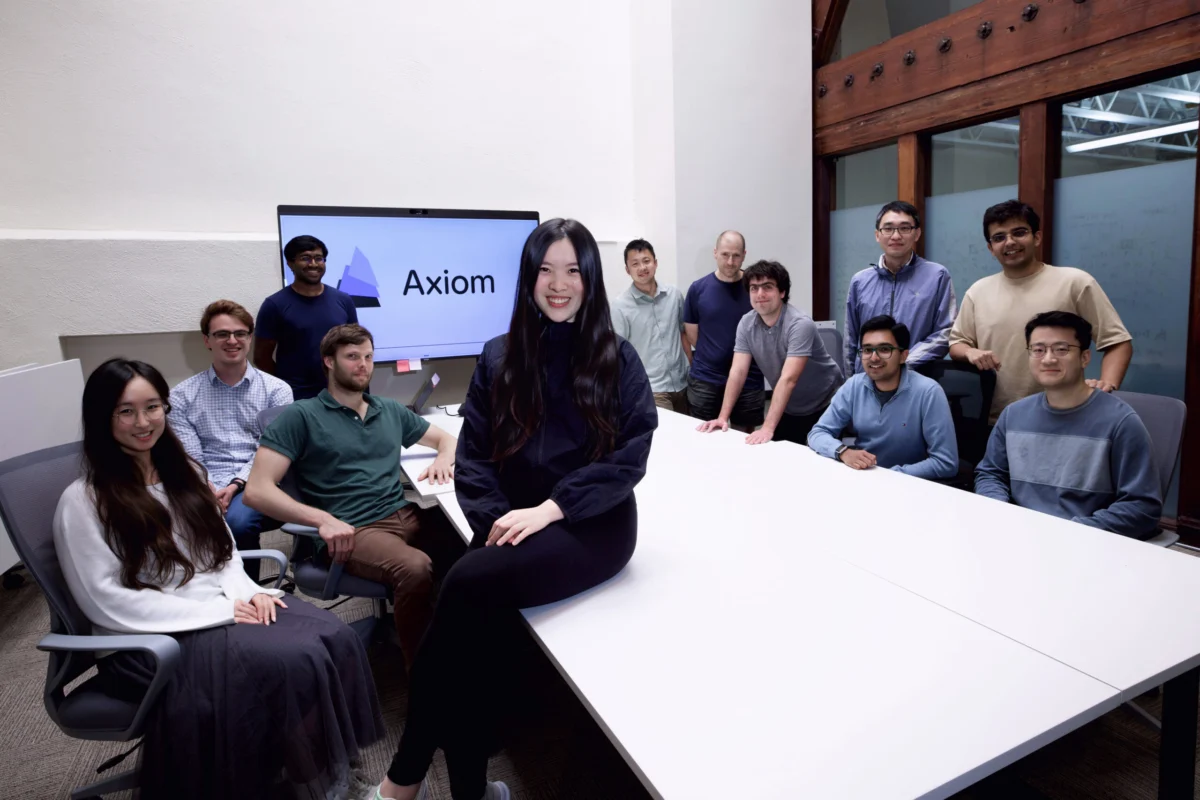
In an era increasingly defined by the prolific, yet often unverified, output of artificial intelligence, a significant development has emerged that promises to inject a new level of rigor and reliability into the burgeoning field of AI-driven mathematics and software development. AxiomMath, a rapidly ascending startup valued at $1.6 billion, announced this week the successful formal verification of the Stacks Project, one of the most extensive and intricate bodies of mathematics ever compiled by human intellect. This monumental achievement, translating approximately 7,654 pages of advanced mathematical theory into 16 million lines of meticulously computer-checked code, marks a pivotal step towards establishing a foundational layer of provably correct knowledge upon which future AI agents can confidently build, thereby addressing the growing concerns surrounding the quality and trustworthiness of AI-generated content.
The imperative for such a rigorous approach has become acutely apparent in recent months. The landscape of AI innovation often feels like a weekly assault on complex problems, with breakthroughs announced at a dizzying pace. Yet, this rapid expansion has also brought with it a shadow of concern regarding the veracity of AI-generated solutions, particularly in highly technical domains like mathematics. Just last month, for instance, OpenAI alone reportedly released 719 manuscripts claiming resolutions to some of the field’s most formidable challenges. While impressive in volume, the sheer scale and complexity mean that even initial computer checks can occasionally falter, leading to a pervasive sense of "AI slop" – a term describing the proliferation of unverified, potentially flawed, or logically inconsistent output. This raises a fundamental question: if AI can generate such a volume of potentially unreliable content in other areas, is mathematics, long considered the bastion of absolute truth, truly next in line to face similar challenges?
AxiomMath is unequivocally betting that mathematics can indeed avoid this fate, not by decelerating the pace of AI innovation, but by grounding it on an unshakeable foundation of formal verification. The company’s core mission revolves around constructing a robust, verified substrate that AI agents can depend on to not only write complex software but eventually to conduct groundbreaking scientific research with unparalleled accuracy. This vision positions AxiomMath as a critical player in the global effort to ensure that the future of AI is built on principles of verifiable truth rather than probabilistic approximations.
The target of this ambitious verification effort, the Stacks Project, is itself a testament to human mathematical collaboration and foresight. Initiated in 2005 by Columbia University mathematician Johan de Jong, the Stacks Project began as an open-source online reference, meticulously curated and expanded by a global community of mathematicians. Over nearly two decades, it has evolved into a comprehensive compendium, spanning from college-level algebra to the most advanced concepts in algebraic geometry, number theory, and related fields. Its significance within the mathematical community is immense; Columbia mathematician Peter Woit has lauded it as having "nothing else really comparable," drawing parallels to the legendary Bourbaki books – a series in the 20th century that famously sought to rebuild mathematics from its most fundamental axioms. The Bourbaki group’s work fundamentally reshaped mathematical pedagogy and research, and the Stacks Project is seen by many as a modern successor in its scope and ambition, aiming to systematize vast swathes of contemporary mathematics.
Formalizing mathematics is a sophisticated process designed to ensure the inherent logical soundness of mathematical structures and proofs. It involves rewriting mathematical proofs as code within a specialized programming language, most notably Lean. A sophisticated software program known as a proof assistant then meticulously checks this code line by line, verifying every logical inference and deduction against a predefined set of axioms and rules. If a proof successfully navigates this rigorous inspection, mathematicians gain an unprecedented level of confidence in its absolute logical correctness. This methodology is not novel to high-stakes fields; formal verification is a standard practice in engineering, where it is used to confirm the flawless functionality of intricate chip designs before fabrication. Similarly, researchers in France have successfully employed it to identify and rectify critical bugs in software systems responsible for calculating sensitive family benefits, underscoring its utility in safeguarding against errors in critical applications.
For a library as vast and intricately interconnected as the Stacks Project, the task extended far beyond merely checking individual theorems. The Stacks Project is not a mere collection of isolated results; its theorems, definitions, and lemmas are interwoven in a complex tapestry, with each concept building upon preceding ones. Much like a vast, branching family tree, countless results within Stacks trace their logical lineage back through a hierarchy of foundational concepts. This profound interconnectedness presented AxiomMath with one of its most formidable challenges. The team had to ensure that every single logical connection and dependency remained perfectly intact across the staggering 16 million lines of Lean code generated during the formalization process.
Carina Hong, the 25-year-old CEO of AxiomMath, articulated the magnitude of this challenge to TechCrunch, stating, "Things that are big and things that are delicate in life just don’t go together." She further emphasized the critical importance of maintaining internal consistency within Stacks: "[Stacks] is a collection of mathematical results that is the foundation of mathematics. You want [theorems] to be consistent and not, like, paradoxical. You want the definitions to not fight with each other." Hong, a Stanford math Ph.D. dropout who founded the company in March 2025 and secured a $200 million Series A round led by Menlo Ventures, initially harbored doubts about whether their innovative approach, which she playfully referred to as "vibe coding," could truly capture and preserve the intrinsic beauty and logical integrity of Stacks.
To surmount this unprecedented challenge, AxiomMath developed a sophisticated methodology involving a fleet of specialized AI agents. Rather than imposing a rigid, top-down command structure, the team adopted a more flexible, decentralized approach. Ashvin Swaminathan, a key member of Axiom’s technical staff, explained, "With Stacks, we imposed a hierarchy… [but] it was not, like, a complete hierarchy of dictating what every single agent was doing. The agents were finding tasks for themselves and identified things that they could work on in parallel." This autonomous, parallel processing capability proved crucial for tackling the project’s immense scale and complexity. Furthermore, AxiomMath distinguished itself by training its own proprietary AI models specifically to excel at mathematical formalization – an approach Hong noted is largely overlooked by most other verification startups. Initially, these agents were guided by one of Axiom’s in-house Lean experts, who imbued them with a human-like "sense of taste" for mathematical elegance and rigor. Over time, Hong reported, the agents independently developed this discernment.
The successful formalization of the Stacks Project fills one of the most significant lacunae in the landscape of formalized mathematics. As Swaminathan pointed out, "When you look at what has been formalized in mathematics, there’s this huge black hole. And that black hole covers algebraic geometry." Algebraic geometry, a field that combines abstract algebra with geometric concepts, is notoriously complex and foundational to many areas of modern mathematics and theoretical physics. Until now, researchers endeavoring to verify new work in algebraic geometry using proof assistants like Lean found themselves with a sparse foundation to build upon. "Well, now they do," Swaminathan affirmed, highlighting the immediate and profound impact of AxiomMath’s work. This achievement aligns perfectly with the observation by Fields Medal winner and UCLA mathematician Terence Tao, who has eloquently stated the general principle: "The more formalized proofs you have, the more formalized proofs you can make." Each verified result, therefore, acts as a new building block, accelerating the pace and expanding the scope of future formalization efforts.
The implications of AxiomMath’s achievement extend far beyond the realm of pure mathematics. While mathematicians represent a primary audience, the company’s long-term vision encompasses a broader, transformative impact on software engineering and scientific research. Software developers have long grappled with the persistent challenge of guaranteeing their code is entirely free of bugs, vulnerabilities, and security flaws. This problem is rapidly escalating as AI agents increasingly contribute to writing the world’s software. The inherent complexity and scale of AI-generated code make traditional debugging and testing methods increasingly insufficient, fueling a growing demand for more robust verification mechanisms.
AxiomMath is strategically positioning itself on the premise that the software of tomorrow, particularly that generated by AI, will necessitate foundations built upon the same rigorous verification principles now applied to the Stacks Project. Swaminathan elaborated on this transferable skill: "We believe that mathematics is the domain where you start building these things, and that it’s a transferable skill. Agents can read our code, understand it, and build new infrastructure on top of it. Our Lean formalization is now the substrate that agents can build upon." This perspective suggests a future where AI does not merely generate code, but generates provably correct code, fundamentally altering the paradigm of software development.
The very methodology employed by AxiomMath’s agents in formalizing Stacks – working in parallel, autonomously identifying tasks, and operating within a flexible hierarchy – is, according to Hong, a blueprint for how much of AI’s future work will unfold. She contends that for AI agents to continually push the frontiers of knowledge and innovation without succumbing to the "slop" problem, they will absolutely require a well-constructed, reusable, and rigorously verified body of knowledge. "You want [agents] to have a reusable library for them to build on and keep pushing the frontier," Hong asserted. She cautioned against the dangers of flawed foundational choices: "If you slop drop in a way that’s bad engineering choices in the beginning, then it’s very hard for them to grow that boundary."
In a bold declaration that underscores her confidence in AxiomMath’s pioneering approach and the profound significance of formal verification, Hong issued an open challenge: "I openly challenge all the coding companies to work on formalization at this scale." This statement is not merely a taunt but a strategic call to action, urging the broader tech industry to recognize and invest in the foundational work necessary to ensure the reliability and integrity of the AI-driven future.
The formal verification of the Stacks Project by AxiomMath represents more than just a technological feat; it is a profound philosophical statement on the future of AI and knowledge. By providing a trusted, immutable foundation for advanced mathematics, AxiomMath is not only empowering AI to engage with complexity at an unprecedented level but also establishing a critical precedent for quality and reliability in an increasingly automated world. This achievement could herald a new era of scientific discovery, where AI-driven insights are not just novel but demonstrably true, and where the software underpinning our digital lives is inherently more robust and secure. The impact on areas from drug discovery to climate modeling, from advanced engineering to fundamental physics, could be transformative, fostering an environment where human ingenuity and artificial intelligence collaborate on a bedrock of verifiable truth.
