

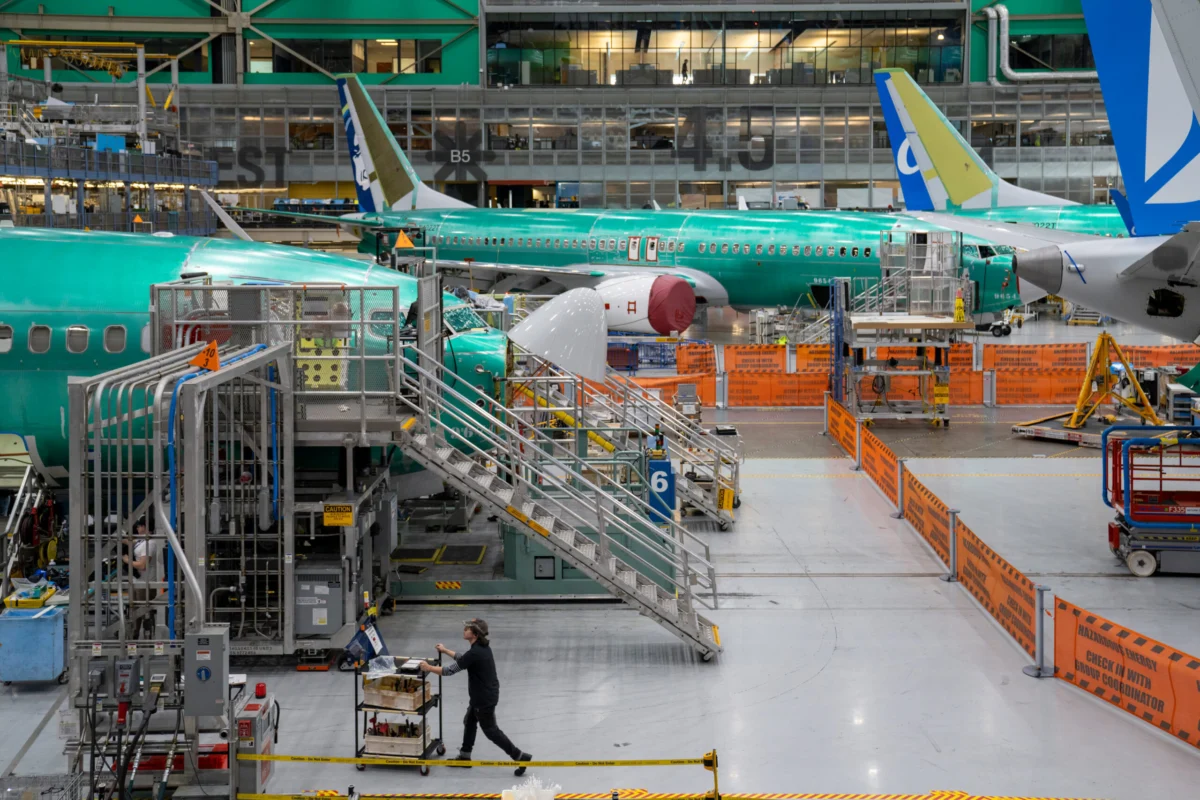
Boeing, the aerospace giant, has significantly tempered expectations for a crucial ramp-up in the production of its best-selling 737 MAX aircraft, announcing that it does not foresee reaching a higher output rate until the second half of 2027. This revised timeline, revealed during the company’s recent quarterly earnings call, pushes back earlier projections and underscores the ongoing challenges within its supply chain, particularly concerning the manufacturing pace of aircraft wings. The news sent Boeing’s stock plummeting by 10% in Tuesday’s trading, reflecting investor anxiety over the prolonged recovery trajectory.
Production Bottlenecks and Revised Outlook
Chief Executive Officer Kelly Ortberg informed investors and analysts on the call that the company is now targeting a production rate of 52 737 MAX planes per month by the latter half of 2027. This represents a modest increase from the approximately 47 units currently being manufactured each month. Ortberg had previously indicated last month that the stabilization of production was proving "a little bit longer" than anticipated, attributing the delay primarily to the slower-than-expected pace of wing production. This issue is a critical bottleneck, as the precise and timely delivery of major structural components like wings is fundamental to maintaining a smooth final assembly line.
The aerospace industry has been grappling with a fragile global supply chain, exacerbated by the COVID-19 pandemic, geopolitical tensions, and labor shortages across various tiers of manufacturing. For Boeing, a company under intense scrutiny following past quality control issues and production halts, these supply chain disruptions present a compounded challenge. The wings, a complex assembly involving thousands of parts and intricate manufacturing processes, are often produced by key suppliers, making Boeing reliant on their operational efficiencies and quality adherence. This interdependence means that even minor slowdowns at a supplier can have cascading effects on the final assembly schedule.
Ortberg acknowledged the pressure for faster acceleration but reiterated the company’s commitment to a methodical approach. "I know everybody wants us to go faster, but we’re going to do it right," he told CNBC, emphasizing a prioritization of quality and safety over speed. This sentiment was echoed in an internal memo to staff, where Ortberg stated, "Looking ahead, expectations are rising, and they should. That means elevating our performance through lean, productivity and efficiency improvements in our day-to-day work while upholding our high levels of safety and quality." This directive highlights a corporate culture shift aimed at embedding rigorous processes and quality checks throughout the production cycle, a direct response to lessons learned from previous crises.
Financial Performance in the Third Quarter
Against the backdrop of these production challenges, Boeing reported a mixed set of financial results for the third quarter. The company successfully narrowed its net losses significantly, largely bolstered by a robust performance from its defense unit. For the three months ending September 30, Boeing posted a net loss of $116 million, or 26 cents per share. This marked a substantial improvement compared to the staggering $5.34 billion loss, or $7.14 per share, recorded in the same period a year earlier. Adjusting for certain one-time items, the company reported an adjusted loss of 34 cents per share. The previous year’s figures were heavily impacted by a nearly $5 billion charge related to its long-delayed 777X aircraft program, illustrating the financial volatility that has plagued the manufacturer.
Total revenue for the quarter climbed 4% year-over-year, reaching $24.19 billion, exceeding analysts’ consensus estimates. Crucially for its operational health, free cash flow saw a healthy increase, rising to $464 million from $238 million in the third quarter of 2025. This positive cash flow generation is a vital indicator of financial stability and the ability to fund operations and investments without relying on external financing.
The defense, space, and security unit emerged as a strong performer, with its revenue jumping 15% from a year earlier to $7.94 billion. This segment’s consistent contributions provide a degree of financial ballast, offsetting some of the volatility experienced in the commercial aircraft division. The diversification of Boeing’s portfolio across commercial, defense, and services sectors has been a strategic advantage, especially during periods of stress in its primary commercial aviation business.
However, the commercial aircraft business, which is the cornerstone of Boeing’s long-term growth strategy, presented a less encouraging picture. Revenue in this all-important segment declined by 3% to $10.72 billion. Despite delivering 161 commercial airplanes in the quarter, just one more jet than in the previous year, the unit recorded a negative operating margin of 6.5%. Boeing attributed this to a "less favorable delivery mix, higher projected costs associated with future production rate adjustments and higher estimated supply chain costs." The "less favorable delivery mix" suggests a higher proportion of lower-margin aircraft or a blend that did not optimize profitability, while the "higher projected costs" directly reflect the inefficiencies and additional expenses incurred due to the ongoing production issues and supply chain pressures. Ortberg’s internal memo acknowledged this, stating the manufacturer has "more work to do" in this critical area.
Historical Context and the 737 MAX Saga
The challenges Boeing faces with its 737 MAX production are deeply intertwined with a tumultuous period in its history. The 737 MAX, once envisioned as the future backbone of single-aisle fleets globally, was grounded worldwide for 20 months following two fatal crashes in 2018 and 2019 that claimed 346 lives. These tragedies, linked to faulty flight control software, led to an unprecedented crisis for the company, triggering intense regulatory scrutiny, significant financial losses, and a profound erosion of public and airline trust.
The subsequent recertification process involved extensive software updates, new pilot training protocols, and rigorous oversight from aviation authorities globally. This period forced Boeing to re-evaluate its engineering processes, safety culture, and supply chain management. The current emphasis on "doing it right" rather than "doing it faster" is a direct legacy of this painful experience, demonstrating a cautious approach to avoid any recurrence of quality or safety compromises.
Recent Certifications and Strategic Wins
Amidst the production hurdles, Boeing has secured several significant achievements recently, offering glimmers of future growth and stability. The Federal Aviation Administration (FAA) last week granted certification for the 737 MAX 10, the largest variant in the MAX family. This followed the approval of the 737 MAX 7 in August, which is the smallest variant. These certifications are monumental for Boeing, marking the final regulatory hurdles for the entire 737 MAX aircraft line. The MAX 10, in particular, is crucial for competing with Airbus’s highly successful A321neo in the lucrative narrow-body market, which demands larger capacity aircraft for high-density routes. With these certifications, airlines that have placed orders for these specific variants can now anticipate deliveries, albeit within the context of the revised production ramp-up schedule.
Beyond its commercial division, Boeing also registered a significant strategic win in its defense sector. The U.S. Navy selected Boeing to develop its next-generation fighter jet, a highly competitive and prestigious contract. This win not only underscores Boeing’s continued prowess in advanced military aircraft but also reinforces the importance of its diversified portfolio. Government contracts in defense provide a stable revenue stream and contribute to technological innovation that can sometimes cross-pollinate into commercial applications. This contract, alongside others, helps to mitigate some of the financial risks associated with the unpredictable nature of commercial aircraft production and sales cycles.
Broader Implications and Market Outlook
The delay in the 737 MAX production ramp-up carries significant implications for Boeing, its customers, and the broader aerospace industry. For airlines, the slower delivery schedule means delays in fleet modernization and expansion plans, potentially impacting their capacity strategies and competitive positioning. Many airlines have placed substantial orders for the 737 MAX, banking on its fuel efficiency and operational economics to enhance profitability. Prolonged delays can lead to financial penalties for Boeing and strain customer relationships, potentially pushing some customers towards competitor Airbus, which has been aggressively ramping up its own narrow-body production.
From a competitive standpoint, this setback could allow Airbus to further solidify its market dominance in the single-aisle segment. Airbus has been less affected by specific production quality issues compared to Boeing, although it too faces general supply chain constraints. Analysts will be closely watching how the market share dynamics evolve in the coming years.
The 10% drop in Boeing’s stock price immediately following the announcement reflects deep investor concern. Investors prioritize production rates because they directly correlate with cash flow. Aircraft manufacturers typically receive the bulk of an aircraft’s price upon delivery, making a consistent and increasing delivery schedule paramount for revenue recognition and positive cash generation. Any slowdown, therefore, directly impacts the company’s financial health and its ability to invest in future programs, such as its much-anticipated next-generation aircraft.
The path to a full recovery for Boeing is proving to be a marathon, not a sprint. While the company has made strides in narrowing losses, improving cash flow, and securing critical certifications, the persistent challenges in its production system highlight the complex interplay of supply chain vulnerabilities, historical legacies, and an unwavering demand for stringent quality control. CEO Ortberg’s commitment to "doing it right" suggests a long-term strategy focused on rebuilding trust and operational excellence, even if it means a slower climb back to peak production. The industry, customers, and investors will continue to monitor Boeing’s progress closely as it navigates these intricate dynamics on its journey toward sustained profitability and leadership in the global aerospace market.
