

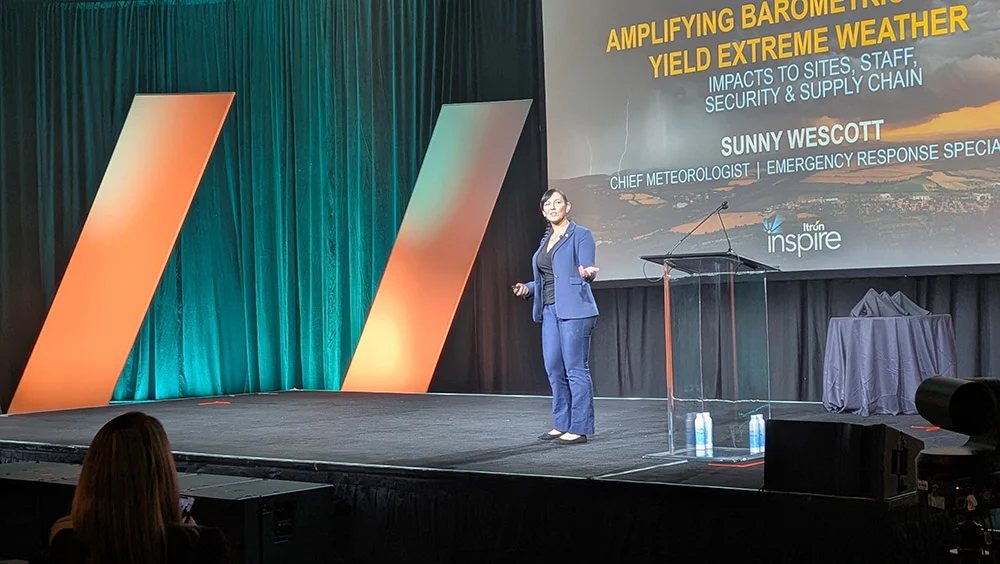
The traditional boundaries of seasonal weather patterns have effectively dissolved, replaced by a paradigm of year-round atmospheric volatility that poses an existential threat to the stability of the North American power grid and water infrastructure. This was the central message delivered by Sunny Wescott, a Chief Meteorologist and prominent federal emergency response leader, during her keynote address at the Itron Inspire 2026 conference. Speaking to an audience of utility executives, engineers, and policy makers, Wescott argued that the convergence of unprecedented wildfires in the Northeast, shifting tornado corridors, and extreme temperature fluctuations necessitates a radical departure from historical planning models. The urgency of her message was underscored by a series of climate events throughout 2025 and early 2026 that have seen utilities struggling to maintain reliability in regions once considered low-risk.
The New Reality of Meteorological Volatility
For decades, utility providers operated on a predictable calendar: winter storms in the North, hurricanes in the South and East during the summer and fall, and a defined wildfire season in the West. However, Wescott’s analysis reveals that these "weather silos" have collapsed. The year 2026 has already witnessed devastating wildfires in the Northeastern United States, a region historically characterized by high humidity and consistent precipitation. These fires are no longer anomalies but symptoms of a broader shift in atmospheric circulation that creates prolonged dry spells in unexpected geographies.
Wescott noted that the Appalachian Mountains are currently grappling with frost and ice conditions at temperature thresholds that defy previous meteorological records. This phenomenon is not merely a matter of colder weather but of "flash freezes" and moisture-heavy icing events that occur with little warning, placing immense physical stress on transmission lines and distribution assets. In these instances, the weight of ice accumulation, combined with high-velocity winds, has led to structural failures in equipment designed for less severe conditions.
A Chronology of Increasing Grid Strain
The transition to this "perpetual weather threat" environment has been accelerating over the past three years. In 2024, the industry saw the first signs of "shoulder season" crises, where extreme heat waves occurred in May and October, forcing utilities to delay critical maintenance schedules to meet unexpected cooling demands. By 2025, the El Niño-Southern Oscillation (ENSO) patterns began to exhibit erratic behavior, leading to the "El Niño 2026-27" projections that Wescott referenced as a primary concern for the coming eighteen months.
This chronology suggests that the "once-in-a-hundred-years" storm has become a decadal or even annual occurrence. Wescott’s keynote served as a chronological marker for the industry, signaling that the window for reactive adaptation has closed. Utilities must now operate in a state of constant readiness, where emergency response and infrastructure hardening are integrated into daily operations rather than treated as seasonal contingencies.
Engineering Challenges and Material Degradation
One of the most profound insights shared by Wescott involves the impact of climate shifts on the fundamental physics of utility construction. The engineering of the grid relies on specific assumptions regarding temperature and humidity. As these baselines shift, the integrity of the materials used to build the grid is compromised.
For example, Wescott highlighted the challenges of concrete curing in an era of unpredictable humidity and heat. Concrete requires specific environmental conditions to reach its maximum structural strength; premature drying due to extreme heat or excessive moisture from unseasonal rains can lead to micro-fractures and reduced longevity of utility poles and substation foundations. Similarly, the increasing density and size of hail in the central United States are testing the limits of solar panel durability and the impact resistance of transformers.
These physical stressors are driving a sharp increase in insurance premiums for utility companies. As risk models are updated to reflect the new reality of "perpetual peril," the cost of insuring assets has become a significant budgetary hurdle, often outpacing the funds allocated for actual grid hardening. Wescott emphasized that utilities must bridge the gap between meteorological data and engineering standards to ensure that the infrastructure built today can survive the climate of 2040.
The Intersection of Energy Demand and Resource Scarcity
The challenge is further complicated by the explosive growth of data centers, particularly those supporting artificial intelligence and cloud computing. These facilities require immense amounts of power and water for cooling, often in regions already facing resource constraints. Wescott pointed out that the power demands of these centers are now directly competing with residential and industrial needs during extreme weather events.

In the Southeast, where water resources are increasingly strained by shifting precipitation cycles, the water required to cool a large-scale data center can impact the availability of hydroelectric power or the cooling capacity of thermal power plants. This creates a feedback loop where the very infrastructure designed to process climate data and manage the grid becomes a primary driver of resource scarcity. Wescott advocated for cross-departmental collaboration within utilities and regional authorities to manage these competing demands, ensuring that the expansion of the digital economy does not come at the expense of grid resilience.
Data-Driven Resilience: Moving Beyond Historical Models
A recurring theme in Wescott’s address was the inadequacy of historical data. Traditional meteorological models rely on past performance to predict future risks, but in a rapidly changing climate, the past is no longer a reliable guide. Wescott urged utilities to adopt real-time topographic mapping and high-resolution environmental data.
By utilizing Geographic Information Systems (GIS) that incorporate real-time data on soil moisture, vegetation health, and micro-climatic shifts, grid operators can anticipate localized threats. For instance, a utility can identify specific sections of the distribution network where soil saturation from a previous storm has made trees more susceptible to falling during a subsequent wind event, even if the wind speeds themselves are not record-breaking.
"Utilities cannot afford to wait for the perfect model," Wescott noted. The strategy must shift from "predict and act" to "monitor and adapt." This involves leveraging the vast quantities of environmental data already available from federal agencies and private sensors, rather than attempting to build proprietary forecasting systems from scratch.
Workforce Safety and the Human Element of Emergency Response
Beyond the physical assets, the "new weather" poses significant risks to the utility workforce. Wescott shared sobering examples of the hazards faced by field crews during restoration efforts. In flood-prone regions, crews are increasingly encountering displaced wildlife—including snakes and other hazardous animals—in flooded substations and equipment vaults.
Moreover, the expansion of the wildfire season means that field workers are more frequently exposed to heavy smoke and airborne particulates. This not only presents immediate health risks but also reduces visibility and increases the time required for repairs. Wescott emphasized that utility resilience strategies must include robust protections for the workforce, recognizing that human capital is the most critical component of any emergency response.
Industry Reactions and Regulatory Implications
The reaction from industry leaders at Itron Inspire was one of cautious urgency. Many executives acknowledged that while the technical solutions for grid hardening exist—such as undergrounding lines, installing smart sensors, and deploying microgrids—the primary obstacle remains the regulatory and financial framework.
Building a case for regulators to approve large-scale resilience investments is difficult when using traditional Return on Investment (ROI) metrics. Wescott and other experts at the conference argued for a shift toward "avoided cost" metrics. By quantifying the economic impact of a multi-day outage—including lost business productivity, spoiled food, and public safety risks—utilities can provide a more compelling justification for the upfront costs of resilience.
Conclusion: A Mandate for Proactive Hardening
The insights provided by Sunny Wescott at Itron Inspire 2026 serve as a call to action for the global energy sector. The era of predictable weather is over, and the era of climate intelligence has begun. For utilities, the path forward involves a multi-faceted approach: updating engineering standards to reflect new environmental stresses, leveraging real-time data for proactive maintenance, and fostering unprecedented levels of collaboration across regional and sectoral boundaries.
As the industry prepares for the projected volatility of the 2026-27 El Niño cycle and beyond, the focus must remain on systemic resilience. The hazards are no longer just "storms" or "heatwaves"; they are a complex web of interconnected risks ranging from shifting tornado corridors to the increased kinetic force of hail. By embracing the reality of a year-round threat environment, utilities can transform from reactive service providers into proactive guardians of modern civilization’s most critical infrastructure. The cost of inaction is no longer just a financial risk; it is a threat to the fundamental reliability of the society the grid was built to serve.
