

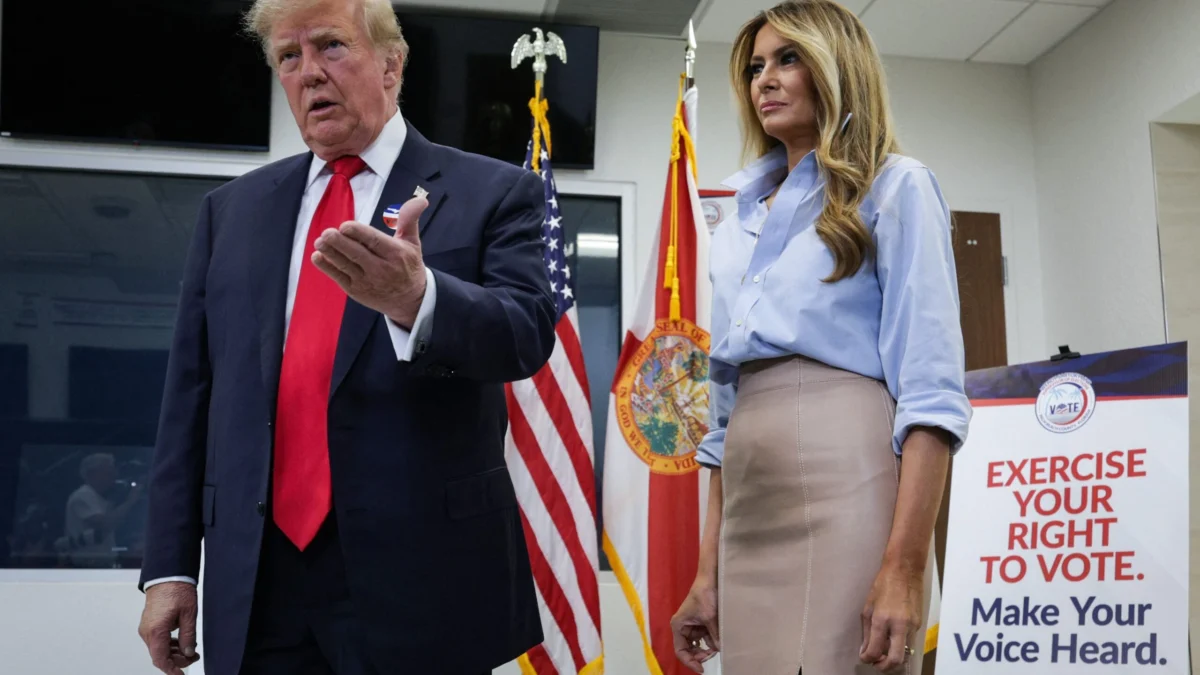
US President Donald Trump cast his early vote for the midterm elections in West Palm Beach, Florida, alongside First Lady Melania Trump. The 80-year-old president, a resident of Florida since relocating from New York, appeared at a polling station in his home state, where his Mar-a-Lago estate is located. He was seen wearing a "voted" sticker on his lapel after casting his ballot, a move that comes amidst his persistent criticisms of mail-in voting, which he has repeatedly claimed is prone to fraud.

This act of personal voting in the early stages of the election cycle directly contrasts with his administration’s efforts to tighten mail-in voting regulations. Critics have accused Trump of using these efforts to suppress the vote of the Democratic electorate, who traditionally rely more heavily on mail-in ballots. The midterm elections, scheduled for November 6th, are seen as a critical referendum on Trump’s presidency and his party’s control of Congress.
Background: The Midterm Elections and Mail-In Voting Controversy
The midterm elections are pivotal in the American political landscape, occurring halfway through a president’s four-year term. They determine the composition of the House of Representatives and a significant portion of the Senate, often serving as a gauge of public sentiment towards the incumbent administration. For President Trump, these elections are particularly crucial as they could either solidify his mandate or lead to a divided government, potentially hindering his legislative agenda.

The debate surrounding mail-in voting has intensified significantly under the Trump administration. While proponents argue that it increases accessibility and voter turnout, particularly for those with mobility issues or inflexible schedules, Trump and his allies have consistently voiced concerns about the security and integrity of such systems. These concerns have often been amplified during election cycles, leading to a polarized national conversation. Trump’s administration has sought to implement stricter verification processes, limit the timeframe for ballot submission, and reduce the availability of ballot drop boxes. These proposed changes have been met with strong opposition from voting rights advocates and Democratic lawmakers, who argue they disproportionately disenfranchise minority voters and those in lower-income brackets.
Timeline of Key Events Leading to the Vote
- Early 2023: President Trump begins publicly questioning the integrity of mail-in voting, a sentiment that escalates throughout the year.
- Summer 2023: The Trump administration initiates policy discussions aimed at reforming mail-in voting procedures, sparking debate among election officials and political strategists.
- Late Summer/Early Fall 2023: Various states begin implementing new voting regulations, some aligned with the administration’s proposals, while others face legal challenges.
- October 2023: As the midterm election date approaches, President Trump intensifies his rhetoric against mail-in voting, urging supporters to vote in person whenever possible.
- Mid-October 2023: President Trump and First Lady Melania Trump travel to Florida, establishing a temporary base at Mar-a-Lago, coinciding with the early voting period in the state.
- Late October 2023: President Trump casts his early vote in West Palm Beach, Florida.
Trump’s Stance on Mail-In Voting and the Allegations of Fraud
President Trump’s consistent opposition to widespread mail-in voting stems from his repeated assertions that it facilitates election fraud. He has often cited anecdotal evidence and conspiracy theories to support his claims, without providing substantial statistical data to back them up. These claims have been widely disputed by election officials across the country, who maintain that mail-in voting systems, when properly administered, are secure and reliable.

The accusations of fraud have become a recurring theme in Trump’s political discourse. During the 2020 presidential election, for instance, he made numerous unsubstantiated claims of widespread fraud, particularly in states that saw a significant increase in mail-in ballots due to the COVID-19 pandemic. These claims led to numerous lawsuits, most of which were dismissed by courts due to a lack of evidence. Despite these legal setbacks, Trump has continued to leverage the issue, often framing it as a defense of electoral integrity.
Reactions and Analysis
The act of Trump casting his vote in person, while publicly advocating against mail-in ballots, has drawn a mixed reaction. Supporters view it as a consistent demonstration of his principles, emphasizing his preference for in-person voting. Conversely, critics interpret it as hypocritical, highlighting the perceived contradiction between his personal actions and his broader political messaging.
Political analysts suggest that Trump’s emphasis on in-person voting and his criticism of mail-in ballots are strategic moves designed to mobilize his base and to sow doubt about the legitimacy of election outcomes should they not favor his party. This tactic aims to energify voters who are already skeptical of the electoral process and to create a narrative of unfairness that could be used in future political contests.
Norbert Röttgen, a foreign policy expert from the CDU, has warned that any electoral defeat for Trump in the midterms could lead to an even more aggressive foreign policy. Röttgen stated, "The more Trump is put under pressure domestically, the more aggressive he will act in foreign policy to distract from his domestic problems." He further elaborated that Trump might gamble everything on his political legacy – ending wars – without regard for allies. This perspective suggests that the outcome of the midterms could have significant international ramifications, particularly concerning global alliances and conflict resolution.

Broader Implications and Future Outlook
The ongoing debate over voting methods is likely to persist beyond the current election cycle. As more states consider expanding or restricting mail-in voting options, the legal and political battles over election integrity are expected to continue. The focus on individual voting acts, such as President Trump’s early ballot cast, underscores the highly politicized nature of the electoral process in the United States.
The midterm elections themselves will be a crucial indicator of the political climate. A strong showing by Democrats could signal a shift in voter sentiment and potentially lead to a more challenging environment for the Trump administration. Conversely, a Republican victory would reinforce Trump’s political standing and could embolden his legislative agenda. The long-term implications of these elections will extend beyond domestic policy, influencing the United States’ role on the global stage and its relationships with international allies and adversaries alike. The events surrounding the midterms, including the contentious issues of voting integrity and the president’s personal engagement, will undoubtedly be scrutinized for years to come.
