

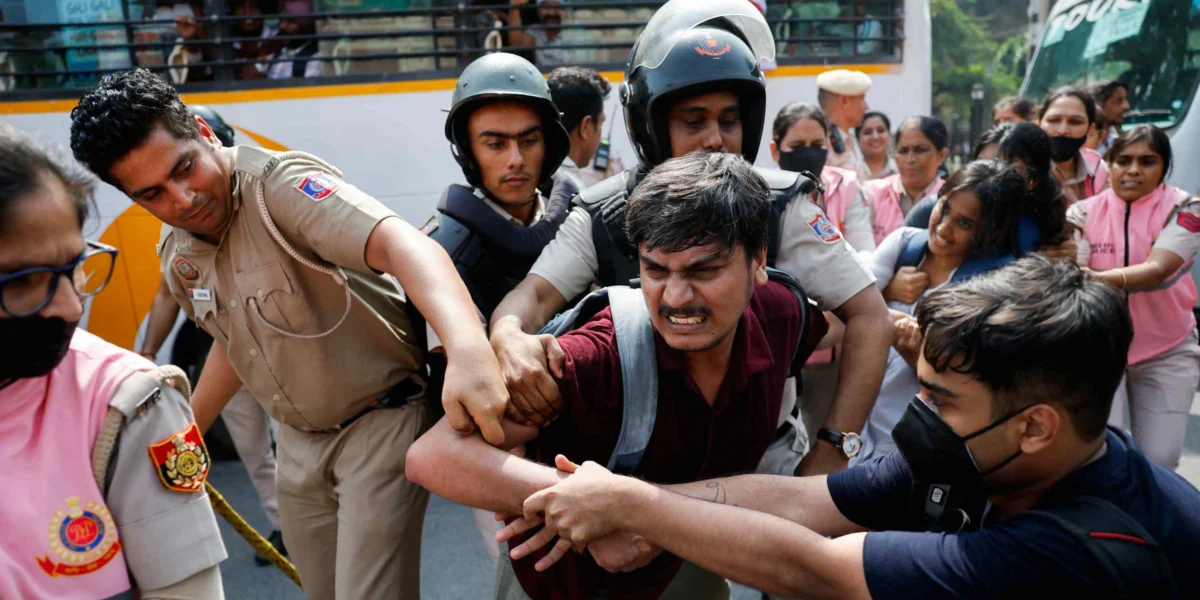
NEW DELHI – India’s latest wave of youth-led protests, spearheaded by the burgeoning "Cockroach Janta Party," is poised to redefine the nation’s political landscape, with young activists declaring a recent police crackdown in the capital has galvanized their resolve to confront what they perceive as a systematic erosion of fundamental constitutional rights, including voting liberties. This burgeoning movement, fueled by a generation deeply connected through digital platforms and acutely aware of socio-political issues, is signaling a more assertive and organized approach to dissent than previously witnessed from India’s youth demographic. The incident, which saw security personnel interdicting members of the Cockroach Janta Party during a demonstration demanding the resignation of Gyanesh Kumar, India’s chief election commissioner, has become a potent symbol of this evolving political engagement.
The Genesis of a Youthful Uprising
The immediate catalyst for the recent protests, as reported on October 16, 2026, was the demand for the resignation of Chief Election Commissioner Gyanesh Kumar. While the specific allegations leading to this demand are not detailed in the initial report, the broad framing of the protesters’ grievances—the perceived undermining of "basic constitutional voting and other rights"—suggests a deep-seated concern regarding the integrity of electoral processes and the broader democratic framework. The Cockroach Janta Party, a moniker that itself suggests an underdog status and a persistent, resilient spirit, appears to have successfully tapped into a vein of discontent among India’s vast youth population, which constitutes a significant portion of the electorate and a potent force for social and political change.
This generation, often referred to as Gen Z, has grown up in an era of rapid technological advancement, increased global connectivity, and a heightened awareness of social justice issues. Unlike previous generations who may have relied on more traditional forms of political participation, Gen Z leverages social media, online activism, and digital organizing to amplify their voices and mobilize support. This inherent digital fluency allows them to bypass traditional media gatekeepers and disseminate information rapidly, fostering a sense of collective identity and shared purpose. The Cockroach Janta Party’s emergence and the subsequent crackdown illustrate how these digital tools are being translated into tangible, on-the-ground action, posing a new challenge to established political structures.
A Timeline of Escalating Tensions
The events of the past week, culminating in the October 16 protest, represent a significant escalation in youth-led political activism in India. While the initial report focuses on this specific incident, it is crucial to understand the broader context that has led to such a display of youthful defiance.
Early 2026: Growing disquiet among various segments of the Indian populace regarding perceived authoritarian tendencies and potential infringements on civil liberties begins to coalesce. Social media platforms become hotbeds for discussions and nascent organizing efforts among young people.
Mid-2026: The formation of informal youth political groups, including the "Cockroach Janta Party," gains traction. These groups, often born out of online forums and campus discussions, begin to articulate specific demands related to governance, economic opportunity, and democratic rights. Their messaging often focuses on issues of transparency, accountability, and the future of Indian democracy.
Late Summer 2026: A series of localized demonstrations, likely concerning a range of socio-economic and political issues, gain momentum. These protests, though perhaps not widely reported, serve as a testing ground for organizational strategies and a means of building solidarity among young activists. The Cockroach Janta Party is identified as a key player in some of these earlier mobilizations.
October 10, 2026: A significant but unelaborated event occurs, which the image accompanying the original report seems to depict, showing Indian security personnel interdicting a protester. This incident, while not explicitly dated in the text, is presented as "recent" and directly linked to the ongoing demonstrations.
October 16, 2026: The protest in New Delhi, demanding the resignation of Chief Election Commissioner Gyanesh Kumar, takes place. This event is the focal point of the original report, highlighting the police crackdown and the protesters’ defiant stance. The image provided is dated October 16, 2026, confirming this timeline.
October 17, 2026: The news report is published, framing the protests as a potential turning point in Gen Z’s political engagement and quoting activists who express strengthened resolve following the crackdown.
Supporting Data: The Demographic Dividend and Digital Reach
India’s demographic profile presents a compelling backdrop to these developments. With a population exceeding 1.4 billion, a substantial segment is under the age of 30. This "youth bulge" represents an enormous potential for economic growth and social progress, but also a significant reservoir of political energy.
- Youth Population: As of 2026, approximately 40% of India’s population is estimated to be between the ages of 15 and 29. This cohort is increasingly educated and connected.
- Internet Penetration: India boasts one of the largest internet user bases globally, with smartphone penetration rapidly increasing, especially among younger demographics. This facilitates rapid information dissemination and online mobilization. Estimates suggest that over 700 million Indians are internet users, with a significant proportion being young adults.
- Voter Demographics: Young voters (18-29 years) constitute a crucial bloc in Indian elections. Their participation, or abstention, can significantly sway electoral outcomes. Data from past elections indicates a growing engagement from this demographic, although their voting patterns are often characterized by a degree of fluidity and a focus on issue-based campaigns.
- Social Media Usage: Platforms like Twitter (now X), Instagram, and WhatsApp are integral to the daily lives of young Indians. They are used not only for communication and entertainment but also for news consumption, political discourse, and activism. Studies consistently show that a majority of Gen Z in India receives their news and forms political opinions through these digital channels.
The Cockroach Janta Party’s ability to mobilize on the ground, as evidenced by the New Delhi protest, suggests that their digital organizing is translating into tangible political action. This combination of a large, digitally-savvy youth population and a growing awareness of civic issues creates fertile ground for movements like theirs to emerge and gain traction.
Official Responses and Reactions: A Developing Narrative
While the initial report focuses on the protesters’ perspective, official responses from governmental bodies and law enforcement agencies are critical to understanding the full scope of the situation. As of the report’s publication, there is no direct statement quoted from Gyanesh Kumar or the Election Commission of India. However, the description of "police crackdown" implies a governmental response aimed at dispersing the protest and potentially maintaining public order.
Law Enforcement Actions: The act of "interdicting" protesters by security personnel indicates an official attempt to control or halt the demonstration. The nature and proportionality of this intervention would be a key point of contention and scrutiny. Reports of such actions often lead to counter-narratives from activists alleging excessive force or suppression of dissent.
Election Commission’s Stance (Inferred): Typically, the Election Commission of India operates with a degree of autonomy. If demands for the resignation of the Chief Election Commissioner are gaining traction, it suggests that the protesters believe the Commission’s actions or inactions are compromising electoral fairness. The Commission would likely defend its institutional integrity and operational procedures, potentially issuing statements to allay public concerns or to refute specific allegations, if made public.
Governmental Reaction (Inferred): The broader government, particularly the Ministry of Home Affairs or other relevant ministries, would be expected to monitor such protests closely. Their response could range from issuing public statements emphasizing the importance of peaceful protest and adherence to the law, to initiating investigations into the organizers or their activities, depending on the perceived threat to public order or national security.
It is plausible that political parties, both ruling and opposition, would also issue statements. Opposition parties might align themselves with the protesters’ grievances to gain political mileage, while the ruling party would likely defend the government’s actions and emphasize the importance of stability.
Broader Implications and Analysis: A Shifting Political Paradigm
The emergence of youth-led movements like the Cockroach Janta Party signifies a potentially profound shift in India’s political dynamics. The implications extend beyond the immediate demands of the protesters.
- Increased Scrutiny of Democratic Institutions: The protesters’ focus on "basic constitutional voting and other rights" suggests a growing demand for transparency and accountability from India’s democratic institutions, particularly the Election Commission. This could lead to increased public pressure for electoral reforms, greater transparency in decision-making processes, and stronger mechanisms for addressing grievances.
- The Power of Digital Activism: This movement underscores the growing influence of digital platforms in shaping political discourse and mobilizing citizens. The ability of Gen Z to organize and amplify their message through social media presents a challenge to traditional political parties that may be slower to adapt to these new forms of engagement. Future political strategies will likely need to incorporate robust digital outreach and engagement.
- Generational Divide in Political Priorities: Gen Z’s concerns may differ from those of older generations. Issues such as climate change, digital privacy, economic inequality, and social justice are likely to be paramount. Their activism could push these issues higher on the political agenda, forcing established parties to address them more directly.
- Potential for Sustained Dissent: The protesters’ declaration that the police crackdown has "strengthened their determination" indicates a resilience that could translate into sustained activism. If these movements can maintain momentum and broaden their support base, they could exert significant long-term pressure on the political establishment.
- The "Cockroach" Symbolism: The choice of the name "Cockroach Janta Party" is likely deliberate. It evokes a sense of resilience, an ability to survive and thrive even in adverse conditions, and a rejection of mainstream political labels. This self-chosen identity suggests a desire to operate outside traditional political structures and to appeal to those who feel marginalized or unheard. It positions them as a persistent force that cannot be easily eradicated.
The events in New Delhi, while specific in their immediate context, are indicative of a broader trend of youth empowerment and political awakening in India. The Cockroach Janta Party and its supporters are not merely expressing grievances; they are actively seeking to reshape the political discourse and demand a more responsive and accountable democracy. The long-term impact of this movement will depend on its ability to sustain its momentum, broaden its coalition, and effectively translate its digital energy into lasting political change. The nation watches to see if this youthful defiance marks a genuine turning point or a fleeting moment of dissent.
