

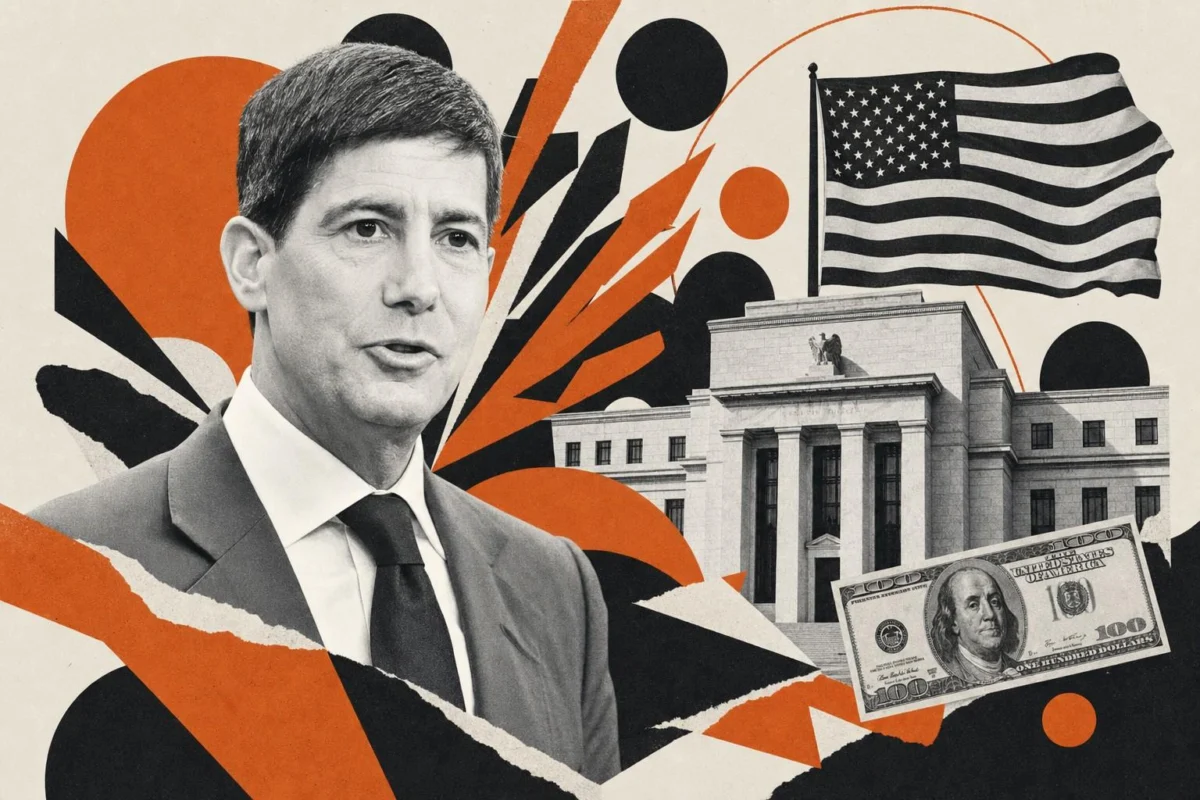
Friday, October 16, marks a continuation of the US Dollar’s (USD) weakening trend against its primary counterparts, extending losses observed throughout Thursday. This decline is largely attributed to a sharp drop in US Treasury bond yields, further exacerbated by comments from Federal Reserve Chair Kevin Warsh. Despite recent upbeat domestic economic data, the Greenback’s appeal has waned, prompting investors to reassess their positions in a rapidly evolving global financial landscape. As European markets processed crucial inflation data and US economic indicators loomed, the USD Index touched its lowest point in two weeks, trading near 101.70, reflecting a 0.3% depreciation on the day.
The Dollar’s Retreat: A Deeper Dive into Market Dynamics
The immediate catalyst for the US Dollar’s pronounced weakness on Thursday, October 15, was the significant decline in US Treasury bond yields. Yields on the benchmark 10-year US Treasury note, for instance, fell by approximately 10 basis points, dropping from 4.60% to 4.50%. This movement came despite several economic releases that, on the surface, appeared supportive of the Dollar. Producer Price Index (PPI) data for September registered a hotter-than-expected increase of 0.5% month-over-month, surpassing consensus forecasts of 0.3%. Concurrently, September’s Retail Sales figures demonstrated robust consumer spending, rising by a healthy 0.7% month-over-month, exceeding projections of 0.4%.
Typically, strong inflation and retail sales data would bolster expectations for continued monetary tightening by the Federal Reserve, thereby pushing Treasury yields higher and strengthening the Dollar. However, the market’s reaction diverged significantly from this conventional pattern. The turning point arrived with comments from Federal Reserve Chair Kevin Warsh. His nuanced remarks, perceived as signaling a more cautious approach to future monetary policy adjustments, triggered a fresh wave of selling in US T-bonds, driving yields even lower and consequently placing additional bearish pressure on the Dollar. This dynamic suggests that the market is increasingly sensitive to the Fed’s forward guidance, prioritizing potential shifts in policy stance over immediate economic data points when forming long-term yield expectations. The inverse relationship between bond yields and the Dollar’s value is a fundamental principle in currency markets; lower yields reduce the attractiveness of dollar-denominated assets, leading to capital outflows and a depreciating currency.
Key Economic Indicators on the Horizon
As Friday progresses, market participants are closely monitoring a series of economic data releases from both the Eurozone and the United States, which could provide further direction for currency movements and broader market sentiment.
Eurozone’s Inflation Watch: During the European trading hours, Eurostat is slated to publish revisions to September’s Harmonized Index of Consumer Prices (HICP) data. HICP serves as a crucial inflation gauge for the European Central Bank (ECB) in formulating its monetary policy. Initial estimates for September’s HICP indicated a preliminary annual rate of 4.3%, a notable deceleration from previous months. Revisions are important as they can confirm or alter the preliminary assessment, potentially influencing the ECB’s perception of inflationary pressures and its future interest rate trajectory. A downward revision, for example, could reinforce expectations of an eventual pause in rate hikes, while an upward revision might rekindle hawkish sentiment. Such data directly impacts the Euro’s valuation, especially against a weakening Dollar.
US Data Snapshot: Later in the day, the US economic calendar will offer several significant data points for September. The Import Price Index and Export Price Index figures will provide insights into inflationary pressures stemming from international trade and the competitiveness of US goods abroad. These indices track changes in the prices of goods and services imported into and exported from the United States. A rising Import Price Index can signal imported inflation, while a declining Export Price Index might indicate weakening global demand or increased price competition. Concurrently, Industrial Production data for September will be released, offering a comprehensive look at the health of the US manufacturing, mining, and utility sectors. Analysts are anticipating a modest increase of around 0.3% month-over-month, following a period of mixed performance. A stronger-than-expected reading would suggest resilience in the industrial sector, while a weaker figure could reinforce concerns about a potential economic slowdown, further complicating the Fed’s policy calculus.
Federal Reserve’s Measured Stance: Warsh’s Influence
Federal Reserve Chair Kevin Warsh’s recent speech, which registered a score of 5.6/10 on the FXS Speechtracker—modestly softer than the historical average of 6.1/10—underscored a balanced yet somewhat less forceful tone from the central bank. A pivotal admission within his speech was the sentiment of being "over-scarred from the global financial crisis." This phrase is highly significant, suggesting a lingering cautious bias within the Fed’s approach to monetary policy, even as the immediate economic landscape appears robust. The "scarring" refers to the deep-seated lessons learned from past financial crises, where premature tightening or an underestimation of systemic risks led to prolonged economic downturns. This historical context informs the Fed’s current preference for patience and data-dependency, even in the face of persistent inflation.
Warsh’s address also highlighted themes of structural growth and an anticipated investment surge, particularly driven by "good policies" and the transformative potential of Artificial Intelligence (AI). He emphasized AI not only as a near-term demand catalyst but also as a tool to enhance data confidence and analytical capabilities within the economic sphere. This forward-looking perspective suggests the Fed is actively considering long-term productivity enhancements and their potential impact on the economy’s non-inflationary growth potential. However, his focus on "negative tailside risks" alongside this optimism points to a cautious equilibrium. The Fed, under Warsh, appears open to further tightening if economic conditions warrant, but is deliberately avoiding any pre-commitment on a definitive policy path. This flexibility is crucial as the central bank navigates its dual mandate of achieving price stability and fostering maximum sustainable employment. Warsh explicitly stated that upcoming Federal Open Market Committee (FOMC) meetings would be the "crystalizing moment" for critical decisions regarding output, employment, and inflation. This phrase implies that the Fed’s policy decisions are not predetermined but will hinge on the cumulative assessment of incoming data and evolving economic conditions, keeping market participants on edge for clearer signals.
To understand the context of the Fed’s actions, it is essential to recall its core responsibilities. The Federal Reserve operates with a dual mandate: to achieve maximum employment and maintain price stability, typically defined as a 2% inflation target. When inflation rises above this target, the Fed typically raises interest rates, increasing borrowing costs across the economy to cool demand. This action usually strengthens the US Dollar, making the US a more attractive destination for international capital due to higher returns on investments. Conversely, if inflation falls too low or unemployment becomes excessively high, the Fed may lower interest rates to stimulate economic activity, which tends to weaken the Dollar. The FOMC, comprised of twelve Fed officials, convenes eight times a year to assess economic conditions and make these critical monetary policy decisions, shaping the financial landscape for both domestic and global markets.
The AI Paradox: OCBC Strategists Unpack a New Dynamic
The evolving landscape of AI-linked investment has introduced a novel dynamic into financial markets, according to FX strategists at OCBC. They highlight the potential for an "unusual combination: risk-off, lower Treasury yields and a softer USD." This scenario challenges the conventional wisdom that during periods of global risk aversion, investors flock to the safety of US assets, particularly the Dollar and US Treasuries, leading to a stronger Greenback.
OCBC strategists stress that "this is not the typical global risk-off shock where investors simply rush into USD." Instead, they posit that if the source of market stress is "US-centric," rather than broadly global, the typical flight-to-safety mechanism for the Dollar may be disrupted. A "US-centric" stress could manifest from various factors, such as concerns over specific US tech sector valuations, regulatory uncertainties impacting dominant US industries, or even a localized economic downturn within the United States. In such a scenario, while demand for the perceived safety of US Treasuries might indeed push yields lower, the simultaneous weakening of US asset returns could diminish the overall appeal of the USD. This underscores the Dollar’s growing vulnerability to any slowdown or shift in US-focused AI investment flows, which have been a significant driver of capital into the US economy. The implication is that the structural advantages that traditionally underpin the Dollar’s safe-haven status might be partially eroding or, at the very least, becoming more nuanced in an era increasingly dominated by technological shifts and localized economic challenges.
Global Currency Landscape: Beyond the Dollar
The Dollar’s broad-based weakness has had a ripple effect across major currency pairs, with several beneficiaries emerging from the shift in market sentiment.
Yen’s Resilience Amidst BoJ’s Hawkish Hints: The USD/JPY pair is trading in a tight channel just below the 158.00 mark, having closed marginally lower on Thursday. This stability, coupled with the Dollar’s broader retreat, suggests a potential shift in the narrative surrounding the Japanese Yen. Further supporting the Yen’s relative strength were comments from Bank of Japan (BoJ) Governor Kazuo Ueda. In a speech read out by Deputy Governor Shinichi Uchida on Friday, Ueda affirmed that the central bank "will continue to raise policy rate in accordance with economic, price, and financial developments." This statement reinforces the BoJ’s commitment to normalizing monetary policy, moving away from its long-standing ultra-loose stance. While the BoJ remains cautious, its clear intent to hike rates, contrasting with the Fed’s newly articulated patience, creates a divergence in monetary policy expectations that could lend further support to the Yen. Market participants are now closely watching for specific "economic, price, and financial developments" that might trigger the BoJ’s next rate increase.
Euro’s Ascent: Capitalizing on Dollar Weakness: The EUR/USD pair is benefiting significantly from the persistent USD weakness, rising towards the 1.1250 level in the European morning on Friday, marking an approximate 0.2% gain on the day. This upward momentum reflects not only the Dollar’s retreat but also the relative stability in the Eurozone, awaiting the HICP revisions. Should the HICP revisions confirm a manageable inflation trajectory, it could alleviate pressure on the ECB for aggressive tightening, contributing to a more stable outlook for the Euro. The pair’s movement above key psychological levels indicates a potential for further gains if the Dollar’s bearish sentiment persists.
Sterling’s Steady Climb: BoE Navigates Inflation Challenges: The GBP/USD pair broke above the critical 1.3300 threshold early Friday, reaching its highest level in three weeks near 1.3320. This upward trajectory for the Sterling comes despite ongoing domestic inflation challenges. Bank of England (BoE) Governor Andrew Bailey, speaking on Friday, acknowledged that the above-target inflation in the UK remains "enormously frustrating." However, he added a crucial caveat, stating that it was "too early to form strong views on the strength of second-round effects." Second-round effects refer to the phenomenon where initial price increases (e.g., from energy shocks) lead to higher wage demands, which then feed back into further price increases, creating a persistent inflationary spiral. Bailey’s cautious stance suggests the BoE is closely monitoring these dynamics but is not yet ready to commit to a more aggressive tightening path, seeking more definitive evidence before making significant policy shifts. Nevertheless, the Dollar’s broad retreat has provided a tailwind for the Pound, allowing it to consolidate gains.
Gold’s Luster Returns: A Safe-Haven Surge
Gold, a traditional safe-haven asset, is preserving its bullish momentum after recording an impressive gain of more than 1.5% on Thursday, now closing in on the significant $2,050 per ounce mark. This robust performance follows a period of three consecutive sessions of losses, indicating a strong rebound in investor confidence in the precious metal.
OCBC’s FX strategists highlight that Gold "rebounded over 1% overnight, recovering from three consecutive sessions of losses as US Treasury yields and the USD retreated." The inverse correlation between gold and both Treasury yields and the Dollar is well-established; lower yields reduce the opportunity cost of holding non-yielding gold, while a weaker Dollar makes gold cheaper for international buyers. Furthermore, the strategists noted that "Brent also eased, offering some relief to the inflation/rates backdrop." A decline in crude oil prices can temper broader inflationary expectations, which, paradoxically, can be supportive of gold if it signals a less aggressive tightening path from central banks. This sentiment was echoed by the perception that "Fed officials also appeared in no hurry to tighten policy further, helping to temper expectations for an October hike." A more patient Federal Reserve, as implied by Warsh’s comments, reduces the immediate threat of higher interest rates, which are typically detrimental to gold prices. Against this backdrop, OCBC remains cautiously constructive on the metal’s near-term prospects. The pullback in yields and a more patient Fed stance are seen as crucial supportive factors for consolidation after recent declines, potentially paving the way for further advances towards or beyond the $2,050 level.
Broader Market Implications and Forward Outlook
The current market dynamics, characterized by a weakening US Dollar and falling Treasury yields, carry significant implications across global financial markets. For equity markets, lower bond yields can reduce borrowing costs for corporations and make future earnings streams more valuable, potentially offering support. However, if the underlying cause of falling yields is a growing concern about economic growth (a "US-centric" stress as described by OCBC), then equities, particularly those sensitive to domestic demand, could face headwinds. The technology sector, which has been a major recipient of investment flows, especially those linked to AI, might experience a re-evaluation if the "unusual combination" scenario plays out.
In the commodities space, a weaker Dollar generally makes dollar-denominated raw materials, such as oil and industrial metals, more affordable for holders of other currencies, potentially boosting demand and prices. However, the easing of Brent crude prices observed recently could indicate a tempering of global demand or an increase in supply, which would act as a counterbalancing force.
Looking ahead, market participants will keenly dissect every piece of incoming economic data and every utterance from central bank officials. The precise revisions to Eurozone HICP and the US industrial production figures later today will be crucial. Beyond that, the focus will quickly shift to next week’s inflation reports and any further commentary from Fed officials, especially in the context of Warsh’s "crystalizing moment" remarks. The possibility of central banks resorting to non-standard policy measures, such as Quantitative Easing (QE) if inflation falls excessively low or the economy faces a severe downturn, or Quantitative Tightening (QT) to reduce their balance sheets, remains a long-term consideration. QE, which involves the Fed buying bonds, typically weakens the Dollar, while QT, the reverse process, tends to strengthen it. For now, the narrative is firmly centered on the Fed’s evolving patience and the re-calibration of global capital flows in response to shifting interest rate differentials and a more nuanced understanding of safe-haven assets. The coming weeks will likely reveal whether the Dollar’s current retreat is a temporary correction or the beginning of a more sustained bearish trend.
