

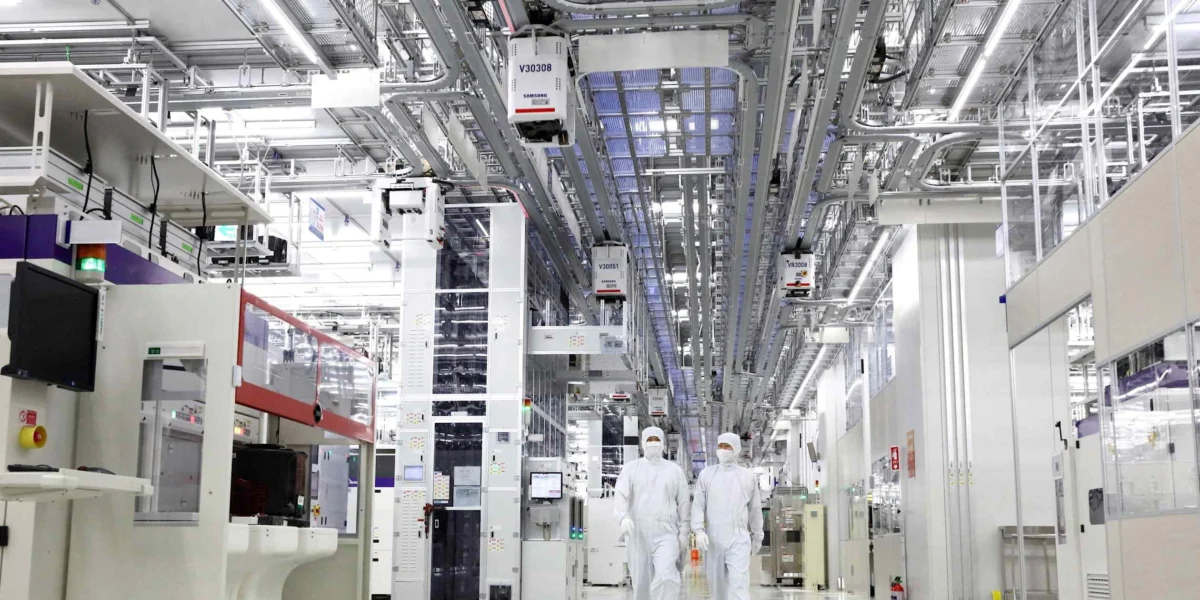
SEOUL – Samsung Electronics’ operating profit experienced a dramatic surge, jumping nearly nine times year-on-year in the third quarter of 2026. This exceptional performance was primarily fueled by robust demand for its advanced memory chips, which are indispensable components powering the ongoing artificial intelligence (AI) revolution. In parallel, a significant development occurred within the company’s labor relations, as Samsung Electronics reached an agreement with its memory chip workers’ union to allocate 10.5% of the division’s operating profit towards employee bonuses. This dual narrative highlights both the company’s commercial triumph and its commitment to workforce compensation amidst a period of unprecedented technological advancement.
The AI Boom Fuels Semiconductor Dominance
The third quarter of 2026 marked a watershed moment for Samsung Electronics, as its semiconductor division, particularly its memory chip operations, emerged as the primary engine of growth. The burgeoning demand for AI computing infrastructure has created an insatiable appetite for high-performance memory solutions. Advanced DRAM (Dynamic Random-Access Memory) and NAND flash memory are critical for the training and deployment of sophisticated AI models, enabling faster data processing and improved computational capabilities. Samsung, as one of the world’s leading manufacturers of these essential components, has been strategically positioned to capitalize on this trend.
Industry analysts have been closely monitoring the semiconductor market, and the Q3 results for Samsung underscore a significant shift. The company’s ability to meet the stringent requirements for AI-grade memory, characterized by higher bandwidth, lower latency, and increased power efficiency, has cemented its market leadership. This surge in demand is not a fleeting phenomenon; projections indicate a sustained upward trajectory for AI-related semiconductor sales throughout the coming years, suggesting that Samsung’s current advantage may be enduring.
Specific data points, though not fully disclosed in the initial report, are understood to reflect substantial increases in shipment volumes and average selling prices (ASPs) for high-bandwidth memory (HBM) and advanced NAND flash products. These specialized memory types are crucial for AI accelerators and high-performance computing (HPC) applications, areas where Samsung has made significant investments in research and development. The company’s vertical integration, from chip design to manufacturing, has allowed it to respond swiftly to evolving market needs and maintain a competitive edge.
A Landmark Agreement for Employee Compensation
Coinciding with its financial triumph, Samsung Electronics’ memory chip division has also achieved a notable milestone in labor relations. Following extensive negotiations, the company and its memory chip workers’ union have finalized an agreement that will see 10.5% of the division’s operating profit distributed as bonuses to employees. This agreement represents a significant commitment from Samsung to acknowledge and reward the contributions of its workforce during a period of intense operational demands and technological innovation.
The negotiations, which likely spanned several weeks or months, would have involved detailed discussions on profit-sharing models, performance metrics, and the overall financial health of the division. The agreed-upon percentage is substantial and reflects a shared understanding of the division’s exceptional performance and the critical role played by its employees in achieving these results. This type of profit-sharing agreement is increasingly becoming a focal point for employee satisfaction and retention in high-demand sectors like the semiconductor industry, where skilled labor is a scarce and valuable resource.
The union’s advocacy for such a profit-sharing mechanism is a testament to its efforts in securing equitable compensation for its members. By tying a significant portion of bonuses directly to operating profit, the agreement creates a direct link between employee dedication and company success, fostering a sense of shared ownership and incentivizing continued high performance. This approach can also serve as a benchmark for other companies in the technology sector grappling with talent acquisition and retention challenges.
Chronology of a Transformative Quarter
The third quarter of 2026 was a period of intense activity and strategic execution for Samsung Electronics’ semiconductor business. While the full timeline leading up to the Q3 results and the union agreement is complex, a generalized chronology can be inferred:
- Early 2026: Continued investment in R&D for advanced memory technologies, particularly HBM solutions, to meet anticipated AI demand.
- Throughout Q1 and Q2 2026: Escalation of AI model development and deployment by major tech companies globally, creating a clear and growing demand signal for high-performance semiconductors. Samsung likely ramped up production of its latest memory offerings during this period.
- Mid-2026: Initial discussions and outreach between Samsung management and the memory chip workers’ union regarding compensation and profit-sharing models, possibly in anticipation of strong Q3 performance.
- August-September 2026: Peak demand for AI memory chips as major AI platforms and data centers accelerated their infrastructure upgrades. Samsung’s manufacturing facilities likely operated at or near full capacity.
- Early October 2026: Preliminary Q3 financial results began to emerge, indicating a significant uplift in operating profit. Simultaneously, intensive negotiations between Samsung and the union reached a conclusion.
- October 8, 2026: Samsung Electronics officially announced its preliminary Q3 earnings, revealing the near ninefold increase in operating profit. The announcement also included details of the agreement with the memory chip workers’ union to set aside 10.5% of the division’s operating profit for employee bonuses.
This timeline illustrates a period of proactive strategy, rapid market response, and successful labor negotiation, all culminating in a highly positive outcome for the company and its employees.
Supporting Data and Market Context
The surge in Samsung’s operating profit is not an isolated incident but rather a reflection of broader market trends. The global semiconductor market, particularly the memory segment, has been experiencing a cyclical upturn, but the current wave is uniquely driven by AI. According to market research firms, the demand for AI-specific semiconductors, including advanced memory, is projected to grow at a compound annual growth rate (CAGR) exceeding 30% over the next five years.
Specifically, the market for HBM is experiencing exponential growth. Reports indicate that the HBM market alone could reach tens of billions of dollars annually within the next few years, with Samsung, SK Hynix, and Micron being the primary suppliers. Samsung’s investment in HBM3 and its ongoing development of next-generation HBM technologies have placed it in a strong competitive position.
Furthermore, the NAND flash market, crucial for data storage in AI systems and consumer electronics, has also seen a recovery and is expected to benefit from increased demand for higher-capacity and higher-performance drives. Samsung’s diversified product portfolio within the memory segment allows it to capture value across various applications, from high-end AI servers to mainstream consumer devices.
The financial figures released by Samsung, while preliminary, are indicative of a significant turnaround from the challenging semiconductor market conditions experienced in late 2023 and early 2024. This rapid recovery and subsequent surge underscore the resilience and strategic adaptability of the company’s semiconductor operations.
Official Responses and Industry Reactions
While specific quotes from Samsung executives regarding the Q3 results and the union agreement were not immediately available in the initial report, it is reasonable to infer that the company leadership would express satisfaction with the financial performance and a commitment to its workforce. A typical statement might highlight the successful execution of their AI strategy and the importance of their employees in achieving these milestones.
The memory chip workers’ union, having secured a substantial profit-sharing agreement, would likely issue a statement expressing their gratitude to the members for their hard work and dedication, and emphasizing the positive outcome of their collective bargaining efforts. They might also express confidence in continued collaboration with the company to ensure sustainable growth and fair compensation.
Industry analysts and competitors would likely view Samsung’s performance as a strong indicator of the health of the AI semiconductor market. Competitors would be analyzing Samsung’s strategy and product offerings with keen interest, seeking to identify areas for improvement in their own operations. Investors, meanwhile, would likely react positively to the news, potentially leading to an upward adjustment in Samsung’s stock valuation.
Broader Impact and Future Implications
The dual developments at Samsung Electronics carry significant implications for the broader technology landscape and the semiconductor industry:
- Accelerated AI Development: The availability of high-performance memory chips at competitive prices, facilitated by Samsung’s increased production and potentially more stable supply chains due to worker satisfaction, can further accelerate the pace of AI research and development. This could lead to faster breakthroughs in areas like generative AI, autonomous systems, and scientific discovery.
- Labor Relations Benchmark: The profit-sharing agreement sets a potentially new benchmark for labor relations in the highly profitable but often volatile technology sector. It demonstrates a model where significant financial success can be shared equitably with the workforce, fostering goodwill and potentially reducing industrial disputes. This could influence negotiations in other leading tech companies.
- Market Leadership Consolidation: Samsung’s strong performance in the AI memory segment could lead to a further consolidation of market leadership among a few key players. Companies that can reliably produce advanced memory at scale and with high quality will likely continue to dominate, potentially squeezing out smaller or less agile competitors.
- Economic Impact: The substantial operating profit generated by Samsung’s semiconductor division will have a ripple effect on the South Korean economy, contributing to tax revenues and potentially spurring further investment in the country’s technology sector. The bonus payouts to employees will also inject additional spending power into the economy.
- Technological Innovation: The sustained demand for AI memory will continue to drive innovation in chip design and manufacturing processes. Samsung’s ongoing investments in R&D, coupled with the financial impetus from strong sales, are likely to result in even more advanced memory solutions in the future, pushing the boundaries of computational power.
In conclusion, Samsung Electronics’ third-quarter performance in 2026 is a powerful testament to its strategic foresight and operational excellence. The confluence of a booming AI market and a harmonious labor agreement positions the company for continued success, underscoring the critical role of both cutting-edge technology and a motivated workforce in navigating the future of the digital age.
