

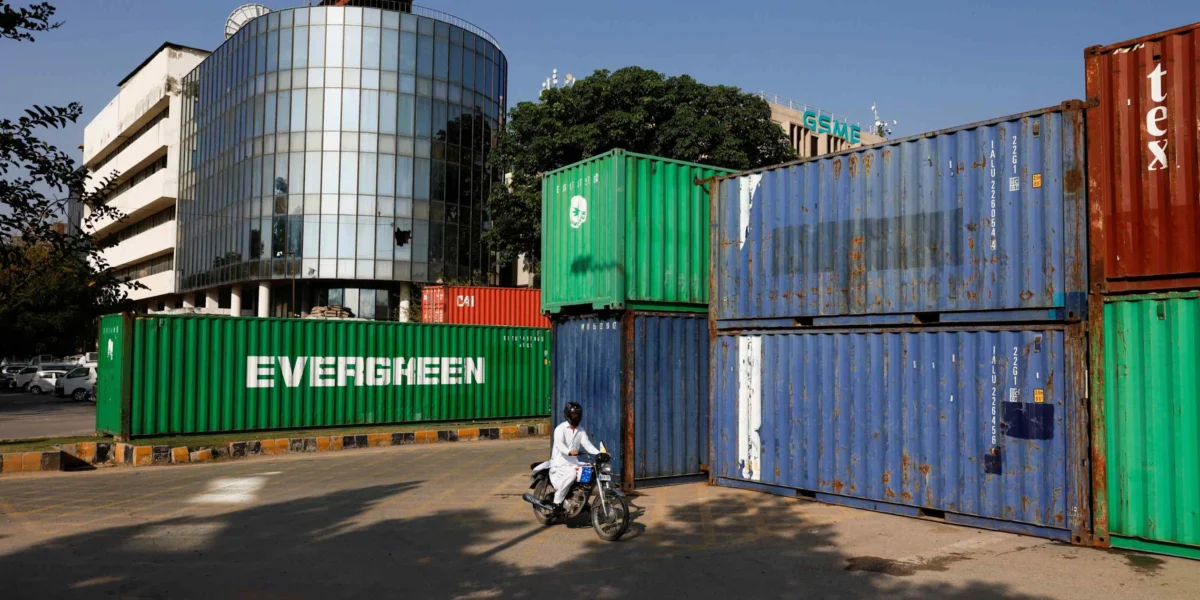
ISLAMABAD – In a dramatic escalation of pre-election tensions, Pakistan’s federal government has deployed over 1,000 shipping containers across the capital city of Islamabad to erect formidable barricades against an anticipated protest march by the country’s largest opposition party. The move, aimed at preventing supporters of former Prime Minister Imran Khan from converging on the capital, is expected to cripple local businesses and severely disrupt vital supply chains, raising concerns about the broader economic and social ramifications. The formidable display of logistical obstruction underscores the deep political polarization gripping Pakistan as it heads towards a highly anticipated general election.
The government’s decision to deploy such a massive number of shipping containers, a tactic previously employed to quell dissent and manage security during significant political events, signals a heightened level of concern regarding the potential scale and impact of the planned demonstration. Sources within the federal interior ministry, speaking on condition of anonymity due to the sensitive nature of the operation, indicated that the deployment began in the early hours of Friday, October 2nd, 2026, with hundreds of containers strategically placed at key entry and exit points to Islamabad. By Saturday morning, the number had surpassed the thousand-mark, effectively creating a labyrinth of steel walls designed to impede any organized movement towards the city center.
This preemptive measure comes in response to calls for a nationwide protest organized by the Pakistan Tehreek-e-Insaf (PTI), the party formerly led by Imran Khan. Khan, who remains a highly influential figure despite his ouster from power in April 2022 and subsequent legal challenges, has been a vocal critic of the current government and the electoral process. His party has accused the ruling coalition of attempting to manipulate the upcoming general elections, scheduled for early 2027, and has mobilized its vast network of supporters to express their grievances. The specific date of the protest march has not been officially announced by the PTI, but intelligence reports, according to government officials, suggested an imminent convergence on Islamabad over the weekend of October 3rd and 4th, 2026.
Background and Context: A Deepening Political Divide
The current political climate in Pakistan is characterized by an intense power struggle between the incumbent government and the opposition, primarily led by Imran Khan and his PTI. Khan’s tenure as Prime Minister (August 2018 – April 2022) was marked by promises of anti-corruption reforms and economic revival, but his government faced persistent challenges, including a struggling economy, political infighting, and accusations of authoritarian tendencies. His removal through a vote of no confidence, supported by a broad coalition of opposition parties, marked a significant turning point, leading to the current administration headed by Prime Minister Shehbaz Sharif.
Since his ouster, Imran Khan has remained a potent force, rallying public support through a series of powerful rallies and speeches. The PTI claims that the current government, along with elements of the powerful military establishment, is actively working to sideline Khan and prevent his return to power. This narrative has resonated with a significant portion of the Pakistani populace, particularly the youth and those disillusioned with traditional political parties. The ongoing legal battles faced by Khan, including convictions and disqualifications that have barred him from contesting elections, have further fueled the perception of political persecution among his supporters.
The upcoming general elections are seen as a critical juncture for Pakistan’s democratic trajectory. The country has a history of political instability, military interventions, and economic crises. The outcome of these elections is expected to have a profound impact on the nation’s economic policies, foreign relations, and internal security. In this context, any significant political agitation or perceived attempt to undermine the electoral process is met with a strong response from the authorities.
Timeline of Escalation: From Rhetoric to Roadblocks
The current standoff did not emerge overnight. It is the culmination of months of escalating political rhetoric and organizational efforts by the PTI.
- Early 2026: Following a series of setbacks in court cases and legislative maneuvers perceived by the PTI as attempts to disqualify their leaders, the party began intensifying its calls for early elections and a transparent electoral process.
- Mid-2026: Imran Khan, addressing large rallies across the country, urged his supporters to prepare for a decisive push to reclaim their mandate, hinting at a major demonstration in Islamabad. The government, in response, issued warnings against any attempt to disrupt public order.
- September 2026: The PTI formally announced its intention to march on Islamabad, framing it as a peaceful protest to highlight alleged electoral irregularities and demand fair elections. This announcement triggered a heightened state of alert within the federal government.
- Late September 2026: Intelligence agencies reportedly provided the government with assessments indicating a significant mobilization of PTI supporters. This information, coupled with concerns about potential clashes and the disruption of essential services, led to the decision to implement stringent security measures.
- October 1st, 2026: Reports emerged of the initial deployment of shipping containers around Islamabad. The scale of this deployment, initially estimated at several hundred, quickly grew.
- October 2nd, 2026: The number of containers exceeded 1,000, transforming major thoroughfares and access routes into a fortified perimeter. Visual evidence from the ground, including images released by news agencies, showed towering walls of containers, effectively sealing off large sections of the capital.
Supporting Data: The Economic Fallout of Blockades
The government’s chosen method of protest suppression, while effective in blocking movement, carries significant economic implications. Shipping containers, essential components of global trade and local logistics, are now being used to choke economic activity within and around Islamabad.
- Supply Chain Disruption: Islamabad serves as a key transit point for goods moving between northern and southern Pakistan. The blockage of major highways, including the Grand Trunk Road (GT Road) and the Islamabad-Peshawar Motorway, will inevitably lead to delays in the transportation of raw materials, finished products, and perishable goods. This can result in increased costs for businesses and higher prices for consumers.
- Local Business Impact: Businesses operating within Islamabad, particularly those reliant on daily deliveries and customer access, are expected to suffer substantial losses. Restaurants, retail stores, and small manufacturing units could face shortages of supplies and a significant drop in sales. The prolonged disruption could lead to temporary closures and potential job losses.
- Estimated Economic Loss: While precise figures are difficult to ascertain without knowing the duration of the blockade, historical data from similar large-scale disruptions in Pakistan suggests that economic losses can run into millions of dollars per day. For instance, a prolonged sit-in or protest that blocks major arteries can impact national GDP by a measurable percentage. The current scale of the blockade suggests a potentially significant economic toll.
- Logistics and Transportation Sector: The transport industry, a backbone of Pakistan’s economy, is directly impacted. Truckers and logistics companies face demurrage charges, fuel wastage, and the inability to fulfill contracts, leading to financial strain.
Official Responses and Justifications
The federal government has defended its actions, framing them as necessary measures to maintain law and order and prevent potential chaos.
- Interior Ministry Statement: A spokesperson for the Ministry of Interior, in a press briefing on Saturday morning, stated, "The government has a responsibility to ensure the safety and security of its citizens and to maintain peace in the capital. Intelligence reports indicated a potential for significant disruption and violence, which we cannot afford to ignore. The deployment of containers is a temporary measure to prevent the escalation of any untoward incidents."
- Prime Minister’s Office: While no direct statement from Prime Minister Shehbaz Sharif has been widely reported regarding the containers, the Prime Minister’s office has consistently emphasized the government’s commitment to upholding democratic principles while also warning against any actions that could destabilize the country.
- Law Enforcement Agencies: Police and paramilitary forces have been deployed in large numbers throughout Islamabad and at the container barricades. They have been instructed to prevent any attempts to breach the security cordon. The capital city has been effectively placed under a de facto lockdown.
Broader Impact and Implications
The extensive use of shipping containers to block access to the capital has far-reaching implications beyond the immediate protest.
- Erosion of Democratic Space: Critics argue that such heavy-handed tactics stifle legitimate political expression and create an environment where dissent is suppressed rather than engaged with. The blocking of roads, while ostensibly for security, can be perceived as an attempt to isolate and marginalize opposition voices.
- Economic Repercussions: The predictable economic damage caused by such blockades raises questions about the long-term sustainability of this approach. Repeated disruptions to supply chains and local commerce can deter investment and further strain an already fragile economy.
- Public Perception: While the government may aim to project an image of strong governance, the visual of a capital city encased in shipping containers can also generate negative public perception, both domestically and internationally. It can be interpreted as a sign of political instability and a lack of confidence in managing public dissent through dialogue.
- Precedent for Future Protests: The successful implementation of such a large-scale blockade could set a precedent for future governments, potentially leading to a normalization of such tactics as a primary response to political demonstrations, further constricting the space for peaceful protest.
- Impact on Election Narrative: For the PTI, this action by the government will likely serve as further evidence to bolster their claims of state repression and an unfair playing field for the upcoming elections. This could energize their base and potentially sway undecided voters who are concerned about the state of democracy in Pakistan.
As the weekend unfolds, the silent, steel walls of shipping containers stand as a stark testament to the deep political fissures in Pakistan. The government’s strategy aims to prevent a specific protest, but its broader consequences – economic disruption, the perception of suppressed dissent, and the deepening of political polarization – are likely to resonate for a considerable time, casting a long shadow over the nation’s democratic aspirations. The effectiveness of this blockade in quelling the protest, and the subsequent reaction from the PTI and its supporters, will be closely watched as Pakistan navigates this turbulent political landscape.
