

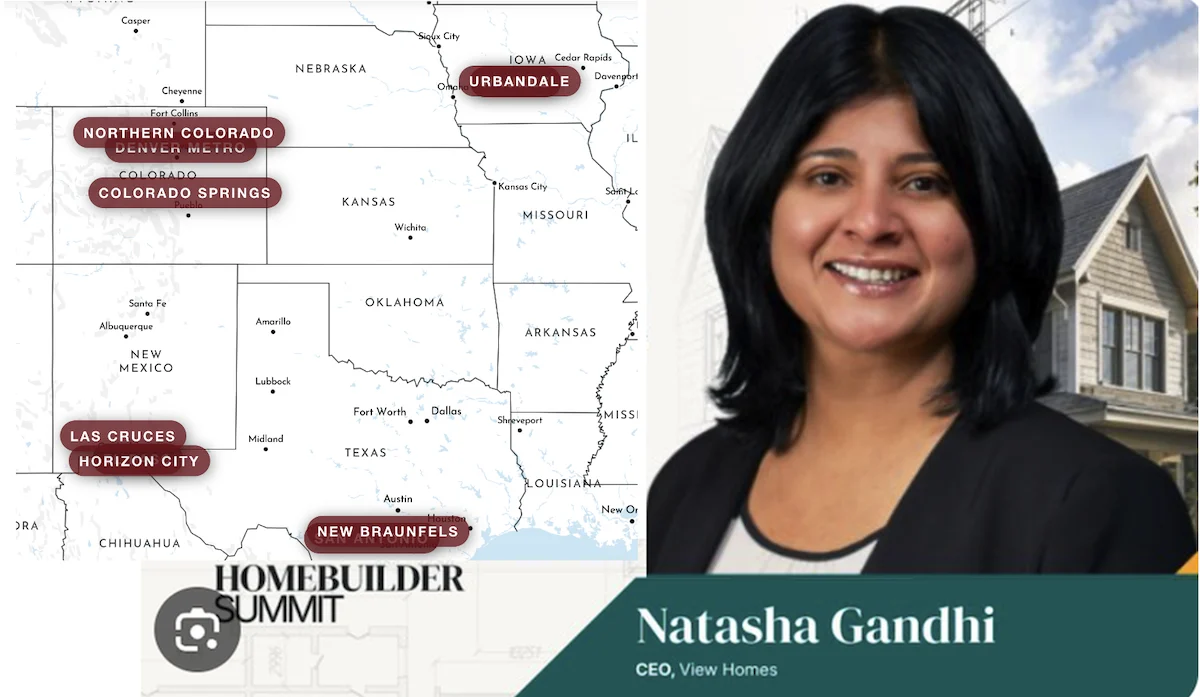
The business of homebuilding rarely affords its leaders the luxury of a pause. In an industry defined by cyclical volatility, supply chain intricacies, and the immediate pressure of consumer commitments, there is no designated "pit stop" for a corporate transformation. For a CEO tasked with overhauling a legacy organization, the work must happen while the assembly line is moving—sales must continue, land must be developed, and homes must be closed. This is the reality facing Natasha Gandhi, who assumed the role of CEO at View Homes in March 2024. Six months into her tenure, Gandhi is spearheading a comprehensive modernization of the company’s operations, culture, and technology, all while the broader U.S. housing market grapples with affordability constraints and fluctuating mortgage rates.
Gandhi’s approach is rooted in a counterintuitive philosophy: the best time to rebuild a company is when the market is soft. While many executives might opt for a defensive crouch during periods of slower demand, Gandhi is utilizing the current environment as a window for radical stabilization and preparation. By standardizing practices and rebuilding the organizational "guts" now, she aims to position View Homes to capture significant market share when the next housing boom inevitably arrives.
A Legacy in Transition: From Entrepreneurial Roots to Institutional Scale
View Homes is not a new entrant to the residential construction landscape. With a 35-year history, the company has established a significant footprint, once ranking among the 35 largest homebuilders in the United States. However, the company’s trajectory changed significantly in October 2023, when Hunt Companies—a diversified real estate investment and management firm—acquired full ownership. This acquisition signaled a shift from View Homes’ origins as a successful, family-owned entrepreneurial enterprise toward a more institutionalized, scalable regional builder.
Gandhi was recruited following a nationwide search to lead this next chapter. Her professional pedigree includes high-level leadership roles at some of the industry’s most prominent names, including Pulte Homes/Del Webb, Century Communities, and Richmond American Homes. This background provided her with a blueprint for what a high-output, disciplined national builder looks like, which stood in contrast to the "loose confederation of entrepreneurial franchises" she inherited at View Homes.
Upon her arrival, Gandhi identified that while the company possessed a strong foundation, its decentralized structure hindered its ability to scale. Different divisions operated with disparate methodologies, reporting was inconsistent, and the enterprise technology stack was insufficient for a company with multi-market aspirations. The mission became clear: stabilize the organization by establishing accountability and consistency across the board.
The Strategic Advantage of a Soft Market
The decision to execute a total organizational overhaul during a period of market cooling is a calculated risk. As of mid-2024, the housing industry has faced significant headwinds. According to data from the National Association of Home Builders (NAHB), builder confidence has fluctuated as high interest rates continue to sideline potential buyers, particularly in the entry-level segment. However, Gandhi views these conditions as an asset rather than a liability.
In a "booming" market, the opportunity cost of internal restructuring is high. When sales are rapid and demand is peaking, every hour spent on process refinement or software implementation is an hour not spent closing deals. Furthermore, a hot market can mask deep-seated operational inefficiencies; high margins can hide waste, and rapid turnover can obscure poor data integrity. By contrast, a slower market provides the breathing room necessary to diagnose and fix systemic issues without the immediate risk of missing out on a once-in-a-decade sales surge.
Additionally, the softer market has shifted the labor landscape. During peak cycles, competition for experienced management and field-level talent is fierce. Currently, View Homes has been able to recruit high-caliber professionals who might otherwise be unavailable. Gandhi has used this opportunity to rebuild her corporate team and install new leadership at the division and middle-management levels, ensuring that the human capital of the company is aligned with its new scalable vision.
Redrawing the Operating Model: Discipline vs. Autonomy
A central component of Gandhi’s strategy is the implementation of "guardrails" for local divisions. In its previous iteration, View Homes allowed for substantial local discretion, particularly in sales incentives and concessions. While this entrepreneurial spirit allowed for quick decision-making, it lacked the visibility required for corporate-level margin management.
Gandhi’s new model does not seek to eliminate local judgment but rather to frame it within a structured operating system. For example, salespeople now operate within a more rigorous framework where buyer situations and competitive contexts are analyzed before management approves concessions. This shift ensures that every dollar spent on incentives is tracked and justified, improving the overall quality and consistency of the company’s financial performance.
This move toward standardization extends to construction processes and land development. By establishing common reporting metrics, Gandhi ensures that the data reaching the executive level is high-integrity. This allows for more accurate forecasting and a clearer understanding of which divisions are performing efficiently and which require intervention.
Asset Disposition and Future Underwriting
Part of the "stabilization" phase involves cleaning up the balance sheet. Gandhi has been transparent about the existence of legacy assets—land or inventory acquired under previous strategies—that may not meet the company’s new, more stringent return-on-investment (ROI) requirements. Rather than holding onto these assets in hopes of an "aspirational" margin, Gandhi has directed her team to work through them quickly. This "fine, happy medium" approach avoids fire sales while ensuring the company is not bogged down by carrying costs for underperforming inventory.
Simultaneously, the company is adopting a highly selective approach to new land acquisitions. The era of "buying land to fill a pipeline" is over at View Homes. Every new investment is now underwritten with the assumption that market conditions could deteriorate further. This discipline ensures that the company’s future growth is built on a foundation of high-quality, strategically located assets.
This strategic shift is also reflected in the company’s product library. Gandhi and her team have conducted a thorough audit of their home plans to identify which designs generate the most revenue and meet current consumer needs. While the company remains committed to first-time buyers, it is expanding its focus to include "move-up" and "second-move-up" buyers, particularly in growth markets like Colorado. By collaborating with architects on new product series, View Homes is evolving its brand to appeal to a broader demographic of homeowners.
The Technological Diagnostic and AI Readiness
A modernized homebuilder cannot function without a robust technological backbone. Gandhi has initiated a comprehensive diagnostic of View Homes’ enterprise stack, including its Customer Relationship Management (CRM) and financial systems. The goal is not to chase the latest industry "buzzwords" but to build a system that supports repeatable processes and provides real-time data.
The implementation of a new enterprise-wide system is expected to take 12 to 18 months. By starting this process now, Gandhi ensures the technology will be fully operational by the time the market recovers. Furthermore, the company is ensuring that its new systems are "AI-ready." While artificial intelligence is not the primary driver of the overhaul, Gandhi recognizes that future competitiveness will depend on the ability to integrate AI for predictive analytics, customer engagement, and construction scheduling.
Broader Impact and Industry Context
The transformation of View Homes is a microcosm of a larger trend within the homebuilding industry: the professionalization of mid-tier builders. As the "Big Builders" (such as D.R. Horton and Lennar) continue to gain market share through superior scale and capital access, regional builders must modernize or risk obsolescence.
Gandhi’s leadership will be a focal point of the CEO Power Panel at the upcoming HousingWire Homebuilder Summit, scheduled for October 19–21 in Dallas. Joining her will be industry veterans like Dwight Sandlin, Chairman of Signature Homes, and Wade Jurney, Executive Chairman of National HomeCorp. The summit provides a platform for leaders to discuss how they are navigating a market that offers "little outside help."
The contrast between Gandhi’s "rebuilding" phase and Sandlin’s "refined" operating system at Signature Homes highlights the different stages of organizational maturity. While Signature Homes benefits from decades of refined construction cycles (such as their 100-day build), Gandhi is demonstrating how a leader can install that same level of discipline into a 35-year-old company while it is still in motion.
Conclusion: Preparing for the Return of Demand
The underlying message of Gandhi’s first six months at View Homes is one of prepared optimism. Backed by the patient capital of Hunt Companies, she is not pressured by the short-term fluctuations of a single selling season. Instead, she is focused on the long-term viability of the enterprise.
By addressing the "basics"—accountability, data integrity, and process consistency—Gandhi is removing the corners that are often cut during boom times. Her conviction is that "change in itself is hard," but waiting for the perfect market conditions to implement that change is a strategic error. When mortgage rates eventually stabilize and consumer confidence returns, View Homes intends to be a different company than the one acquired in 2023: a leaner, more disciplined, and technologically advanced organization built to scale.
