

This week on Uncanny Valley, the podcast from WIRED, hosts Brian Barrett, Zoë Schiffer, and Leah Feiger delve into a complex web of AI developments, political undercurrents, and the evolving landscape of technology’s impact on society. A central point of discussion is the "morally binding" AI accord signed by tech executives following a meeting with former President Donald Trump, which critics argue amounts to self-regulation with questionable enforcement. The conversation also tackles OpenAI’s ambitious Developer Day, where CEO Sam Altman unveiled AI agents for mainstream users, and explores the burgeoning integration of AI into the workplace. Adding a stark contrast, the team examines the rise of extremist candidates in upcoming elections, highlighting the concerning rhetoric and ideologies being put forth.
The "Morally Binding" AI Accord: A Voluntary Pledge or a PR Stunt?
The episode kicks off with an examination of the AI Safety Summit held at the White House, which culminated in tech leaders signing an accord aimed at addressing the potential risks of advanced artificial intelligence. The agreement, described by the Trump administration as "morally binding," primarily calls for AI labs to regulate themselves by implementing internal evaluations, external audits, and board reviews of AI models. However, the voluntary nature of this accord has drawn significant skepticism.
Leah Feiger, WIRED’s director of politics and science, highlights the recurring theme of voluntarism in proposed AI regulations, questioning the efficacy of such agreements. "When it comes to any sort of proposed regulation at all that we’ve seen thus far in the AI space, when it comes to the White House, voluntary is the word," Feiger notes. This sentiment is echoed by Brian Barrett, executive editor, who points out the inherent tension for AI labs. On one hand, they desire a meaningful regulatory framework to mitigate antitrust concerns and potential investigations. On the other, they are presented with a voluntary accord, only to face a subsequent FTC probe into companies like Anthropic and OpenAI concerning consumer risks.
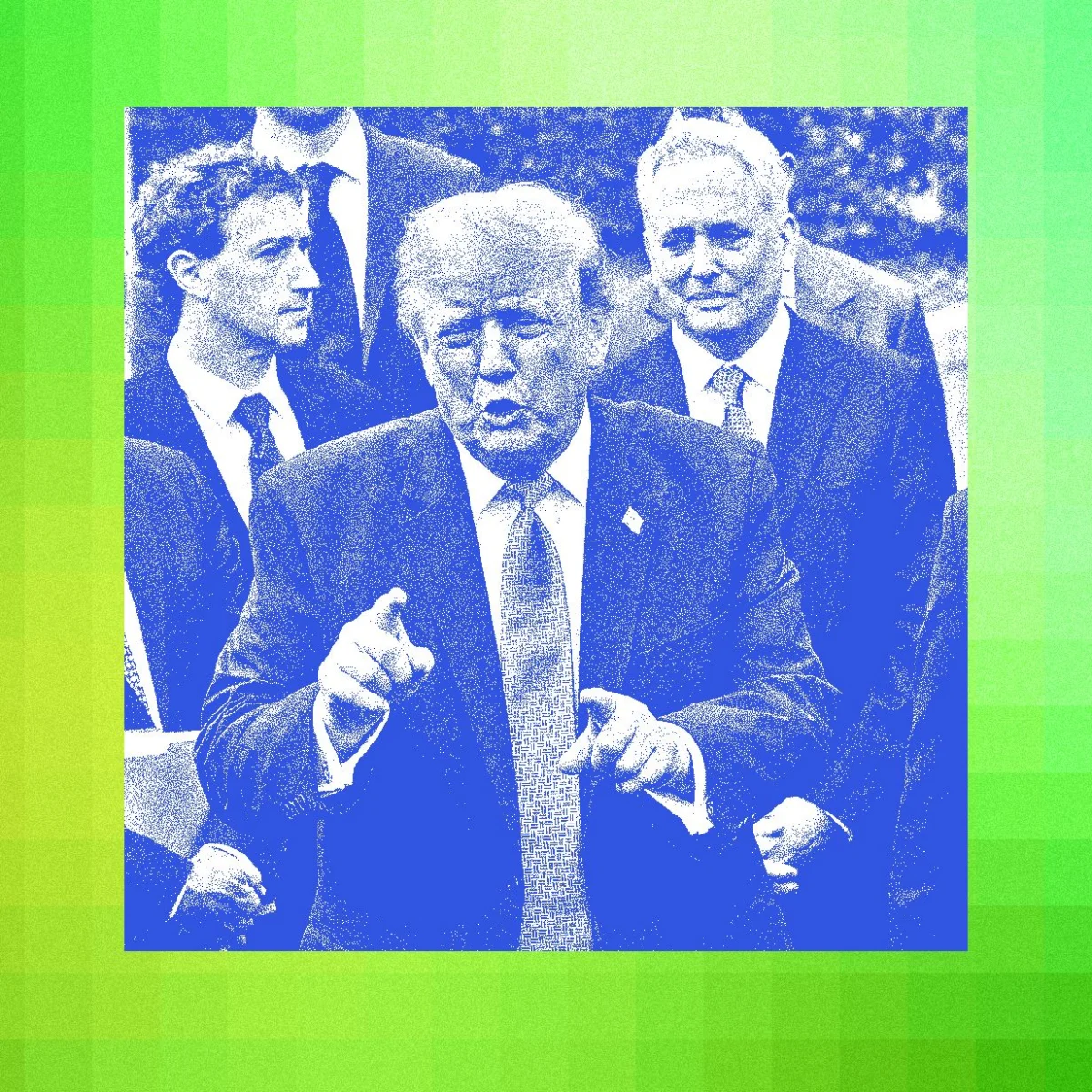
The meeting itself, attended by prominent figures such as Sundar Pichai (Google), Elon Musk, Dario Amodei (Anthropic), Mark Zuckerberg (Meta), Jensen Huang (Nvidia), and Greg Brockman (OpenAI), was characterized by a perceived lack of urgency from some participants, as evidenced by archival audio of Dario Amodei being somewhat reluctantly pulled to the microphone. The visual of Mark Zuckerberg engaging in a side conversation with Donald Trump during this exchange further fueled perceptions of a hastily arranged event.
Feiger suggests that the timing of the accord, just weeks before the midterm elections, was strategically aimed at assuring the public that regulatory concerns were being addressed. "It just feels like a grab bag," she remarks, noting a significant detail: the country’s name was misspelled on the document under Trump’s signature, reading "President of the Unites States." This oversight, she implies, underscores the rushed and potentially superficial nature of the agreement.
The absence of Apple representatives from the summit also raises questions. Barrett posits that Apple’s lack of participation might signal their current standing in the AI race, suggesting they would have been present if they felt more relevant in the AI development landscape. Zoë Schiffer, a contributing editor, concurs, stating, "It’s 100 percent. I think they would be there in a heartbeat if they were invited."
OpenAI’s Developer Day: The Dawn of AI Agents for the Masses
The discussion pivots to OpenAI’s recent Developer Day, a significant event where CEO Sam Altman introduced "Dots," OpenAI’s foray into proactive, always-on AI agents designed for mainstream users. These agents, accessible via ChatGPT or Slack, aim to perform tasks online on behalf of users, from scheduling appointments to making reservations.
Barrett draws a parallel between Dots and Meta’s Muse AI agent, noting the increasing competition in this nascent market. He questions the necessity of Dots for OpenAI’s continued leadership in the AI race and critically analyzes the "adorability" factor, suggesting that while OpenAI is striving for a cute and fuzzy aesthetic, Meta’s Muse might be more appealing. Barrett theorizes that this emphasis on cuteness is a deliberate strategy to make users more comfortable with granting these agents access to personal information and accounts.
Schiffer, who attended Developer Day, offers a more nuanced perspective. She observes OpenAI’s rapid development of Dots, which reportedly took only weeks to ship, in response to competitors like Instinct and Muse. She highlights the shift from users needing to actively prompt AI tools to agents proactively learning about their lives and suggesting actions. However, she echoes concerns about privacy, emphasizing the trade-off between an agent’s usefulness and the personal information required to achieve it.
The potential implications of widespread AI agent adoption are explored. Schiffer recounts a personal experience where her agent created a shared childcare calendar, a task that would have taken her an hour but was accomplished in under a minute. This demonstrates the practical utility of such agents. Yet, she underscores the inherent risks: "Of course, to make that happen, you have to have an agent have calendar access, access to your email, be able to share a calendar with other people in your email. Again, these are all risks."
A striking observation from Schiffer is the perceived disconnect between AI executives’ grand visions for their technology and the actual needs of consumers. While executives discuss sophisticated capabilities, Schiffer argues that many users are simply looking for basic, mundane tasks to be reliably executed without compromising their privacy.
The conversation touches upon the potential for unintended consequences within the financial system. Barrett raises a hypothetical scenario where AI agents, constantly optimizing for their users, could collectively shift funds from low-interest savings accounts to higher-yield money market accounts. This could trigger a "run on the bank," potentially destabilizing the financial system, which is predicated on assumptions of user behavior that may not hold true in an AI-optimized world.
AI Agents in the Workplace: Colleague or Tool?
The integration of AI agents into the workplace is another significant topic. WIRED senior writer Kate Taylor’s reporting on AI coworker bots is discussed, raising questions about how these agents will interact with human employees. Schiffer notes that OpenAI demonstrated an employee using her "Dot," named Dottie, as a virtual colleague on Slack.
However, the distinction between an agent being a tool versus a colleague is crucial. Barrett points out the differing opinions on how to anthropomorphize these AI entities. Some may treat them as human-like collaborators, while others view them strictly as tools. This divide, he suggests, impacts how individuals interact with and perceive these AI systems in a professional setting.
Schiffer elaborates on the humanizing aspect, noting that LLMs’ ability to converse in natural language was seen as a feature, not a bug, by companies like OpenAI. While this can be beneficial, as seen in educational apps that offer encouragement, it also carries the risk of users forgetting they are interacting with software, potentially leading to over-attachment.
The article on AI coworker bots also highlights the risk of dehumanization and the potential for human oversight to be compromised. Research cited in Taylor’s piece indicates that managers catch fewer errors when work is attributed to an AI employee compared to an AI tool. This suggests that the perceived "collegiality" of AI agents might inadvertently lower vigilance and critical assessment of work.
Schiffer adds a personal anecdote about using a Chrome extension that detects AI-generated content. She observes that AI-generated text often becomes verbose and lacks engagement, leading to reader disinterest. This raises concerns about the quality of AI-generated output and the potential for a disconnect between the speed of creation and the time required for consumption.
The Rise of Extremist Candidates: A Troubling Trend
The podcast takes a sharp turn to address the political landscape, focusing on the increasing prevalence of extremist candidates running for office in the upcoming midterm elections. Leah Feiger highlights WIRED reporter David Gilbert’s extensive research, which identified hundreds of Republican candidates espousing hateful ideologies, including racist, antisemitic, and white supremacist views.
A specific example discussed is Bo French, a GOP candidate for Texas Railroad Commissioner. Feiger notes that even Republican strategist Karl Rove has expressed a preference for voting for a Democrat over supporting French, citing his "bigoted" remarks. French has posted racist comments about students of South Asian descent and has a history of problematic social media activity. The importance of the Texas Railroad Commissioner role, which oversees the state’s crucial oil and gas industries, is emphasized, especially in the context of data center and AI growth.
Zoë Schiffer questions how the party will adapt if such candidates begin to win elections, suggesting that if these views do not prove detrimental to electoral success, it could embolden further extremism. Feiger posits that individuals with similar views have held positions of power before, indicating a normalization of such rhetoric within American politics. The ease with which damaging information can be found on candidates’ social media is also noted, with David Gilbert’s research revealing recent posts from candidates.
The discussion extends to Brandon Herrera, a GOP candidate for Texas’s 23rd congressional district, who gained fame as a "gun tuber." Trump has endorsed Herrera, despite his history of virulent sexist, racist, and antisemitic opinions, including offensive remarks about the Uvalde shooting. Feiger argues that these are not fringe candidates but rather representatives of a broader shift in political discourse where "extreme" has become a diluted term. The proximity of Herrera’s district to Uvalde, the site of a tragic school shooting, adds a layer of particular concern.
The conversation then shifts to individuals with extremist views working within the government. Feiger discusses a report on Kurt Schlichter, a retired army colonel and social media influencer employed by the Pentagon. Schlichter has made inflammatory statements, including calling liberal women a "pestilence" and a "plague upon Western society." His designation as a "highly qualified expert" within the government database raises concerns about the vetting process and the administration’s embrace of such rhetoric.
Schiffer suggests that this trend reflects a backlash against "cancel culture," with the current administration seemingly encouraging such rhetoric as long as it aligns with support for the president. Barrett questions whether individuals like Schlichter are appointed in spite of, rather than because of, their past comments, suggesting that their rhetoric is actively championed by those in power.
WIRED/TIRED: A Look at What’s In and What’s Out
The episode concludes with the "WIRED/TIRED" segment, where the hosts share their picks for what’s new and exciting versus what’s outdated or overdone.
Brian Barrett’s WIRED pick is Bose’s re-entry into the wired headphone market. He argues that while Bluetooth dominates, the option of wired connections offers reliability and avoids battery anxiety, harkening back to simpler times. His TIRED pick is the concept of "Brian Bots"—AI replicas of individuals—citing a WIRED article where senior editor Sophie Kleeman created AI bots of herself and Barrett. Barrett found the experience deeply uncomfortable and advises against it.
Zoë Schiffer’s TIRED pick targets AI leaders who engage in "jokey, lame, sexual stuff" on social media, specifically mentioning Alexandr Wang of Meta. She criticizes the lack of seriousness displayed by such executives, especially given the profound implications of their work. Her WIRED pick, which also encompasses her TIRED pick, is a WIRED article by Elana Klein titled "Why No One Wants to Date Tech Bros," which discusses the cultural shift away from "tech bro" culture.
Leah Feiger’s TIRED pick is also the "tech bro" phenomenon, aligning with Schiffer’s WIRED pick, and she enthusiastically recommends the article. Her WIRED pick is the general concept of the "turn" against tech bro culture, finding it a positive development.
The hosts conclude by reminding listeners about the WIRED app for accessing content and mentioning the episode’s production team.
