

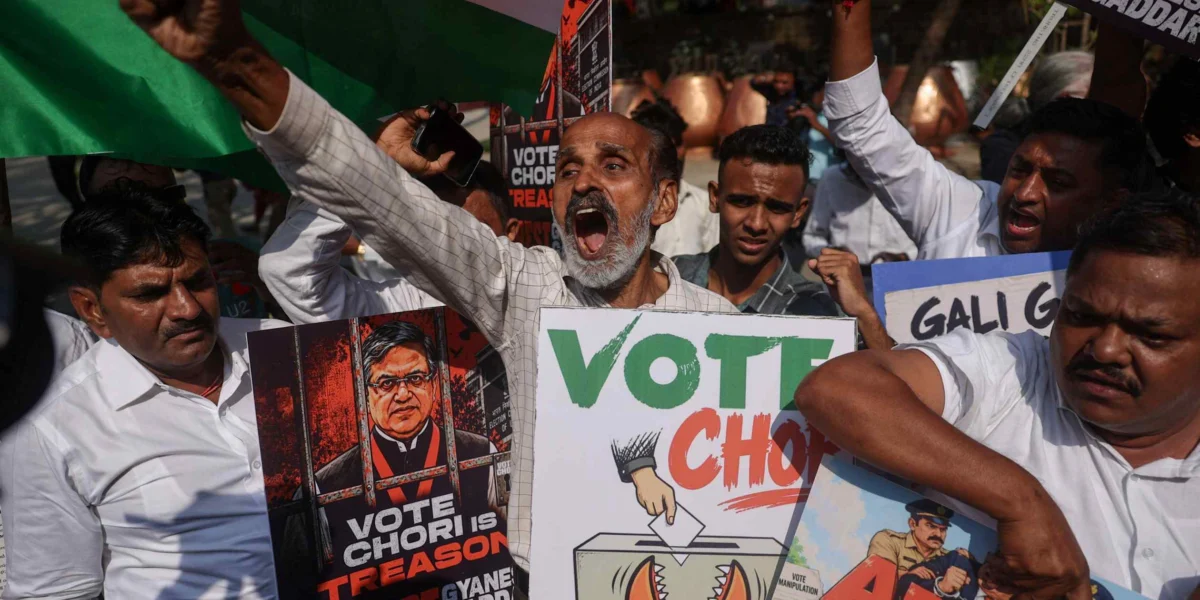
NEW DELHI — India’s opposition parties have escalated their calls for the resignation of Chief Election Commissioner Gyanesh Kumar, citing grave concerns over alleged manipulation of voter lists during a recent, extensive revision of the nation’s electoral rolls. The opposition contends that these revisions have led to the exclusion of approximately 130 million citizens, a move they assert strategically benefits the ruling party helmed by Prime Minister Narendra Modi. The controversy, which has been simmering for weeks, erupted into public protests and formal complaints, casting a shadow over the integrity of India’s democratic processes ahead of anticipated national elections.
Deepening Concerns Over Electoral Integrity
The core of the controversy lies in the Election Commission of India’s (ECI) recent comprehensive revision of electoral rolls, a standard procedure undertaken periodically to ensure accuracy and update voter information. However, opposition parties, including the long-standing Indian National Congress and a coalition of regional parties, have accused the ECI of deviating from established norms and engaging in partisan practices. They allege that the exclusion of an unprecedented 130 million names from the voter rolls was not a result of natural attrition (deaths, permanent relocations) or voluntary deletions, but rather a deliberate, targeted removal designed to disenfranchise specific demographics or areas perceived as opposition strongholds.
Critics point to specific instances and patterns that they claim are indicative of bias. These include the removal of voters based on what they term "dubious grounds," such as minor discrepancies in address details or discrepancies that could arise from common surname variations. The sheer scale of the deletions, far exceeding historical averages, has fueled suspicion. For context, previous electoral roll revisions have typically seen deletions in the range of a few million to perhaps 10-20 million annually, depending on the scope of the revision and demographic shifts. A figure of 130 million represents a seismic shift and, if substantiated, would significantly alter the electorate.
A Timeline of Escalation
The friction between the opposition and the ECI appears to have intensified following the completion of the latest electoral roll revision. While the ECI maintains that the process was conducted transparently and in accordance with legal frameworks, opposition parties have been vocal in their dissent.
Early September 2026: Initial reports emerge from ground-level party workers and citizen groups about difficulties in verifying voter status and discovering names missing from the rolls. These reports, initially localized, begin to coalesce into a broader narrative of concern.
Mid-September 2026: Opposition parties, led by prominent figures from the Indian National Congress, formally submit petitions to the Election Commission of India, raising preliminary objections to the revised rolls and demanding transparency in the deletion process. They cite anecdotal evidence and preliminary data compiled from their party networks.
Late September 2026: Following a lack of what they deem a satisfactory response from the ECI, opposition parties organize public protests in major cities. A notable demonstration took place in Mumbai on September 29, 2026, where supporters of the Indian National Congress explicitly demanded the resignation of Chief Election Commissioner Gyanesh Kumar. The protests, though largely peaceful, underscore the growing public anger and political polarization surrounding the issue.
Early October 2026: The controversy moves beyond public demonstrations to formal legal and political arenas. Opposition leaders engage in consultations to strategize their next steps, which could include filing public interest litigations or initiating parliamentary debates. The narrative gains wider traction in national media, with various stakeholders offering diverse perspectives.
Supporting Data and Statistical Context
While precise, independently verified data on the 130 million figure is still being contested, the scale of the alleged exclusion demands scrutiny. India’s electorate, as of the last general election, comprised over 900 million eligible voters. A deletion of 130 million would represent a significant percentage, approximately 14-15%, of the total voting population. To put this into perspective, such a reduction would be larger than the entire electorate of many developed nations.
The ECI’s own stated rationale for deletions typically includes:
- Deaths: Registered fatalities of voters.
- Permanent Relocations: Voters who have moved out of their registered constituency.
- Duplicate Entries: Instances where a voter is registered at multiple locations.
- Voluntary Deletions: Voters who opt to be removed from the rolls, often due to no longer being eligible or residing abroad.
- Ineligibility: Voters who have lost their citizenship or are otherwise disqualified by law.
Opposition parties argue that the current revision disproportionately involves deletions under categories that are difficult to verify or are susceptible to manipulation, such as "inaccurate address" or "no longer residing at the given address" without sufficient due process for the voter to rectify the information. They are pressing for access to the raw data and the methodologies used to justify these mass deletions.
Official Responses and ECI’s Stance
The Election Commission of India, under the leadership of Chief Election Commissioner Gyanesh Kumar, has consistently defended the integrity of the electoral process. In a statement issued earlier this week, the ECI reiterated its commitment to conducting free and fair elections and assured the public that the revision of electoral rolls was carried out in strict adherence to the Representation of the People Act, 1950, and associated rules.
The ECI has stated that the deletions are a result of a rigorous, multi-stage process that includes verification by Booth Level Officers (BLOs), cross-verification with other databases, and opportunities for citizens to verify their status. They have also pointed out that the revision process involves adding new voters and updating details for existing ones, thereby maintaining the accuracy of the voter list. The commission has invited political parties to submit their specific objections and evidence to facilitate a review.
However, the ECI has not yet provided a detailed breakdown of the deletions by cause or demographic, which is a key demand from the opposition. The commission’s official communications have largely focused on reaffirming the robustness of the existing system rather than addressing the specific statistical anomalies highlighted by the opposition.
Broader Implications for Indian Democracy
The allegations of voter list manipulation, if proven, carry profound implications for the health of Indian democracy. India, the world’s largest democracy, prides itself on its robust electoral framework and the active participation of its citizens. Any perceived or actual compromise of this system can have far-reaching consequences:
- Erosion of Public Trust: The most immediate impact would be a significant erosion of public trust in the Election Commission of India and, by extension, in the electoral process itself. This could lead to voter apathy and disengagement, undermining the very foundation of democratic governance.
- Political Instability: If a substantial portion of the electorate feels disenfranchised, it could lead to widespread social unrest and political instability. This could manifest in intensified protests, civil disobedience, and a deep-seated mistrust in government institutions.
- Questioning Election Outcomes: The integrity of any future election conducted with these disputed voter lists would be immediately called into question. This could lead to prolonged legal challenges and political crises, potentially delaying the formation of governments and hindering policy implementation.
- International Scrutiny: India’s democratic credentials are often held up as an example globally. A major scandal involving electoral manipulation could attract significant international attention and criticism, potentially impacting India’s standing on the global stage and its relationships with other democracies.
- Disenfranchisement of Vulnerable Populations: Opposition parties often argue that such alleged manipulations disproportionately affect marginalized communities, the poor, migrant workers, and young voters, who may have less access to information or resources to rectify errors in their voter registration. This would further exacerbate existing social and economic inequalities.
The coming weeks are critical as opposition parties prepare to intensify their campaign for the resignation of Chief Election Commissioner Gyanesh Kumar and demand a thorough, independent audit of the electoral rolls. The Election Commission’s response, its willingness to share data, and its ability to allay public fears will be closely watched, as the future of fair and transparent elections in India hangs in the balance. The narrative surrounding the 130 million excluded voters is not merely a statistical dispute; it is a fundamental challenge to the democratic fabric of the nation.
